Multicenter series of cilta-cel enterocolitis: 3.0% cumulative incidence, 41% died with active disease
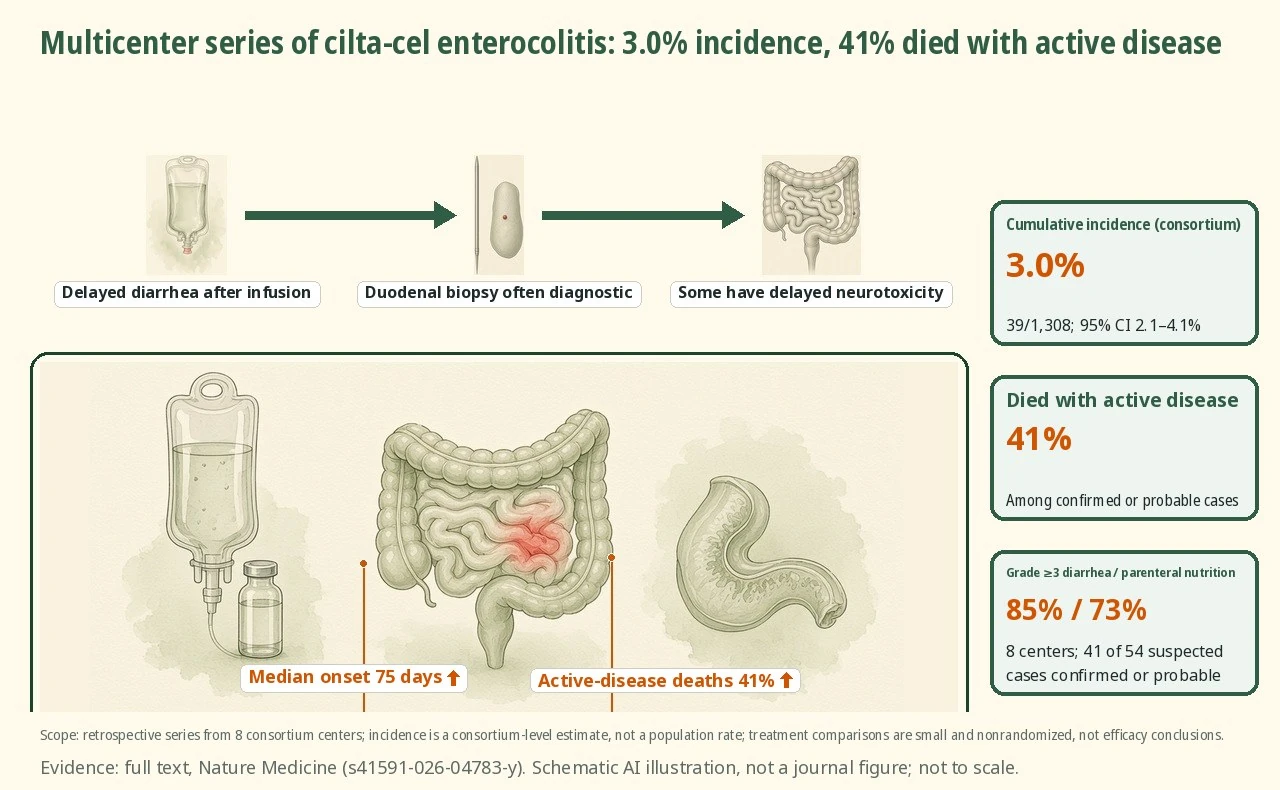
The US Multiple Myeloma Immunotherapy Consortium retrospectively adjudicated 54 suspected cases of immune effector cell-associated enterocolitis (IEC-EC) from 8 institutions: 41 were IEC-EC (31 confirmed by anti-camelid variable heavy-chain immunohistochemistry, 10 probable). Through September 2025, the cumulative incidence among 1,308 cilta-cel recipients was 3.0% (39 of 1,308; 95% CI 2.1–4.1%), and the 12-month competing-risk estimate was also 3.0%. Median onset was 75 days after infusion; grade ≥3 diarrhea occurred in 34 of 40 evaluable patients (85%), and 30 of 41 (73%) required parenteral nutrition. At last follow-up, 13 of 41 (32%) had resolved, 11 (27%) had ongoing symptoms, and 17 (41%) had died with active IEC-EC. Combined biologic plus T-cell-directed therapy had the highest resolution rate in a group of 11 (6 of 11, 55%), but between-approach comparisons were not statistically significant and should not be read as an efficacy ranking.
Background and open questions
Cilta-cel is a BCMA-directed autologous CAR-T used in relapsed or refractory multiple myeloma. Case reports and single-center series have described a delayed, potentially fatal enterocolitis now called IEC-EC. A multicenter, uniformly adjudicated picture of incidence, pathology and outcomes had been missing.
This study asked how IEC-EC should be defined and confirmed in consortium centers, what the cumulative incidence is, and how onset, endoscopy, histology, delayed neurotoxicity and current treatment paths relate to outcomes.
Study design
The consortium assembled 54 suspected cases from 8 institutions and adjudicated them retrospectively. Confirmation relied on anti-camelid variable heavy-chain (VHH) immunohistochemistry: VHH-positive lymphocytes comprising ≥20% of lymphocytes were called confirmed (31 cases). Ten cases lacked that assay or fell below the threshold but were clinically consistent and were called probable. One case (patient 25) was excluded; 53 were evaluable, and 12 were negative.
Of the 54 cases, 15 had been published previously and 39 are reported for the first time, including 16 concurrent with a mechanistic companion in the same journal. The multicenter paper cites that companion as Zuniga et al. (in press); the published article is Sainz et al., DOI 10.1038/s41591-026-04731-w. A further companion by Leet et al. remains under review. The authors state that the incidence estimate is consortium-based, not a definitive population incidence. Year by year, the 12-month cumulative incidence rose from about 2.1% in 2022 to 3.6% in January–September 2025.
Key results
Incidence and clinical course
Through September 2025, 39 IEC-EC cases were identified among 1,308 cilta-cel recipients (raw cumulative incidence 3.0%, 95% CI 2.1–4.1%), matching the 12-month competing-risk estimate. A sensitivity model was 3.0% (95% CI 2.1–4.2%). Among these 39 patients, 15 (38.5%) were female, 7 (17.9%) identified as Black and 11 (28.2%) as non-White, versus 43.2%, 10.2% and 20.1% in the overall population. Raw incidence was numerically higher in Black (5.3%) and non-White (4.2%) patients, but chi-square tests did not show overrepresentation (P = 0.671, 0.193 and 0.300). Prespecified laboratory and disease variables did not differ significantly between IEC-EC and negative cases.
Median onset was 75 days after infusion (range 14–541). Grade ≥3 diarrhea occurred in 34 of 40 patients with recorded diarrhea (85%); 30 of 41 (73%) required parenteral nutrition. Upper endoscopy was grossly normal in 9 of 22 (41%) and lower endoscopy in 14 of 18 (78%); duodenal biopsy was diagnostic in 28 of 34 (82%). Delayed neurotoxicity co-occurred in 17 of 41 (41%); in 11 of 14 cases with a recorded sequence, neurologic symptoms preceded gastrointestinal symptoms by a median of 48 days.
Histology, treatment and outcomes
Histology showed villous blunting, apoptotic bodies and a dense cytotoxic infiltrate. Of 31 cases, 19 (61%) were CD4-predominant, 8 (26%) CD8-predominant and 4 (13%) mixed; cytotoxic markers were positive in 14 of 17 (82%); median Ki-67 was about 10%. A dominant clone was detected in 13 of 17 tested (76%).
At last follow-up, 13 of 41 (32%) had resolved, 11 (27%) had ongoing symptoms, and 17 (41%) had died with active IEC-EC (infection in 10, IEC-EC complications in 5, other causes in 2). All-cause death was 18 of 41 (44%), including one myeloma death after resolution. Infection after diagnosis occurred in 30 of 41 (73.2%). All 4 patients treated with steroids alone died. Among 13 given biologics without T-cell-directed agents, 3 (23%) resolved and mortality was 31%. Among 11 who received biologics plus T-cell-directed therapy, 6 (55%) resolved and 3 (27%) died. These are small, nonrandomized, post hoc groups (log-rank P = 0.82) and do not establish that one path is superior.
Mechanistic interpretation
What the paper shows: IEC-EC is a delayed entity after cilta-cel that anti-VHH immunohistochemistry can help confirm; the consortium-level cumulative incidence is about 3%; duodenal biopsy is often diagnostic even when endoscopy looks normal; many cases show a cytotoxic infiltrate and a dominant clone, and delayed neurotoxicity can co-occur; death during active disease is common.
What still needs testing: 3.0% is not a population incidence; the treatment subgroups cannot guide a standard of care; how this series should be read with the companion Sainz paper, and with Leet et al. still under review, remains to be settled by prospective registries.
Limitations and uncertainties
- Retrospective, consortium referral series, with ascertainment bias; incidence should not be generalized as a population rate.
- Anti-VHH immunohistochemistry was not uniformly available, so confirmed and probable cases have different certainty.
- Treatment comparisons are small and nonrandomized (P = 0.82) and must not be read as a ranking of regimens.
- Some cases appeared in earlier series; this paper adds follow-up and pathology, but it is not an independent replication in a new cohort.
Clinical and industry implications
For centers using cilta-cel, the first value of this paper is recognition: severe diarrhea can appear from two weeks to more than a year after infusion, a normal endoscopy does not rule the diagnosis out, and duodenal biopsy plus anti-VHH staining, where available, can help. Infection and delayed neurotoxicity also need attention. For BCMA CAR-T developers and safety monitoring, IEC-EC should be followed as a delayed toxicity, not as something covered only by early CRS/ICANS frameworks. Escalation paths still lack controlled evidence; the 55% resolution rate in 11 patients on combined therapy should not be written up as a recommendation.
Authors and source
Nature Medicine (2026). Published online 19 November 2026. https://doi.org/10.1038/s41591-026-04783-y. Mechanistic companion, same day: Sainz et al., https://doi.org/10.1038/s41591-026-04731-w.
Numbers are as reported by the authors. Corrections: contact@
Featured
AI Drug R&D Platforms

Related science
Mucosal CAR-positive T-cell expansion defines cilta-cel-associated enterocolitis
In 158 cilta-cel recipients, CAR+ IEC-EC incidence was 5.7%; deaths 4/9 vs 0/8 in CAR-negative enterocolitis. Day-50+ persistence was 101.84-fold higher.
In vivo CAR-T double-knockout screen identifies NR4A1–SOCS3 as a synergistic gene pair
Dual knockout increased metabolic fitness and supported potent antitumor activity across multiple tumor models.
Regulatable IL-15 engineered TIL therapy in ICI-resistant melanoma: RP2D ORR 66.7% (10/15)
OBX-115 expresses acetazolamide-regulatable membrane-bound IL-15, removing the need for exogenous IL-2.
One email, with links to every paper. Reports and custom landscapes: contact@inlightbio.com.
Opens your email app with a pre-filled request; we add you by hand. Free, unsubscribe any time.