OpenScientist: an open-source agent that can complete verifiable biomedical analyses
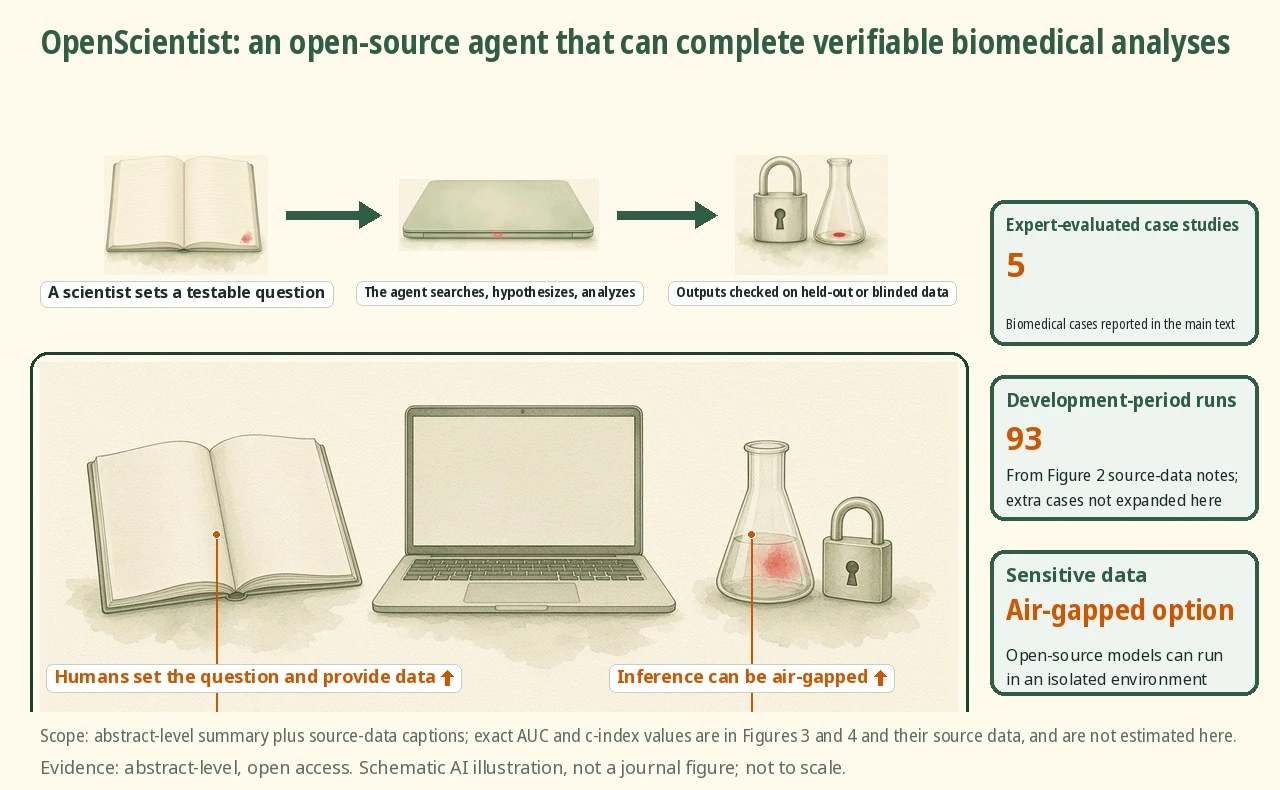
Teams at Washington University in St. Louis, Lawrence Berkeley National Laboratory and collaborating institutions report OpenScientist, an open-source agentic system designed to search the literature, generate hypotheses, run data analyses and produce verifiable results under scientist-defined questions. It was evaluated by domain experts in five biomedical case studies; the authors say analyses that would otherwise take months of specialist time were completed in minutes. The abstract reports that the system quantified Alzheimer’s blood-biomarker performance, generated a plasma proteomic survival model that predicted survival in a hidden-evaluation cohort, proposed a reproducible link between tau pathology and altered lysosomal acidification, generated multiple myeloma hypotheses validated in an external cohort with an attenuated signal in randomized controls, and showed concordance with an independent human analysis in a blinded, prespecified proteomic comparison. For sensitive clinical data, it can run in a fully air-gapped environment using open-source models. Numeric results in this brief are limited to the journal abstract and source-data captions; AUC and c-index point estimates from unopened source tables are not copied here.
Background and open questions
Biomedical datasets are growing faster than the time and domain expertise available to analyze them. Closed commercial models and unauditable pipelines are hard to use with sensitive clinical data or in work that must be reproduced. The authors set out to provide an open, auditable agentic “co-scientist” that can complete verifiable analyses when humans define the questions.
Study design
OpenScientist was designed to investigate scientist-defined queries and generate data-grounded, checkable analyses. Evaluation was performed by domain experts across five biomedical case studies. To support work with sensitive clinical datasets, the system can operate in a fully air-gapped environment using open-source models for inference. Supplementary material includes benchmarking of open-weight models and air-gapped mode, a knowledge-state ablation, and additional case studies 6–8; this brief stays with the main-text abstract and does not recap unchecked supplementary numbers.
Source-data notes on the journal page record 93 development-period runs (Figure 2). Figure 3 source data include ROC coordinates and AUCs with 95% CIs for four biomarkers in both a human-analyst panel and an OpenScientist panel; Figure 4 source data include model c-index values and a comparison with published biological-clock c-index values. Those numeric values sit in downloadable tables that were not opened for this brief, so they are not copied here.
Key results
The following points are taken from the journal abstract, not from a table-by-table transcription of the Results section:
1. Alzheimer’s blood biomarkers. The system accurately quantified blood-biomarker performance. Specific AUCs are in Figure 3 of the paper and are not estimated here.
2. Plasma proteomic survival model. The model predicted survival in a hidden-evaluation cohort.
3. Mechanistic hypothesis. The authors report a reproducible mechanism linking tau pathology to altered lysosomal acidification.
4. Multiple myeloma hypotheses. Hypotheses were validated in an external cohort, with the signal attenuated in randomized controls, underscoring the need to re-examine findings in controlled designs.
5. Concordance with human analysis. In a blinded, prespecified proteomic comparison, the system’s output agreed with an independent human analysis.
The authors conclude that open, auditable agentic AI can support real-world clinical research by searching the literature, generating hypotheses, running analyses and extracting insights from complex datasets, and that it should be used with human experts rather than as a substitute for expert judgment.
Mechanistic interpretation
What the paper shows: An open-source agentic system that can run in an air-gapped environment can produce verifiable analyses of scientist-defined biomedical questions, and it passed expert evaluation plus some hidden-cohort or blinded checks in the five cases listed in the abstract.
What still needs testing: Phrases such as “accurately quantified,” “predicted survival” and “concordance” are the authors’ summary of case results; effect sizes, failure cases and boundary conditions have to be read from the full figures. Repeatability in other diseases, data modalities and fully external teams remains to be shown independently. The paper does not position OpenScientist as end-to-end drug design or as a replacement for clinical trials.
Limitations and uncertainties
- This brief is based on the journal-page abstract and source-data captions; Results-section numbers were not checked line by line because the article body did not expand in the fetched HTML.
- The five cases were organized by the authors and evaluated by domain experts; they are not a random sample of research workflows.
- Hidden-evaluation cohorts and blinded comparisons strengthen the claim, but this remains a methods case series, not evidence of clinical benefit.
- Open-source, air-gapped deployment reduces data-exfiltration risk; it does not make the tool a regulator-cleared clinical decision system.
Clinical and industry implications
For translational teams that handle sensitive cohort data, the main value is at the tool layer: placing literature search, hypothesis generation and analysis scripts in an auditable workflow that can run locally in isolation, then checking outputs against hidden cohorts or blinded comparisons. For readers in AI drug design, this is a verifiable analysis assistant, not an end-to-end molecule generator. Anyone citing biomarker performance or the survival model should go back to Figures 3 and 4 and the source data, not to this abstract-level summary.
Authors and source
Nature Medicine (2026). Published online 16 November 2026; open access. https://doi.org/10.1038/s41591-026-04808-6.
Numbers are as reported by the authors. Corrections: contact@
Featured
AI Drug R&D Platforms

Related science

An LLM platform lets epilepsy patients text with their EEG device
Retraining the seizure detector on patient feedback alone cut false alarms by 77–81% in a pseudoprospective simulation
MedGemma brings open medical vision-language models to Gemma 3
One open-weight model family, medically tuned from Gemma 3, spanning medical images and text
Rentosertib phase 2a: 21/54 aging-clock comparisons significant
A cell cluster with red-marked molecules, showing proteomic aging-related changes
One email, with links to every paper. Reports and custom landscapes: contact@inlightbio.com.
Opens your email app with a pre-filled request; we add you by hand. Free, unsubscribe any time.