In an exploratory proteomic substudy, rentosertib produced significant changes in 21 aging-clock comparisons
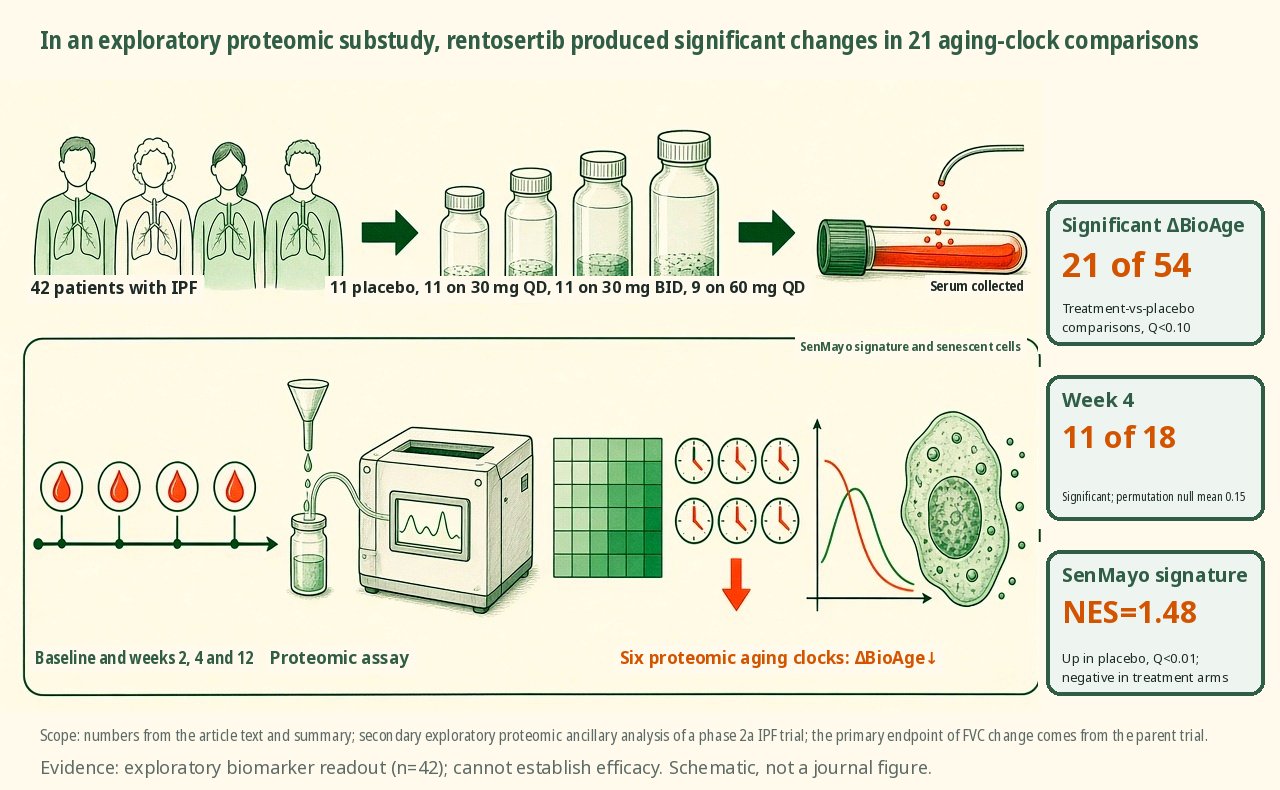
In an exploratory proteomic substudy of 42 patients with IPF, rentosertib produced Q<0.10 in 21 of 54 ΔBioAge comparisons, suggesting a reduction in predicted biological age.
The proteomic substudy of a phase 2a IPF trial included 42 patients (11 placebo, 11 on 30 mg QD, 11 on 30 mg BID, 9 on 60 mg QD). After 12 weeks of the oral TNIK inhibitor rentosertib, ΔBioAge was computed with six proteomic aging clocks: 21 of 54 treatment-versus-placebo comparisons reached Q<0.10, with 11 of 18 comparisons significant at week 4 against a patient-label permutation null mean of 0.15. The SenMayo signature was upregulated in the placebo arm (NES=1.48, Q<0.01) and significantly negative in the treatment arms. This is a secondary exploratory analysis; the primary endpoint of FVC change comes from the parent trial.
Key data card
- Study type: Proteomic aging-clock ancillary analysis of a phase 2a randomized, double-blind, placebo-controlled IPF trial
- Sample size n: 71 patients in the parent trial; 42 in the proteomic analysis: 11 placebo, 11 on 30 mg QD, 11 on 30 mg BID, 9 on 60 mg QD
- Controls: Placebo QD; longitudinal serum sampling at baseline and weeks 2, 4 and 12
- Intervention/dose: Oral rentosertib at 30 mg QD, 30 mg BID or 60 mg QD for 12 weeks, alongside continued standard of care
- Follow-up: 12 weeks
- Primary endpoint: Exploratory proteomic biomarker readout: ΔBioAge, the change from baseline in biological age predicted by six proteomic aging clocks; each treatment arm compared with placebo at weeks 2, 4 and 12
- Primary endpoint result: 21 of 54 treatment-versus-placebo comparisons reached Q<0.10; 11 of 18 comparisons were significant at week 4, against a permutation null mean of 0.15
- Statistics: One-sided Mann–Whitney U tests comparing treatment arms with placebo, with Benjamini–Hochberg correction; 100,000 patient-label permutations; the paper does not state that the proteomic substudy was powered for between-group comparisons
- Evidence level: Full text
- Verification record: Read the Nature Biotechnology open-access full text Abstract, Results, Discussion, Methods and figure legends; the source was the full-text HTML, DOI 10.1038/s41587-026-03286-y
- Serum collected in an IPF trial
- ΔBioAge estimated with six proteomic clocks
- Treatment arms compared with placebo
- Pathway analysis provides clues to the dissociation
Background and open questions
Many drugs for age-related diseases may also touch aging pathways, but conventional clinical endpoints make it hard to separate disease improvement from modulation of biological aging. DNA methylation clocks have already been tried clinically, yet often run into inconsistency between models, interpretive difficulty and only indirect mechanistic information.
In Nature Biotechnology, Zhavoronkov et al. reanalysed serum samples from an IPF trial of rentosertib, an AI-designed TNIK inhibitor, comparing six proteomic aging clocks and placing clocks, protein trajectories, aging cohorts and pathway enrichment in a single framework to assess whether a disease trial can simultaneously read out potential geroprotective signals and mechanistic clues.
Study design
The parent trial was a randomized, double-blind, placebo-controlled phase 2a IPF study conducted at multiple centres in China. Seventy-one patients were assigned to 30 mg QD, 30 mg BID, 60 mg QD or placebo, with 18, 18, 18 and 17 patients per arm, treated for 12 weeks; the paper does not state that the proteomic substudy was powered for between-group ΔBioAge comparisons.
In the proteomic substudy, 43 consented, 1 was excluded for a missing week-12 measurement, leaving 42 participants with a mean age of 67.1 years; the arms comprised 11 placebo, 11 on 30 mg QD, 11 on 30 mg BID and 9 on 60 mg QD. Serum was assayed with Olink Explore 3072 at baseline and weeks 2, 4 and 12. The core readout is ΔBioAge, the change in predicted biological age from baseline; each treatment arm was compared with placebo by one-sided Mann–Whitney U test with Benjamini–Hochberg FDR correction.
Key results
Clocks were calibrated first
Across the 42 baseline samples, the four clocks trained on chronological age correlated well with actual age, with Spearman r of 0.70–0.84 and RMSE below 4 years after linear correction; the two mortality-risk clocks correlated more weakly with age, with r of 0.16–0.23. On this basis the authors treat the two classes of clock as complementary readouts rather than a single scale. Anonymized predictions at each time point are listed separately in supplementary tables for checking each clock's values.
The main readout reached significance
Across 54 treatment-versus-placebo ΔBioAge comparisons, 21 reached Q<0.10; these significant results clustered at week 4, when 11 of 18 comparisons were significant. The patient-label permutation null mean was 0.15 against 21 significant comparisons observed; after removing patients with grade ≥3 adverse events, 19 remained, p<0.0001.
Regimens differ in signal
By regimen, 30 mg BID had 9 significant comparisons, 60 mg QD 7 and 30 mg QD 5. Although 60 mg QD showed the greatest FVC improvement in the original trial, with all four chronological-age clocks significantly reduced at week 4 and ΔBioAge of −2.71 to −3.46 years, neither mortality-risk clock changed significantly.
A plateau rather than disappearance
By week 12 the signal plateaued: between weeks 4 and 12, no arm-clock combination changed significantly at a paired Wilcoxon threshold of P<0.05. At the protein level the picture differed: only 5–9% of protein changes were transient for 30 mg BID and 60 mg QD, and among aging-clock feature proteins the proportion of sustained changes reached 29–36% in the two active-dose arms, indicating that a clock plateau does not mean protein effects have faded.
Dissociation from disease improvement
ΔFVC explained very little of ΔBioAge, with a median R² of 0.06 and a range of 0.01–0.18, N=42. Compared with aging trajectories in 55,319 UK Biobank adults, treatment-related changes in the 30 mg BID arm were negatively correlated, r=−0.30, P<0.01; the 60 mg QD arm showed no such correlation, r=−0.097, P=0.37.
Mechanistic interpretation
Demonstrated in the paper: Linear mixed models showed that rentosertib significantly altered 326 protein trajectories relative to placebo, versus only 2 for placebo; 237 of these appeared in only one treatment arm, while 89 changed in the same direction in two or more arms. The 30 mg BID arm had 142 unique changes, matching the observation that it was most consistent across clocks.
GSEA showed that circulating proteins associated with senescent cells moved in opposite directions: the SenMayo signature was upregulated under placebo, NES=1.48, Q<0.01, and significantly negative in the treatment arms at Q<0.05 except for 60 mg QD at Q=0.17. The Reactome pathway for IGF transport and IGFBP uptake was downregulated in the two effective dose arms, with NES of −1.70 to −1.66.
Author hypotheses: The authors suggest that the lower but more frequent 30 mg BID dosing may sustain aging-related metabolic, redox and IGF-axis regulation better than the large peak exposure of 60 mg QD; this interpretation comes from pathway differences and pharmacokinetic discussion rather than direct measurement of tissue TNIK occupancy or a causal mechanism.
Limitations and uncertainties
- First, generalizability is limited. The proteomic analysis covers only 42 Asian IPF patients, with just 9 in the 60 mg QD arm; most aging clocks were trained in the UK Biobank, so applying them in a severe fibrosis population is out of domain, and the authors themselves call for confirmation in non-IPF populations.
- Second, endpoints and follow-up remain exploratory. The observation period was 12 weeks and the core readout is serum ΔBioAge rather than a clinical geroprotective outcome; the signal was strongest at week 4 and plateaued by week 12, so long-term durability, intermittent dosing and functional benefit cannot yet be judged.
- Third, antifibrotic and anti-aging effects remain methodologically hard to separate. The authors explicitly list the small sample, short observation period, dominance of computational methods and absence of other omics as limitations; the Olink panel covers fewer than 3,000 proteins and TNIK itself is not on the platform, so target pathways can only be inferred indirectly.
Clinical and industry implications
If reproduced in non-IPF or risk-enriched older populations, this work offers a template for extending a disease trial of an AI-designed drug into geroprotective signal detection: prespecifying serum proteomics, multiple aging clocks, a normal-aging trajectory reference and computational pathway analysis within the same trial.
For Insilico Medicine's rentosertib programme, the results also suggest that dosing frequency may shape the biological readout: 30 mg BID produced more consistent aging-clock and metabolic pathway signals, while 60 mg QD aligned more closely with the FVC improvement axis. The current evidence supports only exploratory pharmacodynamic markers and cannot establish anti-aging efficacy in patients.
Authors, source and verification
Evidence level: Full text; verification record: Read the Nature Biotechnology open-access full text Abstract, Results, Discussion, Methods and figure legends; the source was the full-text HTML, DOI 10.1038/s41587-026-03286-y
Zhavoronkov A, Galkin F, Chen S, Ren F, Aliper A, Durymanov M, et al. Integration of proteomic aging clocks in a phase 2a clinical trial supports simultaneous geroprotective assessment. Nat Biotechnol. 2026. https://doi.org/10.1038/s41587-026-03286-y
Primary field: AI drug design · Related: Proteomic aging clocks, TNIK inhibitors, Idiopathic pulmonary fibrosis, Olink Explore, GSEA, Dosing regimens
Summary of a published paper or preprint, written from the original text; numbers are as reported by the authors. Not medical or investment advice. Corrections: contact@
Related science
511 AI antibodies benchmarked: only 9.8–13.8% beat the control in Challenge 2
Many antibodies pointing at a green antigen, with the best binder in red
NISE zero-shot design of drug-binding proteins: APEX affinity of 80 pM
A green designed protein enclosing a red small-molecule drug
Germinal validation: 43–101 designs across 4 antibody targets
Four green targets each bound by a designed antibody, with one epitope in red
One email, with links to every paper. Reports and custom landscapes: contact@inlightbio.com.