NISE designs drug-binding proteins zero-shot, with APEX reaching 80 pM affinity in vitro
In in vitro tasks with exatecan and apixaban, the NISE closed-loop neural network designed binding proteins de novo and validated their affinity; the Kd of APEX for apixaban was 80 pM.
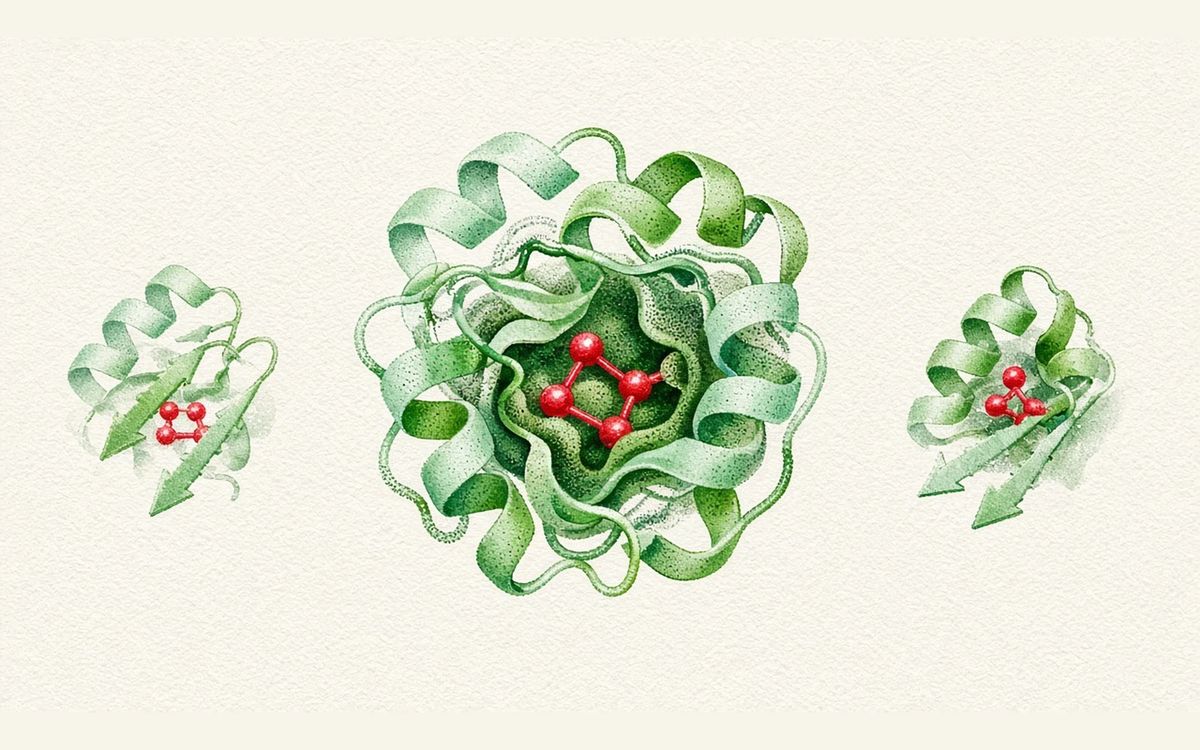
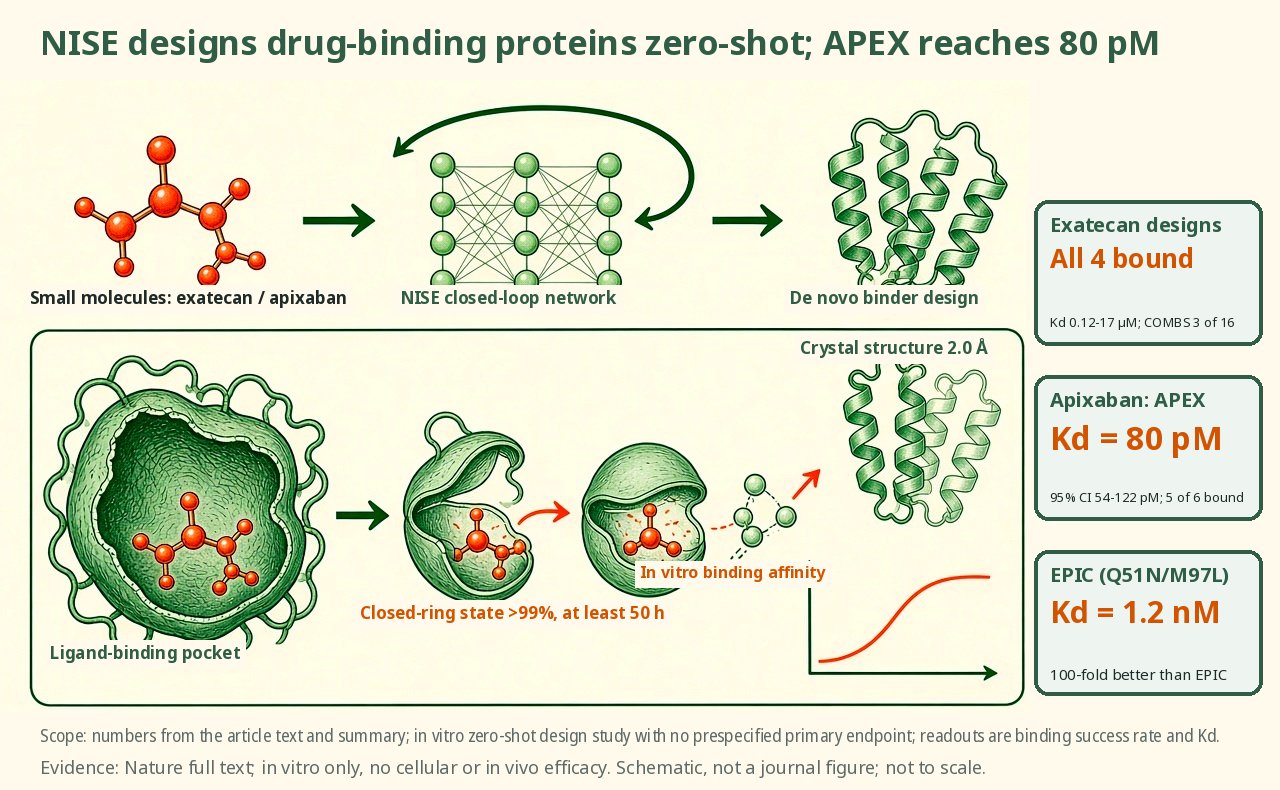
The NISE closed-loop neural network designed drug-binding proteins de novo for in vitro exatecan and apixaban tasks, jointly optimizing ligand pLDDT and sequence NLL. All 4 NISE designs for exatecan bound (Kd 0.12–17 µM), while only 3 of 16 COMBS control designs bound (Kd 8–44 µM), with non-specific HSA at 43 µM; for apixaban, 5 of 6 designs bound, with APEX at Kd=80 pM (95% CI 54–122 pM) versus a Ki of 80–700 pM for factor Xa. EPIC(Q51N/M97L), refined by LASErMPNN, kept exatecan >99% in the closed-ring state for at least 50 h (PBS pH 7.4), with Kd=1.2 nM, a 100-fold improvement over EPIC. The EPIC crystal structure was solved at 2.0 Å, with a backbone Cα r.m.s.d. of 0.8 Å to the NISE input. Free exatecan has a hydrolysis half-life in plasma of about 2 h.
Key data card
- Study type: Nature full text; in vitro validated zero-shot design of small-molecule binding proteins
- Sample size n: exatecan: 4 NISE designs and 16 COMBS controls; apixaban: 6 NISE designs.
- Controls: HSA, COMBS–Rosetta, energy-based ISE; the APEX specificity control included 50 nM exatecan.
- Intervention/dose: The NISE closed loop; for exatecan, the top 3 were selected each round with 1,000 sequences sampled for each, and for apixaban 50 NTF2 folds and 14–28-round trajectories were used.
- Follow-up: Hydrolysis protection absorbance experiments for at least 50 h.
- Primary endpoint: A preclinical methods study with no stated prespecified primary endpoint; the main readouts are in vitro binding success rate, Kd affinity, and retention of the exatecan closed-ring state.
- Primary endpoint result: 100% binding for exatecan with Kd 0.12–17 µM; 5/6 binding for apixaban with APEX Kd=80 pM (95% CI 54–122 pM); EPIC(Q51N/M97L) Kd=1.2 nM, with >99% closed-ring state for at least 50 h.
- Statistics: Most Kd intervals come from 1,000-iteration bootstrap residual fitting; the APEX Kd is reported with a 95% CI.
- Safety: SEC showed that the selected designs and mutant proteins are monomeric.
- Evidence level: Full text
- Verification record: Read the Europe PMC full-text XML PMC13441969 Abstract, Results, Discussion, figure legends and Methods placeholder.
- Place the drug and screen pockets
- Expand sequences with LASErMPNN
- Select self-consistent complexes by co-structure prediction
- Measure Kd after expression and purification
- Validate specificity and hydrolysis protection
Background and open questions
Designing proteins de novo that can capture small molecules requires matching sequence, backbone and ligand conformation at the same time. Past successes relied largely on high-throughput screening or on simplifying ligand functional groups into amino-acid-like fragments; once the target becomes a real drug, both the search space and the chemical characterization expand.
The approach Fry et al. introduce in Nature joins "sequence given structure" and "structure given sequence" neural networks into a closed loop. Rather than finalizing designs with an energy function first, NISE retains at each round the candidates whose protein backbone and ligand pose are mutually self-consistent and then expands their sequences, aiming to obtain expressible, binding drug-binding proteins zero-shot.
Study design
The exatecan search began from a library of 40 AF2-predicted four-helix bundles, each with at least 8 sequences passing a confidence threshold. The authors first used COMBS to place an exatecan conformer into the pocket, then stripped the sequence from an experimentally uncharacterized COMBS–Rosetta model to serve as the NISE input. For exatecan, each NISE round selected the top 3 self-consistent structures by ligand pLDDT and sampled 1,000 LASErMPNN sequences for each.
The apixaban task instead used 50 computationally generated NTF2 folds with rigid-body docking and ran 14–28-round NISE trajectories. That task swapped in Boltz-2 as the co-structure predictor and ranked designs by a composite score of ligand pLDDT and P(bind). The study was not powered for between-group comparisons; the NISE, COMBS, historical LigandMPNN/Rosetta and HSA controls serve mainly as methodological comparators, and differences in success rate were not formally tested.
Key results
Core readouts
At the abstract level, NISE achieved binding success rates of 100% for exatecan and 83% for apixaban, with the tightest binders roughly 70-fold and nearly 10,000-fold better than the next leading method. The main text then validated candidates by fluorescence polarization, competition binding and absorbance spectroscopy, with readouts centred on Kd, the fraction binding and the exatecan closed-ring state. These readouts span different folds and chemically distinct drugs.
exatecan binding
In the exatecan experiments, all 4 NISE designs bound with Kd values of 0.12–17 µM, 3 of them below 10 µM; non-specific HSA was 43 µM. Of the 16 COMBS control designs, only 3 bound exatecan, with Kd values of 8, 12 and 44 µM. EPIC, the tightest NISE binder, was also tighter than HSA.
Closed-loop controls
Algorithmic controls showed that NISE, but not energy-based ISE, simultaneously increased ligand pLDDT and decreased sequence NLL, with the quartiles in the legend drawn from n=1,500 designs per round and n=500 in the first round. Conventional energy minimization loops neither lowered NLL nor raised ligand pLDDT, supporting the "closed-loop neural network" rather than screening alone as the key factor.
apixaban affinity
The headline result of the apixaban task is APEX: Kd=80 pM with a 95% CI of 54–122 pM, versus a Ki of 80–700 pM for factor Xa, and a molecular weight of 13 kDa versus 43 kDa. Of the 6 selected designs, 5 bound apixaban, all with Kd below 50 nM. The specificity readout carries a legend caveat: APEX showed no appreciable binding at 50 nM exatecan, and the connecting line is not a fit.
Refinement and protection
LASErMPNN-guided refinement produced EPIC(Q51N/M97L), improving affinity 100-fold to Kd=1.2 nM, with ΔΔG=−2.7 kcal mol−1. The single mutants EPIC(Q51N) and EPIC(M97L) had Kd values of 8.0 nM and 7.4 nM. In PBS at pH 7.4, EPIC(Q51N/M97L) kept more than 99% of exatecan in the closed-ring state for at least 50 h with no major hydrolysis products. By comparison, free exatecan has a hydrolysis half-life in plasma of about 2 h.
Mechanistic interpretation
Demonstrated in the paper: The computational chain directly shows that on the same exatecan input NISE raised ligand pLDDT and lowered sequence NLL, while energy-based ISE did not improve both. The experimental chain then maps onto in vitro Kd: all 4 NISE exatecan designs bound, while only 3 of 16 COMBS controls did.
Structurally, the EPIC crystal structure was solved at 2.0 Å and EPIC(Q51N) at 2.2 Å. The EPIC backbone is close to the upstream NISE input, with a Cα r.m.s.d. of 0.8 Å; the shorter Q51N side chain lets exatecan sit about 0.5 Å deeper in the pocket and forms a bidentate hydrogen bond, giving a structural basis for the affinity gain.
Author hypotheses: The authors suggest that NISE climbs toward high-probability modes of the joint distribution P(sequence, structure, ligand conformation); this framing comes from changes in complementary conditional distributions and model confidence and is not the same as directly observing a true design energy landscape. They also propose combining the gap between on-target and off-target pLDDT for negative design in future work.
Limitations and uncertainties
- Generalizability is limited: the experimental targets are confined to exatecan and apixaban, and the scaffolds to four-helix bundles and NTF2. Although success rates were 100% and 83%, these results cannot be automatically extrapolated to other drugs and scaffolds not tested in the paper.
- Sample sizes remain small: only 4 NISE candidates for exatecan and 6 for apixaban were actually ordered and tested, against 16 COMBS controls. The Kd intervals are clear, but these were not randomized experiments powered to compare success rates.
- Endpoints stop at the in vitro level: hydrolysis protection was shown for at most at least 50 h, in PBS or in the presence of HSA; the paper provides no animal pharmacokinetic, immunogenicity, tissue distribution or release kinetics data.
- Model choice remains a limitation: the authors state that evaluating with RFAA would have discarded the apixaban binders, so Boltz-2 was important for experimental selection. The APEX off-target readout is also limited to 50 nM exatecan with a connecting line that is not a fit, and cannot substitute for a systematic off-target panel.
Clinical and industry implications
If this closed loop holds up across more drugs, NISE would shift small-molecule binding protein design from large-library screening toward a computation-first workflow with few candidates. For drug delivery or drug clearance concepts, the most direct value here is the ability to produce high-affinity "sponges" or protective proteins, not demonstrated in vivo efficacy.
For industry, the results suggest that combinations of models such as LASErMPNN, RFAA or Boltz-2 could serve drug payload protection, sensing and catalytic precursor discovery; any translational judgement, however, must rest on expression, stability, selectivity and in vivo exposure all holding together.
Authors, source and verification
Evidence level: Full text; verification record: Read the Europe PMC full-text XML PMC13441969 Abstract, Results, Discussion, figure legends and Methods placeholder.
Fry B, Slaw K, Polizzi NF. Zero-shot design of drug-binding proteins via neural iterative selection−expansion. Nature. 2026 Jun 24. https://doi.org/10.1038/s41586-026-10670-w
Primary field: AI drug design · Related: Small-molecule binding proteins, Protein design, LASErMPNN, Boltz-2, Dissociation constants, Closed-loop neural networks
Summary of a published paper or preprint, written from the original text; numbers are as reported by the authors. Not medical or investment advice. Corrections: contact@
Related science
Rentosertib phase 2a: 21/54 aging-clock comparisons significant
A cell cluster with red-marked molecules, showing proteomic aging-related changes
511 AI antibodies benchmarked: only 9.8–13.8% beat the control in Challenge 2
Many antibodies pointing at a green antigen, with the best binder in red
Germinal validation: 43–101 designs across 4 antibody targets
Four green targets each bound by a designed antibody, with one epitope in red
One email, with links to every paper. Reports and custom landscapes: contact@inlightbio.com.