Low-throughput validation of Germinal: 43–101 designs per antigen yield antibodies against 4 targets
Across 4 protein targets, Germinal tested only 43–101 designs per antigen and generated functional antibodies in nanobody and scFv/Fab formats.
Germinal combines an AF-M structural objective with the IgLM antibody sequence prior to generate antibodies de novo, testing 43–101 designs per antigen across 4 protein targets: 101 nanobodies for PD-L1, 46 for IL3, 43 for IL20 and 52 for BHRF1. After NanoBiT prescreening, BLI confirmed binding for 7/25 (28%) for PD-L1, 2/11 (18%) for IL3, 4/11 (36%) for IL20 and 5/20 (25%) for BHRF1. PD-L1 E11 had a Kd of 170 nM (BLI), IL3 D2 Ser a Kd of 280 nM and IL20 H5 a Kd of 190 nM. Among scFv/Fab candidates, BLI confirmed 3/4 anti-PD-L1 binders. The H5-PD-L1 complex was resolved by cryo-EM at 3.9 Å with a Cα RMSD of 1.25 Å to the predicted model, and in hotspot alanine mutagenesis 17/26 designs lost detectable binding entirely with at least one hotspot mutation. PSR polyspecificity: all Germinal designs scored <4% of the positive control.
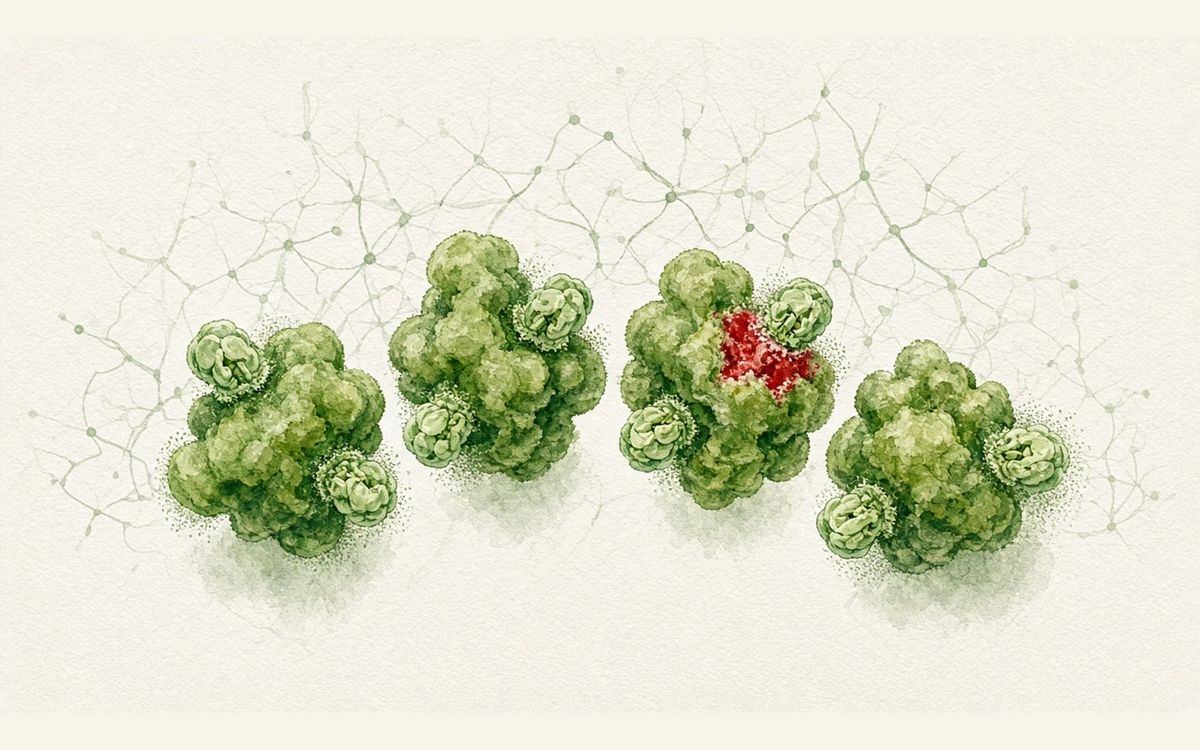
Key data card
- Study type: Computational antibody generation pipeline with in vitro validation
- Sample size n: Nanobodies: 101 PD-L1, 46 IL3, 43 IL20 and 52 BHRF1 designs; scFv/Fab: 48 PD-L1 and 48 IL3 designs
- Controls: Validated binders against the same target as positives and binders against unrelated antigens as negatives; mutagenesis experiments included fold-preserving positive antibodies or binders to overlapping epitopes
- Intervention/dose: Germinal combines an AF-M structural objective with the IgLM antibody sequence prior to redesign CDRs; NanoBiT prescreening with BLI/SPR confirmation of binding
- Primary endpoint: Obtaining functional antibodies against 4 protein targets and in all binder formats tested, after low-n experimental testing
- Primary endpoint result: 43–101 designs tested per antigen; detectable BLI binding for nanobodies in 7/25, 2/11, 4/11 and 5/20; among scFv/Fab, BLI confirmed 3/4 anti-PD-L1 and 1 anti-IL3 SPR candidate
- Statistics: Non-clinical and not powered for between-group comparison; success rates and format comparisons are descriptive readouts
- Safety: PSR polyspecificity: Germinal designs scored <4% of the positive control; D2 Ser showed higher polyreactivity than the original D2
- Evidence level: Full text
- Verification record: Source: author manuscript PMC13366713; sections checked: Abstract, Results, Methods, figure legends, Discussion, Limitations
- Specify the antigen epitope and framework
- Generate and filter CDR sequences
- Screen candidates at low throughput
- Confirm binding by BLI
- Validate the epitope by mutagenesis
Background and open questions
Antibodies can recognize protein epitopes with high specificity, but conventional animal immunization and large library screening are time-consuming and expensive and make it hard to specify in advance which region of the antigen the antibody will hit. For drug discovery and basic research, the scarce commodity is not another screen but compressing screening to low n while retaining epitope control and developability.
In Nature Biotechnology, Mille-Fragoso et al. present Germinal, which merges the structure predictor AF-M and the antibody language model IgLM into a single generative objective. Rather than starting from an existing weak binder, it designs CDRs de novo on a given antibody framework, then uses low-throughput experiments to test whether candidates express, bind and hit the specified epitope.
Study design
The study combines computational generation with in vitro validation. Germinal takes a predicted antigen structure, a specified epitope and an antibody framework as input, then generates, optimizes and filters CDR sequences. The nanobody validation cohorts were the top-ranked 101 PD-L1, 46 IL3, 43 IL20 and 52 BHRF1 designs; scFv/Fab work was extended only to PD-L1 and IL3, with 48 designs each.
Nanobody prescreening used NanoBiT. HiBiT (K_D=0.7 nM) quantified expression of LgBiT-fused binders, while antigen–SmBiT reported binding despite SmBiT's K_D of 190 μM. Candidates were then confirmed by BLI; scFvs were reformatted as Fabs and tested first by SPR and then by BLI. This is not a clinical or between-group powered study; the core readouts are measurable binding and epitope validation, and all success rates are descriptive.
Key results
Low-n coverage of four targets
The main readout shows that Germinal generated functional antibodies against 4 protein targets and in every format tested, with only 43–101 designs tested per antigen. From 101 PD-L1, 46 IL3, 43 IL20 and 52 BHRF1 nanobodies, NanoBiT screening advanced 25/101, 11/46, 11/43 and 20/52 to BLI.
BLI confirmation of nanobodies
BLI then detected 7/25, 2/11, 4/11 and 5/20 binders for PD-L1, IL3, IL20 and BHRF1, with nanomolar binders obtained for all 4 antigens. These numbers use the candidates entering BLI as denominators and are not formal comparisons between targets; a hit was defined as a shift of >0.07 nm at the highest BLI concentration tested.
Format extension and affinity
Among scFv designs, 48 PD-L1 and 48 IL3 candidates were prescreened by SPR in Fab format, yielding 4 PD-L1 and 1 IL3 candidate; BLI confirmed measurable binding for 3/4 anti-PD-L1 and 1 anti-IL3. The nanobody examples in Fig. 3 are PD-L1 E11 at K_D=170 nM, IL3 D2 Ser at K_D=280 nM, IL20 H5 at K_D=190 nM and BHRF1 A5 at K_D=1.2 μM.
Epitopes confirmed experimentally
At the epitope level, the H5-PD-L1 complex was resolved by cryo-EM at 3.9 Å with a global Cα RMSD of 1.25 Å to the predicted model, and the predicted model also matched the cryo-EM density locally across all 6 CDR loops. Hotspot alanine mutagenesis across PD-L1, IL3, IL20 and BHRF1 reduced affinity at least twofold relative to wild type, and 17/26 designs lost detectable binding entirely with at least one hotspot mutation.
Low polyreactivity overall
PSR polyspecificity experiments (a flow cytometry bead assay) showed that all Germinal designs had polyreactivity below 4% of the positive control, close to the negative control. The exception is D2 Ser: after regaining monomeric expression and target binding, it showed markedly higher polyreactivity than the original D2, indicating that developability assessment cannot rely on K_D alone. The overall evidence chain therefore spans generation, prescreening, affinity confirmation, structural localization and polyspecificity screening.
Mechanistic interpretation
Demonstrated in the paper: Cryo-EM directly links the computational epitope to real binding: PD-L1 H5 retains the intended hotspot contacts in a 3.9 Å structure with an overall Cα deviation of 1.25 Å; the mutagenesis matrix shows that 17/26 designs were completely blocked by at least one hotspot mutation.
The experiments also separate expression, binding and non-specificity. NanoBiT first read out expression with HiBiT at K_D=0.7 nM, then antigen proximity with SmBiT at K_D=190 μM; BLI confirmed target-level hits of 7/25, 2/11, 4/11 and 5/20, and PSR showed values below 4% of the positive control overall.
Author hypotheses: The authors suggest that jointly optimizing a structural objective with the IgLM sequence prior reduces non-antibody-like CDRs and framework contacts; the D2 Ser result suggests that a single cysteine substitution, while it may improve monomeric expression, can introduce non-specific interactions. They also consider that scFv filtering rules may not generalize directly from nanobodies and need format-specific calibration.
Limitations and uncertainties
- Generalizability is constrained first by antigen structure. The AF3 input structures for the 4 experimental targets were checked against existing experimental structures, all with Cα RMSD <1 Å; the results therefore show that Germinal can design using high-quality predicted structures but do not establish a success rate for antigens lacking experimental structures.
- Endpoint claims should also stay modest. Testing 43–101 designs per antigen is enough to show the feasibility of low-n validation, but the study was not powered for success rates across targets or formats; scFv/Fab work extended to only 2 targets, so differences between nanobodies and scFvs or between targets should not be written up as superiority comparisons.
- Engineering costs remain high. The Methods state that typical sampling requires 200–500 H100-GPU hours to obtain 200–400 designs passing the filters. Developability cannot be judged on affinity alone either: after D2 Ser regained monomeric expression and binding, its polyreactivity rose relative to the original D2.
Clinical and industry implications
For researchers who already have a reliable protein antigen structure and a defined epitope, Germinal offers a reproducible route: compress candidates computationally to 43–101 per antigen, then strip out false positives step by step through expression, binding, structure and mutagenesis. Its open code and experimental workflow lower the barrier to replication.
Its significance for industry lies in early discovery efficiency, not in demonstrated patient efficacy. If future work can lower H100 compute costs, validate more difficult surfaces and fold polyreactivity into ranking, epitope-targeted antibody design could shift from large-scale library screening toward smaller, more interpretable design–validation cycles.
Authors, source and verification
Evidence level: Full text; verification record: Source: author manuscript PMC13366713; sections checked: Abstract, Results, Methods, figure legends, Discussion, Limitations
Mille-Fragoso LS, Driscoll CL, Wang JN, Dai H, Widatalla T, Zhang JL, et al. Efficient generation of epitope-targeted antibodies with Germinal. Nat Biotechnol. 2026-06-23. https://doi.org/10.1038/s41587-026-03187-0
Primary field: AI drug design · Related: Antibody engineering, De novo CDR design, Epitope-targeted antibodies, AlphaFold-Multimer, IgLM, BLI validation
Summary of a published paper or preprint, written from the original text; numbers are as reported by the authors. Not medical or investment advice. Corrections: contact@
Related science
Rentosertib phase 2a: 21/54 aging-clock comparisons significant
A cell cluster with red-marked molecules, showing proteomic aging-related changes
511 AI antibodies benchmarked: only 9.8–13.8% beat the control in Challenge 2
Many antibodies pointing at a green antigen, with the best binder in red
NISE zero-shot design of drug-binding proteins: APEX affinity of 80 pM
A green designed protein enclosing a red small-molecule drug
One email, with links to every paper. Reports and custom landscapes: contact@inlightbio.com.