44% of rhesus macaques developed serum bnAb activity after the complete sequential HIV vaccine regimen
Among rhesus macaques that received the complete heterologous sequential regimen, 44% of animals developed serum bnAb activity after N332-GT5 priming, as stated in the abstract.
Twenty-four rhesus macaques in 4 groups of 6 received priming with the HIV envelope immunogen N332-GT5 followed by heterologous protein boosts. The abstract reports that 44% developed serum broadly neutralizing antibody activity. In the 8 best animals after the seventh boost, breadth relative to BG18 averaged 41%, with geometric mean ID50 values ranging from 52 to 481 and an overall value of 107. The immunogens target the N332 glycan epitope of the HIV envelope, with BG18-class antibodies as the readout. The work elicits HIV broadly neutralizing antibodies in non-human primates.
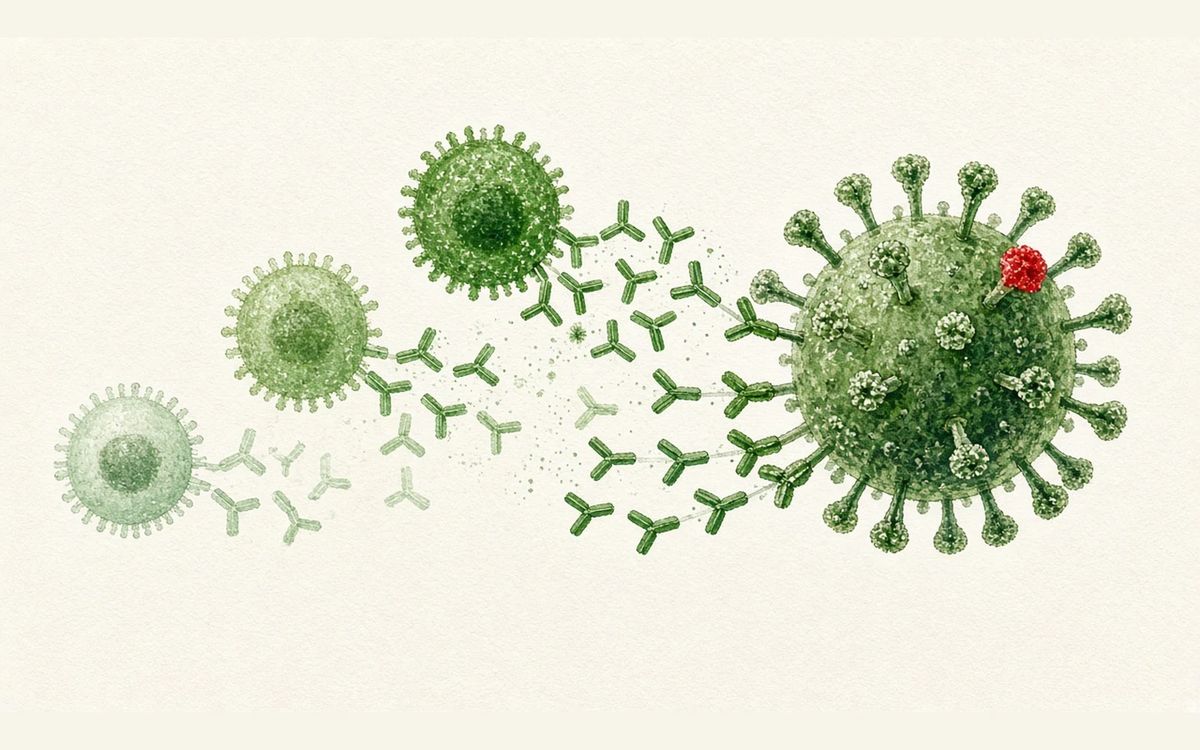
Key data card
- Study type: Open-label non-clinical immunization study in rhesus macaques
- Sample size n: 24 rhesus macaques in 4 groups of 6; group 1 through boost 5, groups 2–4 through boost 7
- Controls: Group 1 as a homologous N332-GT5 boosting control; between-group comparisons were not declared to follow a formal power design
- Intervention/dose: Priming with N332-GT5 plus SMNP in escalating doses; groups 2–4 then received B46/B54/B50, B20, DU156, ABCG, ABCG, AMP and trimer–NP boosts in sequence
- Follow-up: BG18-class BCRs remained detectable in groups 2–4 after boosts 6 and 7; the main text describes more than 2 years
- Primary endpoint: The paper defines no formal primary endpoint; the important/central serum readout is whether serum bnAb activity against BG18-sensitive HIV pseudoviruses arose after boost 7, with breadth and ID50 quantified on a 63-virus BG18-sensitive pseudovirus panel
- Primary endpoint result: The abstract reports serum bnAb activity in 44% of animals; in the 8 best animals after boost 7, mean breadth relative to BG18 was 41%, with geometric mean ID50 values of 52–481 and an overall geometric mean ID50 of 107
- Statistics: Mann–Whitney U, Wilcoxon signed-rank/rank-sum; no correction for multiple comparisons; neutralization breadth reported mainly descriptively
- Evidence level: Full text
- Verification record: Europe PMC fullTextXML PMC13489963; sections checked: Abstract, Results, Methods, Figure legends, Discussion and Limitations
- N332-GT5 primes rare precursors
- Heterologous Env progressively recalls and matures them
- WT and cocktail immunogens broaden recognition
- Serum bnAbs observed after the trimer–NP boost 7
Background and open questions
The HIV Env trimer is highly variable antigenically across isolates, so conventional Env immunization struggles to prime bnAb precursors from the naive antibody repertoire. Passive transfer of bnAbs can protect non-human primates and humans, so the key to vaccine design is not merely to induce anti-Env antibodies but to prime rare precursors against a predetermined epitope and drive their affinity maturation.
Germline-targeting regimens have reliably induced VRC01-class precursors in human phase I trials, but mature bnAbs had previously been generated by sequential immunization only in highly permissive mouse models. In Nature, Steichen et al. test a complete sequential regimen for the BG18-class V3 glycan epitope, aiming to generate memory B cells and serum bnAbs in the endogenous rhesus macaque B cell repertoire.
Study design
The study enrolled 24 rhesus macaques matched by weight, age and sex, in 4 groups of 6; investigators were not blinded. All animals were first primed with N332-GT5 plus SMNP in escalating doses, totalling 100 µg N332-GT5 and 750 µg SMNP given in 7 doses every other day. All boosts were bolus injections of SMNP-adjuvanted protein, with no declared power design for between-group neutralization endpoints.
Group 1 served as a homologous control, boosted with N332-GT5 through boost 5; groups 2, 3 and 4 received B46, B54 or B50 respectively at boost 1 and then shared B20, DU156, the ABCG cocktail twice, the AMP cocktail and the trimer–NP cocktail through boost 7. The central B cell readout used flow cytometry on PBMCs: epitope-specific memory B cells were defined as N332-GT5 double positive and negative for epitope-knockout probes.
Key results
Heterologous boosts recall precursors
After boost 1, pooled animals from groups 2–4 had higher boost-binding epitope-specific memory B cells at week 12, while group 1 was lower, with P<0.0001 between groups. Sequencing detected BG18 type I BCRs with HCDR3s of at least 20 amino acids in all 22 animals tested; frequencies were higher in groups 2–4 than in group 1, P=0.01.
Moving toward wild-type Env
After boost 2, 10–20% of epitope-specific memory B cells in groups 2–4 bound B20 versus about 5% in group 1, P=0.015; among BG18-class cells, 30–100% bound B20 versus 0 in group 1, P<0.01. After boost 3 switched to WT DU156, 14 of 18 animals in groups 2–4 had BG18-class cells binding WT Env, P=0.003.
Maturation and glycan specificity
Multivalent Env drove maturation further. After boost 5, 12 of 18 animals in groups 2–4 still had BG18-class type I BCRs, and more than 50% of these BCRs bound at least 3 ABCG Envs. Median heavy chain SHM after boost 5 exceeded 14% in all three heterologous groups, with the most mutated BCRs approaching 30%. Asn332 glycan controls showed that of 84 type I antibodies able to bind N332-containing BG505-MD39, 0 of 84 showed detectable binding to the N332T variant lacking the N332 glycan.
mAb neutralization breadth
Per the abstract, bnAb lineages were found in at least 50% of animals, with individual mAbs reaching up to 67% of the neutralization breadth of the reference BG18. On the large 63-member BG18-sensitive pseudovirus panel, 13 type I mAbs neutralized a median of 15 viruses with geometric mean IC50 values of 1.4–10.8 µg ml−1 and breadth up to 57% relative to BG18; 6 type III mAbs neutralized a median of 26 with geometric mean IC50 values of 0.7–7.3 µg ml−1 and monomer breadth up to 67% relative to BG18.
Serum bnAb readout
At the serum level, the abstract reports bnAb activity in 44% of animals. After boost 7, 7 of 18 animals neutralized sentinel tier 2 pseudoviruses; all 8 of the best animals had bnAb activity on the 63-virus panel, with mean neutralization breadth across those 8 animals of 41% relative to BG18; geometric mean ID50 values ranged from 52 to 481 with an overall geometric mean ID50 of 107. The best animal's serum reached 84% of the breadth of mature BG18, corresponding to roughly 52% on the standard global panel overall; its geometric mean ID50 was 481, which the authors say would be expected to confer 75–90% protection.
Mechanistic interpretation
Demonstrated in the paper: The directly demonstrated chain begins with epitope-specific recall: heterologous boost 1 gave BG18 type I memory B cells and germinal centre B cells in groups 2–4 the ability to bind the boost, and B20 and WT DU156 then selected cells able to bind wild-type Env. Clonal trees show lineages present across multiple time points, expanding and accumulating SHM over 6 sequential immunizations.
Structural and specificity evidence supports maturation against the designed epitope. Cryo-EM resolved 2 type I antibodies and 1 type III Fab, which approach Env at angles close to human BG18, contact the GDIR motif with their HCDR3 and interact with the Asn332 glycan. The N332T negative control and the drop in serum Asn332 dependence indicate that the main neutralization is directed at the V3 glycan epitope.
Author hypotheses: The authors propose that progressively reducing germline-targeting mutations ("shepherding"), introducing WT Env as early as possible, and "polishing" with multi-branch cocktails together push rare BG18 precursors toward broad neutralization. They further speculate that trimer–NP at boost 7 may enhance plasma cell responses through stronger avidity, B cell activation and lymph node trafficking; this step was not formally compared head-to-head with soluble trimer at the same stage.
Limitations and uncertainties
- First, generalizability is limited. The subjects are 24 adult Indian rhesus macaques, not humans; although the authors note that BG18 precursor frequency is lower in this model than in humans, whether humans would achieve 44% serum bnAb activity from the same sequence remains unverified.
- Second, the regimen is very burdensome. The authors note that the regimen tested requires 7 boosts and that future work should obtain the broadest responses with fewer immunizations; the 34-week interval between boost 1 and boost 2 arose for logistical reasons. Durability was also not explored, and stability 2 to 6 weeks after boost 7 says nothing about long-term maintenance.
- Third, statistical and methodological limitations must be kept in view. Investigators were not blinded, and no between-group power design for serum neutralization or protection endpoints was declared; statistically, the asterisks for pooled tests in the figures use uncorrected P values with no adjustment for multiple comparisons. The expectation that an ID50 of 481 in the best animal corresponds to 75–90% protection is based on prior studies, and no HIV or SHIV challenge was performed here.
Clinical and industry implications
If this path from rare precursors to serum bnAbs can be reproduced in people with fewer immunizations, the BG18-class V3 glycan epitope will provide a workable precision-immunology template for HIV vaccines. The value of this paper is in advancing germline targeting from "precursors can be primed" to detectable serum bnAb activity in non-human primates.
Industrial translation still depends on simplification and format of manufacture. The materials mention testing mRNA platforms to support scalable manufacturing and exploring membrane-anchored trimer delivery; this paper validates only protein plus SMNP and the trimer–NP combination, so which platform suits clinical development cannot yet be judged.
Authors, source and verification
Evidence level: Full text; verification record: Europe PMC fullTextXML PMC13489963; sections checked: Abstract, Results, Methods, Figure legends, Discussion and Limitations
Steichen JM, Madden PJ, Flynn CT, Phulera S, Shil M, Kalyuzhniy O, et al. Vaccination elicits HIV broadly neutralizing antibodies in primates. Nature. 2026. https://doi.org/10.1038/s41586-026-10837-5
Primary field: Vaccines & infection immunology · Related: Antibody engineering, Disease models, HIV Env, Broadly neutralizing antibodies, Germline targeting, Sequential immunization
Summary of a published paper or preprint, written from the original text; numbers are as reported by the authors. Not medical or investment advice. Corrections: contact@
Related science
Triple therapy at 72 hours: 8 infant macaques aviraemic for 6 months off treatment
Virus particles and three drug chains, with red marking suppressed virus
Observational study: mRNA-1010 recipients had larger increases in memory B cells
A cross-section of a lymph node germinal centre, with memory B cells at right
A fungal glycan adjuvant extends COVID-19 mRNA vaccine protection to day 500
Lipid particles with mannan chains, a dendritic cell and a B cell producing antibodies
One email, with links to every paper. Reports and custom landscapes: contact@inlightbio.com.