Adding a fungal mannan adjuvant to a COVID-19 mRNA vaccine: neutralizing antibody breadth and duration extended to day 500 in mice
In mice and cynomolgus monkeys, mixing mannadjuvant, a complex of fungal mannan with alum, into a WA1 mRNA vaccine induced neutralizing antibodies against BA.5 and XBB.1.5 that persisted to day 500 and overcame antigenic imprinting.
In mice, adding a mannan-alum adjuvant (100 µg alum plus 500 µg mannan) to WA1 spike messenger ribonucleic acid (1 µg) extended neutralization of BA.5 and XBB.1.5 pseudoviruses to day 500, which messenger ribonucleic acid alone or with alum did not. In 10 cynomolgus monkeys given 30 µg of vaccine, spike antibodies and neutralization of three pseudoviruses rose through day 180. After challenge on day 56 in humanized mice, virus was undetectable in the lungs of the adjuvanted group. This glycan adjuvant expands the breadth and duration of the vaccine.
Key data card
- Study type: Preclinical study: mouse immunization and challenge, cynomolgus monkey immunization, and in vitro experiments on human peripheral blood cells
- Sample size n: Mostly 5–14 mice per group (per figure legends); 10 male cynomolgus monkeys aged 3–5 years
- Controls: WA1mRNA alone, WA1mRNA+alum, MA alone, saline, an AS04 adjuvant control, and irrelevant antigen and autoantigen arrays
- Intervention/dose: WA1mRNA (1 µg per mouse) alone or mixed with MA (100 µg alum plus 500 µg mannan per mouse); 30 µg per monkey, with MA containing 1 mg Alhydrogel plus 5 mg mannan per animal
- Follow-up: Mice followed to day 500 after immunization; monkeys to day 180; BA.5 challenge on day 56 with readout 4 days after challenge
- Primary endpoint: Central preclinical readout: the magnitude, duration and variant breadth of neutralizing antibodies (live virus and pseudovirus NT50) with MA added, relative to WA1mRNA alone
- Primary endpoint result: WA1mRNA+MA (but not +alum) extended WA1 neutralization to day 84 and neutralization of WA1 D614G pseudovirus to day 500; neutralization of BA.5 and XBB.1.5 pseudoviruses persisted to day 500; in monkeys, IgG and neutralization of three pseudoviruses were significantly elevated through day 180
- Statistics: Two-way ANOVA with Tukey multiple comparisons (Figs. 1 and 2); clonal diversity by rarefied Hill numbers, with P values given
- Safety: No rise in body temperature or systemic inflammatory cytokines within 48 hours in mice; no injection site reactions in monkeys, with temperature, body weight and haematology comparable to controls; autoantigen arrays showed no breach of self-tolerance
- Evidence level: Full text
- Verification record: Europe PMC full-text XML (PMC13226070): Abstract, Results, Discussion, Methods and legends for Figs. 1–8
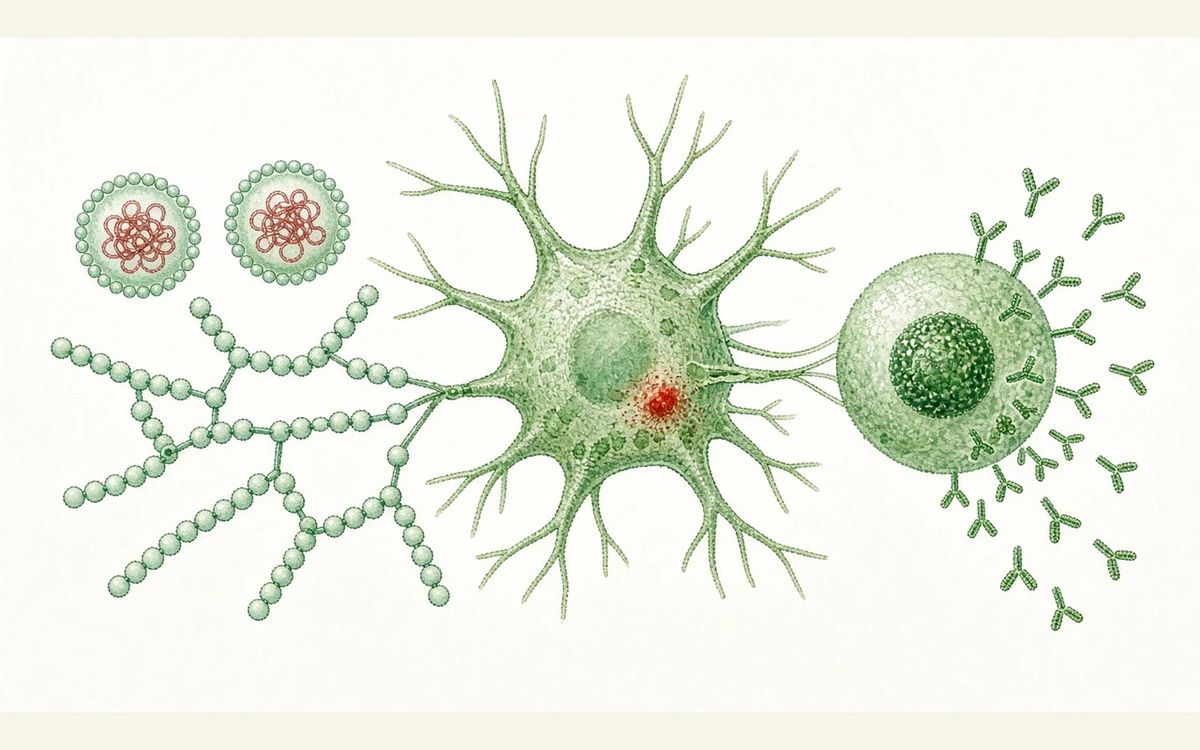
- Mannan and alum form MA
- Mixed with WA1mRNA and injected intramuscularly
- IL-1 and interferon rise in draining lymph nodes
- Germinal centres expand and clones become more even
- Broad neutralization persists to day 500
Background and open questions
mRNA vaccines, in which lipid nanoparticles encapsulate mRNA encoding an antigen, proved effective during the COVID-19 pandemic, but the immune pathways controlling their potency remain debated, and whether modulating inflammation with an adjuvant can improve mRNA vaccine potency has rarely been asked. Separately, the difficulty of covering multiple variants of the same virus is a major limitation of current mRNA vaccines, as the authors note.
Glycans are understudied as adjuvants. Mannan from Candida albicans activates the C-type lectin receptor dectin-2; the complex it forms spontaneously with aluminium hydroxide, called mannadjuvant (MA), has previously been reported to enhance protein vaccines. In Nature Immunology, Jena et al. test whether MA can enhance the original monovalent mRNA vaccine (WA1mRNA).
Study design
C57BL/6J mice received intramuscular WA1mRNA, WA1mRNA+MA or MA alone on day 0 (prime) and day 14 (boost), with serum collected, plus WA1mRNA+alum and saline controls; doses were 1 µg WA1mRNA per mouse and MA composed of 100 µg alum with 500 µg mannan. Follow-up extended to day 500 after immunization, with readouts including spike-specific IgG, live virus and pseudovirus neutralization, lymph node TFH and germinal centre B cells, and bone marrow plasma cells.
Three further systems were used: K18-hACE2 mice challenged with BA.5 on day 56 with lung virus measured on day 4; 10 male cynomolgus monkeys aged 3–5 years given intramuscular WA1mRNA (30 µg per animal) or WA1mRNA+MA (1 mg Alhydrogel plus 5 mg mannan per animal) on days 0 and 21; and in vitro stimulation of human peripheral blood mononuclear cells. The neutralization readout was NT50, the serum titre giving 50% inhibition of infection; if the initial 1:30 dilution did not reach 50% inhibition or regression fits were poor, the value was recorded as the limit of detection.
Key results
Duration extended to 500 days
Mixing did not alter the vaccine itself: dynamic light scattering showed no change in particle size, mRNA leakage within 24 hours was under 3% regardless of MA, and body temperature and systemic IL-1β, TNF and IL-6 within 48 hours of immunization were comparable between groups. Anti-WA1 spike IgG in the WA1mRNA+MA group remained higher than in the WA1mRNA or WA1mRNA+alum groups through day 500, with higher proportions of bone marrow antibody-secreting cells and long-lived plasma cells as well.
Breadth extended to variants
Neutralization of WA1 SARS-CoV-2 was extended to day 84 and neutralization of pseudovirus bearing the WA1 spike with D614G to day 500, which the WA1mRNA+alum group did not achieve, indicating that mannan rather than alum is responsible. Only sera from the WA1mRNA+MA group still neutralized pseudoviruses expressing BA.5 or XBB.1.5 spike at day 500, and they neutralized live BA.1 and BA.5 virus on days 35 and 56.
Larger germinal centres and more even clones
TFH and germinal centre B cell numbers in the WA1mRNA+MA group exceeded those of the other two groups through day 84, falling back by day 500. Single-cell BCR sequencing showed reduced clonal dominance and a more even distribution: richness of WA1-specific clones (q=0) rose by 37.85 effective clones (P=0.0280), evenness-weighted diversity (q=2) rose by 20.61 (P=0.0012), and somatic hypermutation of heavy and light chains also increased significantly.
Challenge protection and validation in monkeys
When K18-hACE2 mice were challenged with BA.5 on day 56, lung viral titres on day 4 were lower in the WA1mRNA group than in unimmunized animals, while virus was undetectable in the lungs of the WA1mRNA+MA group, with significantly less alveolar and peribronchiolar damage. In cynomolgus monkeys, spike-specific IgG and neutralization of WA1, BA.4/BA.5 and XBB.1.5 pseudoviruses were significantly higher than with WA1mRNA alone and persisted to day 180 after immunization.
Overcoming antigenic imprinting
Mice primed with two doses of WA1mRNA and then given a secondary boost of XBB.1.5mRNA+MA on day 56 showed day-84 neutralization of XBB.1.5 pseudovirus comparable to two full doses of XBB.1.5mRNA, with significantly improved neutralization of BA.5 and WA1 spike pseudoviruses, and higher numbers of spike-specific germinal centre B cells, memory B cells and TFH cells than any other group.
Mechanistic interpretation
Demonstrated in the paper: Draining lymph node transcriptomes show that the programmes induced by WA1mRNA and WA1mRNA+alum largely overlap, while WA1mRNA+MA falls in a separate space: inflammasome- and IL-1-related pathways were upregulated on day 1 (Nlrp3, Il1rn and Il1a at the top), and interferon-driven responses remained elevated on days 3 and 7, whereas genes upregulated on day 1 in the other two groups were already switched off by day 3.
Functional blockade provides causal evidence: the IL-1 receptor inhibitor anakinra and the caspase-1 inhibitor VX765 each prevented the increases in anti-spike IgG, germinal centre B and TFH expansion and enhanced neutralization of WA1, BA.5 and XBB.1.5 pseudoviruses in the WA1mRNA+MA group, with little effect on WA1mRNA alone; blocking interferon did the same. The two are mutually upstream, and Il1rn-deficient mice reached WA1mRNA+MA levels with WA1mRNA alone, from which the authors conclude that sustained type I interferon production in the draining lymph node together with enhanced IL-1 signalling is necessary and sufficient for MA's effect.
Author hypotheses: The authors speculate that a durable germinal centre response lets high-affinity antibodies mask immunodominant epitopes and gives low-affinity clones an opening, explaining the more even clonal repertoire and broader neutralization produced by MA; they also state explicitly that how MA controls inflammasome activation remains to be determined.
Limitations and uncertainties
- The mechanistic chain is not closed: the authors state that how MA-induced interferon shapes the WA1mRNA response, how MA controls inflammasome activation, and the division of labour between interferon pathways and classical pro-inflammatory cytokines all require further study, and current conclusions rest on blockade experiments and transcriptomic associations.
- The level of evidence remains preclinical: the only protective endpoint is BA.5 challenge of K18-hACE2 mice on day 56, the monkey experiments provide immunogenicity without challenge, and human data are limited to cytokine secretion by peripheral blood mononuclear cells and dendritic cells in vitro, with no human vaccination data.
- Scale and generalizability are limited: mouse groups were mostly 5–14 animals, the monkey study used only 10 males aged 3–5 years with follow-up to day 180, and safety readouts cover reactogenicity, haematology and autoantigen arrays without long-term safety.
Clinical and industry implications
If validated in higher species and humans, fungal glycan adjuvants targeting dectin-2 point to a way of upgrading existing mRNA vaccines: leaving the antigen sequence unchanged and simply mixing in an adjuvant to prolong antibody duration and cover highly escape-prone variants.
A second implication for vaccine development concerns antigenic imprinting: in this paper, priming with WA1 and then boosting with MA-containing XBB.1.5 brought neutralization of the new variant up to the level of a full course with the new strain, an approach that could influence booster design if it is validated clinically.
Authors, source and verification
Evidence level: Full text; verification record: Europe PMC full-text XML (PMC13226070): Abstract, Results, Discussion, Methods and legends for Figs. 1–8
Jena KK, Qu P, Baracco L, Saghaei S, Keerti, Allahyari Z, et al. A glycan-based adjuvant expands the breadth and duration of protection of mRNA-based vaccines. Nat Immunol. 2026 May 22. doi: https://doi.org/10.1038/s41590-026-02517-3
Primary field: Vaccines & infection immunology · Related: Nucleic acid and gene therapy, mRNA vaccines, Adjuvants, dectin-2, Neutralizing antibody breadth, Germinal centres
Summary of a published paper or preprint, written from the original text; numbers are as reported by the authors. Not medical or investment advice. Corrections: contact@
Related science
Triple therapy at 72 hours: 8 infant macaques aviraemic for 6 months off treatment
Virus particles and three drug chains, with red marking suppressed virus
44% of rhesus macaques developed serum bnAb activity after the complete sequential HIV vaccine regimen
Three generations of B cells maturing step by step, with antibodies binding the viral spike at right
Observational study: mRNA-1010 recipients had larger increases in memory B cells
A cross-section of a lymph node germinal centre, with memory B cells at right
One email, with links to every paper. Reports and custom landscapes: contact@inlightbio.com.