Lymph-node-targeted KRAS vaccine phase 2: DFS endpoint not met, immune signal awaits confirmation
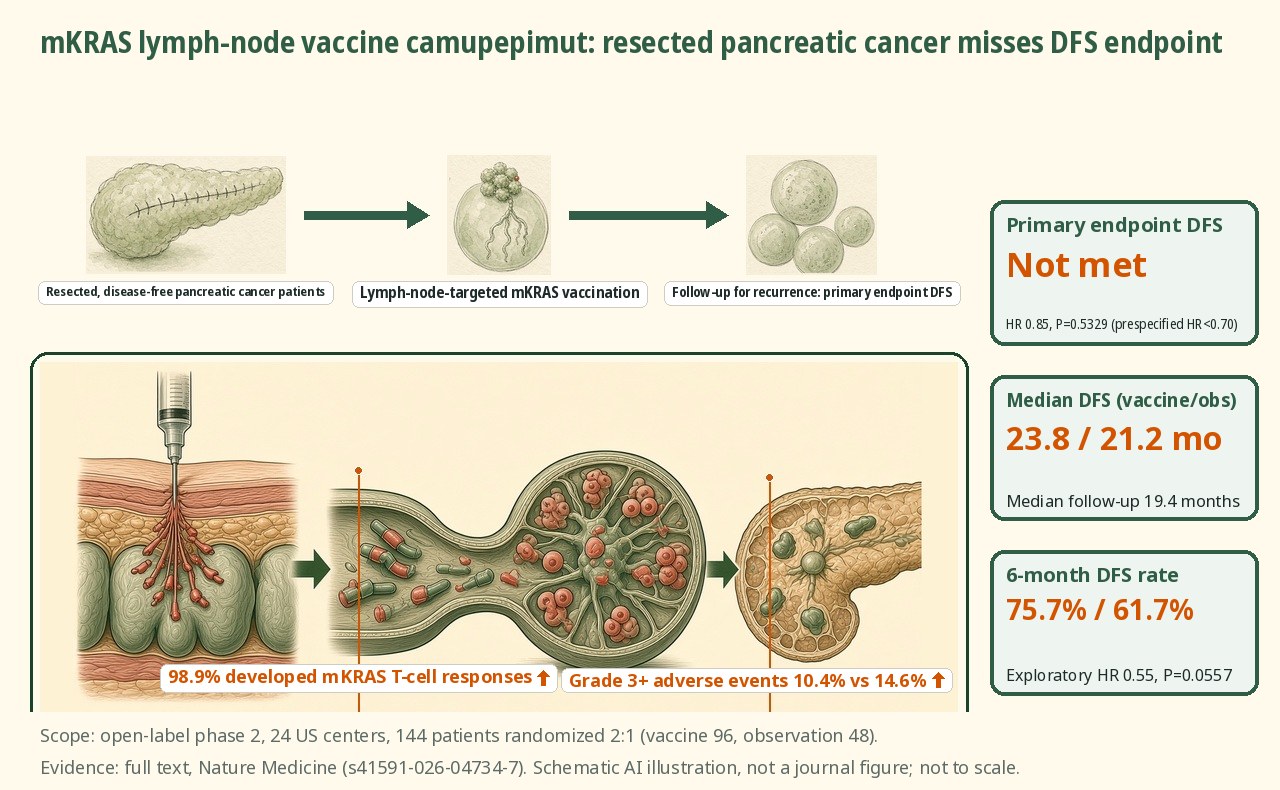
In the open-label randomized phase 2 AMPLIFY-7P trial (144 patients, 2:1), the amphiphile lymph-node-targeted seven-valent mutant KRAS (mKRAS) peptide vaccine camupepimut (ELI-002 7P), given after radiographically recurrence-free curative local therapy for KRAS-mutant pancreatic ductal adenocarcinoma, missed its disease-free survival (DFS) primary endpoint in the intention-to-treat population (median 23.8 vs 21.2 months, HR 0.85, P = 0.5329); the 6-month on-treatment DFS rate was 75.7% vs 61.7% (HR 0.55, P = 0.0557). Prespecified subgroups (ctDNA-negative, no prior radiotherapy) and post hoc multivariable adjustment (HR 0.47) suggest a benefit signal; 98.9% of evaluable patients developed mKRAS-specific T cells, and those with responses above 9.17× baseline had markedly better DFS (HR 0.22); prior radiotherapy was linked to lymphopenia and weaker T-cell responses. Grade ≥3 adverse events were 10.4% vs 14.6%.
Background and open questions
Pancreatic ductal adenocarcinoma (PDAC) causes about 67,000 new cases and 53,000 deaths per year in the US; surgery is the only curative option, but there is a high propensity for local and hepatic recurrence after surgery, and 5-year survival is only 15%–17.4%; immune checkpoint blockade is essentially ineffective in PDAC. KRAS mutations are truncal driver mutations, found in about 90%–95% of PDAC and not expressed in normal tissue, making them an ideal "public neoantigen." Yet prior approaches each had shortcomings: G12D-restricted TCR-T cell therapy is HLA-restricted and operationally complex; unmodified long-peptide KRAS vaccines combined with dual checkpoints gave limited responses to the most common G12D; and among 13 patients whose personalized mRNA neoantigen vaccines included mKRAS antigens, only 1 developed mKRAS-specific T cells.
The amphiphile (AMP) strategy links antigen and adjuvant to an albumin-binding lipid so they enrich in lymph nodes via the lymphatics. In the phase 1 study of the prior two-valent product ELI-002 2P (20 PDAC and 5 colorectal patients, radiographically disease-free but MRD-positive), 84.0% of patients developed mKRAS-specific T-cell responses, and an ROC analysis defined a 9.17× response threshold; patients above the threshold had median RFS not reached vs 3.02 months (HR 0.12). The seven-valent camupepimut aims to broaden the eligible population. The core questions here are whether, under randomized controlled conditions, this off-the-shelf mKRAS vaccine can delay recurrence in the adjuvant setting, and whether the "response magnitude–clinical outcome" association seen in phase 1 can be reproduced.
Study design
AMPLIFY-7P is an open-label randomized phase 2 trial. Eligible patients were ≥18 years, ECOG 0–1, with pathologically confirmed PDAC carrying one of the seven vaccine-covered KRAS mutations, resectable or borderline-resectable stage I–III (AJCC 8th edition), who had completed NCCN standard chemotherapy/chemoradiation and undergone R0 or R1 resection, and were radiographically no evidence of disease (NED) within 6 months of finishing local therapy. Patients could enroll regardless of ctDNA positivity and/or CA19-9/CEA elevation (i.e., MRD positivity) — importantly, this was not a trial of MRD-positive patients only, with baseline MRD-positive patients making up 60.4% of the whole. Prior immune checkpoint inhibitors or cancer vaccines, lymphocytes <1.0 × 10⁹/L, or germline BRCA1/2 mutations were exclusions.
Patients were stratified by nodal status and randomized 2:1 to camupepimut or observation. The primary endpoint was investigator-assessed DFS by iRECIST. About 71 DFS events were estimated as needed for HR 0.53, two-sided α 0.10 and 80% power; the success threshold was prespecified as HR < 0.70 and P < ~0.10. Prespecified subgroups included age, sex, ECOG, nodal status, margins, prior radiotherapy, prior splenectomy, G12D/G12V/G12R, and ctDNA and MRD status. Immunogenicity was assessed by ex vivo IFNγ/granzyme B Fluorospot and intracellular cytokine staining (ICS); a "responder" was defined as a ≥2-fold rise over baseline above the assay threshold at any post-vaccination timepoint. Whole-exome sequencing selected up to 10 non-vaccine neoantigens per patient to assess epitope spreading, and high-resolution HLA typing was done in 89 patients. Notably, protocol version 6.0 (13 September 2023) only then changed the primary endpoint from RFS to DFS and added stratification and a larger sample; the statistical analysis plan v1.0 was approved on 28 February 2025 (after enrollment closed), and v2.1 (31 December 2025) added subgroups for tumor stage, prior systemic therapy and KRAS mutation.
Key results
Enrollment and baseline: stratification balanced nodal status, but high-risk factors were unevenly distributed
Of 144 patients, all 96 in the vaccine arm received treatment, at a median dose intensity of 100% (6 priming + 4 booster doses), with 72/96 (75.0%) completing treatment, while 30/48 (62.5%) in the observation arm completed the observation period. The vaccine arm had a median age of 65 years, 54.2% female, 81.3% white; stages I, II and III were 31.3%, 42.7% and 26.0%, all had received chemotherapy and pancreatectomy, and 24.0% had received radiotherapy. The stratification factor nodal status was balanced (N0 40.6% vs 39.6%), but the vaccine arm had a higher proportion of ctDNA positivity (20.8% vs 12.5%) and more R1 resections (26.0% vs 18.8%), while the observation arm had more prior radiotherapy (31.3% vs 24.0%); CA19-9 elevation was 29.2% in both arms. The tumor KRAS mutation distribution also differed: the vaccine arm was led by G12V (40.6%) with G12D at 38.5%, while the observation arm had G12D at 56.3%.
Primary endpoint not met, with early separation coinciding with the dosing period
In the ITT population median DFS was 23.8 vs 21.2 months, HR 0.85 (95% CI 0.52–1.41), P = 0.5329, failing the prespecified HR < 0.70 threshold. The prespecified 6-month DFS rate (corresponding to the dosing period) was 75.7% vs 61.7%, with a randomization-to-6-month exploratory HR of 0.55, P = 0.0557. In other words, the two curves separated during the dosing period and then converged — and this shape is itself the main basis for the "maintenance dosing" hypothesis.
Post hoc multivariable adjustment and prespecified subgroups: a signal, but the statistics need careful reading
Post hoc multivariable Cox regression gave an adjusted HR for camupepimut versus observation of 0.47 (95% CI 0.27–0.82, P = 0.0086), while stage III (adjusted HR 2.29), CA19-9 elevation (3.16) and baseline ctDNA positivity (5.99) were independent adverse prognostic factors. In a pooled analysis of both arms, ctDNA-positive patients had a median DFS of only 4.2 months versus 24.0 months for ctDNA-negative patients (HR 6.56).
Among prespecified subgroups, ctDNA-negative patients (93, 64.6% of ITT) had median DFS not reached vs 21.2 months (HR 0.51, P = 0.0280), with 18-month recurrence-free-or-alive proportions of 70% vs 56%; ctDNA-positive patients (26) had 4.3 vs 1.9 months (HR 0.57, P = 0.0489). Patients without prior radiotherapy (106, 73.6%) had median DFS 23.8 vs 10.4 months (HR 0.59, P = 0.0221), with 18-month proportions of 55% vs 44%. What needs careful reading: the 95% CIs of these subgroup HRs all cross 1 (ctDNA-negative 0.25–1.02, ctDNA-positive 0.22–1.48, no radiotherapy 0.33–1.03), the P values come from the Wilcoxon test which is more sensitive to early differences, and they are uncorrected for multiplicity. Moreover, within the ctDNA-negative subgroup the observation arm still had a markedly higher proportion of prior radiotherapy (38.7% vs 14.5%), so the two "benefit subgroups" overlap and confound each other.
Radiotherapy, lymphocytes and vaccine response
Patients with prior radiotherapy had lower baseline absolute lymphocyte counts (median 1.2 vs 1.7 × 10⁹/L, P < 0.0001) and weaker vaccine-induced mKRAS-specific T-cell responses (median 15-fold vs 58-fold, P = 0.0011); the proportion above the 9.17× threshold was 61.9% vs 88.4%, odds ratio 0.21 (P = 0.005). This is the study's most design-relevant "biological chain."
Immunogenicity: broad, durable and with epitope spreading
Among 90 evaluable patients, 89 (98.9%) developed mKRAS-specific T cells, with a median rise of 44.3-fold over baseline (range 2.13–1,310-fold); 85% (68/80) activated both CD4 and CD8 T cells, 70% (62/89) responded to all seven antigens, and 87.6% (78/89) responded to the mutation carried by their own tumor. Mean fold-rises for G12D, G12R and G12V were 48.6, 51.3 and 31.1, with response rates of 89%, 87% and 82% — the authors argue lymph-node targeting may overcome the weak G12D immunogenicity of prior unmodified-peptide vaccines. Cytotoxic responses with raised granzyme B and/or perforin occurred in 80.2% (69/86); at ≥46 weeks, 95.5% (63/66) still had a measurable positive response. Epitope spreading to non-vaccine neoantigens occurred in 13 of 15 patients (86.7%). HLA typing identified 1,132 unique HLA molecules, with no particular allele linked to response magnitude, and DFS curves nearly overlapped for patients with or without HLA class I alleles known to present mKRAS peptides (HR 1.02). Wild-type KRAS responses were rare and low-level.
Association of immune response with efficacy
In the vaccine arm, 82.2% (74/90) had responses above 9.17×, and these patients had significantly better DFS (HR 0.22, 95% CI 0.08–0.63, P < 0.0001), with median DFS not reached vs 6.08 months (events 35.1% vs 81.3%). Grouping by the first quartile of response to the patient's own tumor mutation (HR 0.31), by Fluorospot median (HR 0.48) or by ICS median (HR 0.38) gave consistent directions, reproducing the phase 1 "response magnitude–outcome" association.
Safety
The vaccine was well tolerated: treatment-emergent adverse events 72.9% vs 77.1%, serious adverse events 6.3% vs 8.3%, grade ≥3 10.4% vs 14.6%; 5.2% of patients needed a dosing adjustment for adverse events (mostly dose delays), with no reductions, no withdrawals or deaths from adverse events. Events associated with disease progression, such as abdominal pain (10.4% vs 16.7%) and fatigue (10.4% vs 12.5%), were numerically more common in the observation arm.
Clinical and industry implications
Clinically, this is a negative randomized phase 2 trial, and camupepimut should not now be regarded as an effective adjuvant therapy for resected PDAC. But it provides several points of value for the whole "off-the-shelf KRAS vaccine" field: first, a lymph-node-targeted peptide vaccine can induce a broad-spectrum mKRAS T-cell response — including to G12D — in the vast majority of patients, without HLA restriction, which is exactly what personalized or TCR therapies struggle to do; second, ctDNA status discriminates post-surgical recurrence risk far more strongly than the vaccine effect itself (pooled HR 6.56), and future adjuvant immunotherapy trials that do not stratify by ctDNA can easily be swamped by baseline risk imbalance; third, radiotherapy-related lymphopenia may blunt vaccine responses, suggesting an interaction between prior treatment choices and immunotherapy that needs prospective validation. The authors' planned phase 3 will intensify dosing, consider combination with immune checkpoint inhibitors, stratify by ctDNA and exclude prior-radiotherapy patients — whether these enrichment strategies can turn the phase 2 subgroup signals into confirmatory benefit is the key test of the platform's value.
Mechanistic interpretation
Demonstrated in the paper: Under randomized controlled conditions, camupepimut did not significantly prolong DFS in the intention-to-treat population; but it reliably induced high-magnitude, multivalent mKRAS-specific T-cell responses with both CD4/CD8 and cytotoxic phenotypes, still measurable at ≥46 weeks and independent of HLA background, with safety similar to observation. Prior radiotherapy was associated with lower baseline lymphocytes and weaker vaccine responses, and ctDNA positivity was a strong adverse prognostic factor.
Author hypotheses: The authors argue that ctDNA-positive patients were over-concentrated in the vaccine arm, diluting the ability to detect efficacy; the adjusted HR of 0.47 and the subgroup signals represent a "real but imbalance-masked" treatment effect. The early benefit within 6 months, coinciding with the dosing period, is read as meaning longer or maintenance dosing might sustain benefit; epitope spreading is viewed as evidence that lymph nodes orchestrate bystander tumor-specific T cells in situ. The authors also propose combination with immune checkpoint inhibitors or RAS inhibitors. It must be stressed: the association between response magnitude and DFS is a within-vaccine-arm comparison only, subject to "responder bias" — early recurrers may not have time to complete vaccination or mount a response — so this association itself cannot prove T-cell responses cause efficacy; the adjusted HR is a post hoc analysis, and epitope spreading was assessed in only 15 patients, all hypothesis-generating.
Limitations and uncertainties
- The primary endpoint was negative; the trial had a moderate sample size, was open-label, and used a two-sided α 0.10 design, with DFS judged by investigators per iRECIST rather than RECIST, which may introduce assessment bias.
- Prespecified subgroup and immunogenicity analyses were all uncorrected for multiplicity; subgroup HR 95% CIs cross 1 and P values are from the Wilcoxon test; the Methods state subgroups would be reported with a treatment×subgroup interaction P value, but no interaction-test results appear in the text or figures.
- The post hoc multivariable Cox regression can partly address baseline imbalance (ctDNA positivity, R1 resection, radiotherapy, G12D proportion) but can only be regarded as a hypothesis-generating signal.
- The association between immune response and efficacy is confined to the vaccine arm, with no comparable control group, and may be subject to responder bias.
- Median follow-up was only 19.4 months, OS is immature and crossover was allowed, so future OS interpretation is limited; tumor-marker and crossover analyses are not yet reported.
- Enrollment was predominantly white with underrepresentation of Black patients, and from limited US centers only, so generalizability is limited; the primary endpoint was changed mid-study, and the statistical analysis plan was approved after enrollment closed and had subgroups added.
- The study was initiated, designed and funded by Elicio Therapeutics, with several authors employees holding shares or related patents.
Authors and source
George B, Singh H, Devoe CE, Chung V, Hosein PJ, Hendifar A, et al. Nature Medicine (open access, CC BY-NC-ND 4.0). Submitted 10 September 2026, accepted 1 October, published online 23 October 2026. https://doi.org/10.1038/s41591-026-04734-7. ClinicalTrials.gov: NCT05726864.
Numbers are as reported by the authors. Corrections: contact@
Related science
Restoring IL-15 signalling boosts innate immunity in brain metastasis
The brain starves innate lymphoid cells of IL-15; restoring it locally lets them control metastasis without T cells

In vivo BCMA CAR-T phase 1: 15 months of follow-up, one ongoing sCR
Green CAR-T cells attacking a red myeloma cell at right

Synthetic TCR library: on average only 56% of VDJdb TCRs reproduce their annotated reactivity
Green peptide-MHC complexes binding synthetic TCRs, with one non-reproducing case marked in red
One email, with links to every paper. Reports and custom landscapes: contact@inlightbio.com.
Opens your email app with a pre-filled request; we add you by hand. Free, unsubscribe any time.