In vivo BCMA CAR-T in myeloma at 15 months of follow-up: no new important ESO-T01-related adverse events, one ongoing sCR, median PFS 4.0 months
Four patients with relapsed/refractory myeloma received a single infusion of in vivo BCMA CAR-T; with up to 15 months of follow-up there were no new important ESO-T01-related adverse events, one patient had an ongoing sCR and median PFS was 4.0 months, while the other three died after relapse or progression.
Four patients with relapsed/refractory myeloma received a single intravenous infusion of the in vivo BCMA CAR-T product ESO-T01 (0.2×10^9 transducing units), with no leukapheresis and no lymphodepleting chemotherapy. With up to 15 months of follow-up the objective response rate was 100% (2 sCR, 2 PR), and one sCR was maintained for 15 months; median PFS was 4.0 months, and the other three patients died after relapse or progression, all with extramedullary disease. All four had grade 1–3 biphasic CRS and grade 3–4 haematological toxicity (neutropenia 75%, lymphopenia 75%). Integration site analysis showed no clonal expansion.
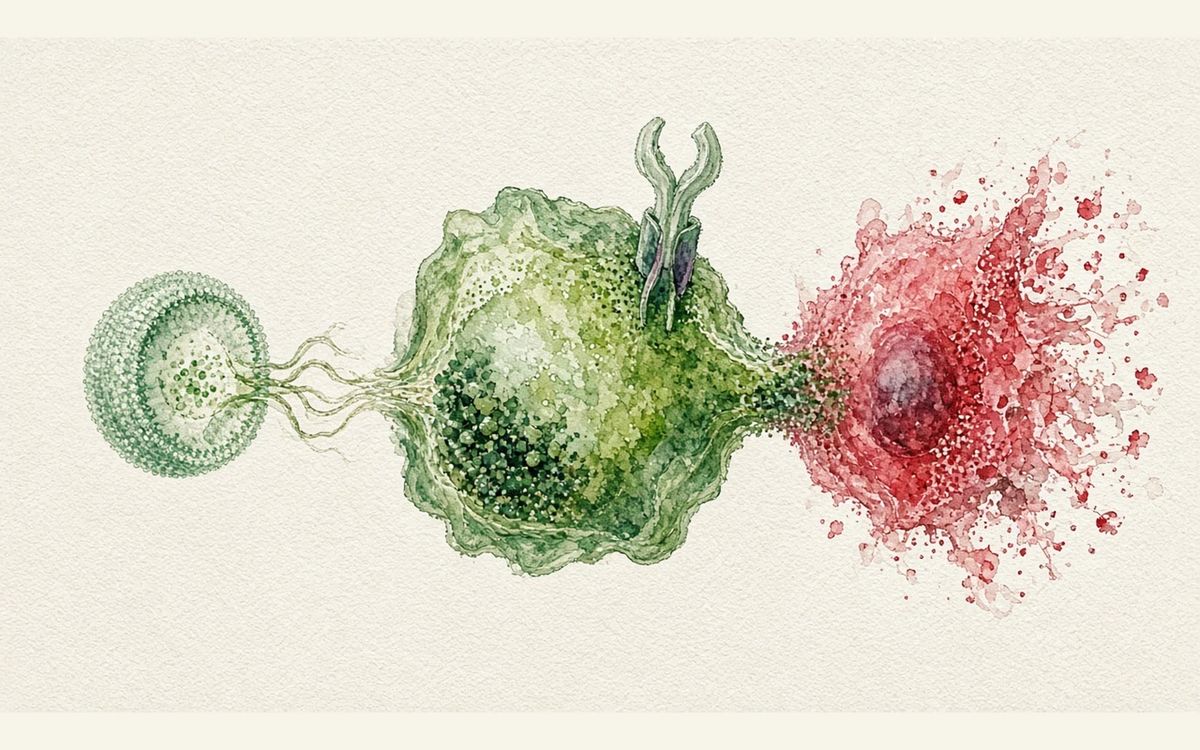
Key data card
- Study type: Extended follow-up of a phase 1, single-arm, open-label clinical study (ESO-T01, NCT06691685; peer reviewed)
- Sample size n: 6 screened, 2 did not meet eligibility criteria, 4 enrolled and treated; the ex vivo CAR-T analysis of Patient 3 is n=1
- Controls: None (single arm); antibody analyses additionally used 4 patients with ITP, 5 with MM and healthy donors as controls
- Intervention/dose: A single intravenous infusion of ESO-T01 at 0.2 × 10^9 transducing units, with no leukapheresis and no lymphodepletion
- Follow-up: Data cutoff March 2026, with up to 15 months of follow-up
- Primary endpoint: Protocol-specified primary endpoint: safety and tolerability of ESO-T01 (including dose-limiting toxicities, adverse events and laboratory tests)
- Primary endpoint result: With up to 15 months of follow-up, the abstract reports no immunogenicity or integration-related toxicity and no important ESO-T01-related adverse events beyond those first reported; all 4 patients had grade 3–4 haematological toxicity (neutropenia 75%, leukopenia 50%, thrombocytopenia 50%, lymphopenia 75%); no inferential statistics were performed
- Statistics: n=4, with no hypothesis testing, power calculation or inferential statistics, so all results are descriptive; efficacy by 2016 IMWG criteria and CRS/ICANS by ASTCT criteria
- Safety: All patients had grade 1–3 biphasic CRS and grade 3–4 haematological toxicity; Patient 4 had grade 1 ICANS; integration site analysis showed no clonal expansion
- Evidence level: Full text
- Verification record: Read the Abstract, Results (all subsections), Discussion, Methods, figure legends and Extended Data legends of the open-access Nature Medicine full text
- A single intravenous infusion of ESO-T01, with no apheresis and no lymphodepletion
- Lymphocytes plunged within hours of infusion, with chemokines rising
- All 4 patients responded, with one sCR maintained for 15 months
- Three relapsed or progressed at 5, 3 and 3 months
Background and open questions
Access to CAR-T is constrained by manufacturing, logistics, waiting times and cost. A real-world study in the United States showed that fewer than 40% of patients with relapsed/refractory multiple myeloma (R/R MM) on waiting lists for commercial BCMA CAR-T had been treated cumulatively at 12 months, with 26% mortality during the wait.
In vivo CAR technology uses viral or non-viral vectors to deliver the CAR directly to endogenous T cells inside the patient, promising to turn an individualized product into an off-the-shelf one, but clinical data remain scarce. The previously reported first-in-human study of ESO-T01 covered only 4 patients with up to 3 months of follow-up. This paper gives long-term safety and response durability in the same cohort through March 2026.
Study design
This is a phase 1, single-arm, open-label study. Six patients with R/R MM were screened between November 2024 and February 2025, 2 did not meet eligibility criteria, and 4 were ultimately enrolled. ESO-T01 is a self-inactivating lentiviral vector encoding an anti-BCMA CAR, given as a single intravenous infusion of 0.2 × 10^9 transducing units, with no leukapheresis and no lymphodepletion. The primary endpoint was safety and tolerability; efficacy, pharmacokinetics and pharmacodynamics were secondary.
Enrolled patients had a median age of 63 years and a median of 4 prior lines of therapy; all 4 had extramedullary disease with bulky plasmacytomas exceeding 5 cm in diameter, 1 was penta-refractory and 1 had previously received BCMA-GPRC5D CAR-T. Efficacy was assessed by the 2016 IMWG criteria, and CRS and ICANS were graded by ASTCT criteria. With n = 4, no power calculation or hypothesis testing was performed, all results are descriptive, and the design was not intended for between-group comparison. The trial was terminated after the sponsor EsoBiotec was acquired by AstraZeneca.
Key results
Primary endpoint: safety and tolerability
The primary endpoint was safety and tolerability. All 4 patients had vector-related reactions presenting as fever, hypoxia and hypotension, corresponding to grade 1–3 biphasic CRS; Patient 4 had grade 1 ICANS. All 4 had grade 3–4 haematological toxicity: neutropenia 75%, leukopenia 50%, thrombocytopenia 50% and lymphopenia 75%. At 1 month, 3 of the 4 had recovered to grade ≤2, and the remaining patient had grade 3 neutropenia already at baseline.
Efficacy and duration of response
Data cutoff was March 2026, with up to 15 months of follow-up. The objective response rate was 100%: 2 sCR and 2 PR. One patient (Patient 2, with only 2 paraskeletal lesions at baseline) maintained sCR for 15 months. The other 3 relapsed or progressed at 5, 3 and 3 months after infusion, all with extramedullary involvement; median PFS was 4.0 (range 3.0–15.0) months.
Outcomes after relapse
The 3 patients who relapsed or progressed received salvage therapy (2 chemotherapy, 1 BCMA-GPRC5D bispecific CAR-T) and all ultimately died, of infection, disease progression and intracranial haemorrhage respectively, with overall survival of 5.5–10.9 months after infusion. CAR-T remained detectable in the cerebrospinal fluid of Patient 4, where tumour cells made up 98.78% of nucleated cells at month 3, and she died of disease progression at 10.9 months.
Ex vivo CAR-T in Patient 3
Patient 3 progressed at month 3, with BCMA positivity of 0% in bone marrow and 50% in an extramedullary subcutaneous lesion, and then received ex vivo BCMA-GPRC5D CAR-T at 1.5 × 10^6 cells/kg after lymphodepleting chemotherapy, reaching VGPR. The in vivo CAR-T peaked on day 10 at 86 cells/μl by flow cytometry; the ex vivo CAR-T peaked on day 16 at 419 cells/μl. On day 27 she developed an IEC-HS-like syndrome, on day 32 she became unconscious from intracranial haemorrhage, and she died 3 days later.
Immunogenicity and integration sites
In exploratory analyses, anti-VSVG antibodies were detectable at baseline in Patients 1 and 2; anti-CAR antibodies were low apart from a mild rise in Patient 1, with controls being 4 patients with ITP who received the same VHH, 5 patients with MM who received a different scFv and 8 healthy donors. Among integration sites, the clonal fraction at tumour- or adverse-event-related sites did not exceed 3% in any patient and the top 10 clones together accounted for less than 10%, a polyclonal pattern.
Mechanistic interpretation
Demonstrated in the paper: Within hours of infusion, all 4 patients had a plunge in lymphocytes. Luminex assays showed that most cytokines and chemokines, including CXCL9, CXCL10 and CXCL11, rose 100- to 1,000-fold shortly after infusion in parallel with the lymphocyte decline, usually falling back by day 2. This analysis covered 4 patients with a single measurement each and is a correlative observation.
Integration site analysis detected no high-risk integration events either at the expansion peak or 3 months after infusion. CAR-T was no longer detectable in the periphery at relapse in Patients 1 and 3, while CAR-T persisted in the cerebrospinal fluid of Patient 4 without clearing the tumour; both are single-case observations.
Author hypotheses: The authors speculate that the disappearance of lymphocytes mainly reflects chemokine-driven egress of T cells from the circulation, which they consider more likely than vector-promoted adhesion or virus-induced apoptosis, though other mechanisms cannot be excluded. The three early relapses may reflect extramedullary and cerebrospinal fluid tumour burden overwhelming the CAR-T locally, with suppressive microenvironment and antigen downregulation also possibly contributing.
For the durable sCR in Patient 2, the authors suggest a possible role for host factors such as the lowest baseline tumour burden, no glucocorticoid use during expansion, a more naive and central memory phenotype and younger age, but it cannot be attributed to any single factor.
Limitations and uncertainties
- The sample is only 4 patients; the paper performed no hypothesis testing, power calculation or inferential statistics, and the 100% ORR and median PFS of 4.0 months are descriptive and cannot be extrapolated to other populations, vectors or targets.
- The 15-month maximum follow-up comes from a single patient, while the other 3 died within 5.5–10.9 months of infusion, and all deaths followed multiple salvage therapies, making attribution to ESO-T01 alone difficult.
- The association between the lymphocyte plunge and chemokines is based on 4 patients with a single measurement each and no technical replicates; the paper states that mechanistic understanding of this and of extramedullary relapse is incomplete, and several analyses are post hoc. BCMA expression at relapse is available only for Patient 3, is unknown for the other 2, and the role of antigen escape cannot be judged.
- The antibody control groups are very small (4 with ITP, 5 with MM, 6 or 8 healthy donors) with no statistical comparison; integration sites were tested only at the expansion peak and at 3 months, so later clonal evolution is unknown.
Clinical and industry implications
If confirmed in larger samples with longer follow-up, these data suggest that in vivo CAR-T can produce responses in heavily pretreated patients with extramedullary disease without apheresis or lymphodepletion, with no immunogenicity or integration-related toxicity observed during follow-up.
Durability of response is the main shortcoming, and the authors argue the platform needs optimization to improve CAR-T persistence. Only if future studies routinely test BCMA expression at relapse can the role of antigen escape be clarified. The experience of Patient 3 suggests that infusing ex vivo BCMA-GPRC5D CAR-T after in vivo CAR-T is feasible in individual patients, but she subsequently died, which is not enough to support a general conclusion.
Authors, source and verification
Evidence level: Full text; verification record: Read the Abstract, Results (all subsections), Discussion, Methods, figure legends and Extended Data legends of the open-access Nature Medicine full text
Xu J, Liu L, Xie W, Su L, Wang W, Li C, et al. Extended follow-up of in vivo BCMA CAR-T therapy in relapsed/refractory multiple myeloma. Nat Med. 2026. doi:10.1038/s41591-026-04704-z. https://doi.org/10.1038/s41591-026-04704-z
Primary field: Tumor immunology & cell therapy · Related: In vivo CAR-T, BCMA, Multiple myeloma, Lentiviral vectors, Extramedullary disease, Long-term follow-up
Summary of a published paper or preprint, written from the original text; numbers are as reported by the authors. Not medical or investment advice. Corrections: contact@
Related science
Synthetic TCR library: on average only 56% of VDJdb TCRs reproduce their annotated reactivity
Green peptide-MHC complexes binding synthetic TCRs, with one non-reproducing case marked in red
Targeting ZMYND8 increases effector-like exhausted T cells in mice and enhances immunotherapy responses
Green immune cells attacking red tumour cells
12 diet models: 4/6 obesogenic diets associated with anti-PD-1 response
Intestinal villi and microbiota at left, T cells and a red tumour at right
One email, with links to every paper. Reports and custom landscapes: contact@inlightbio.com.