Neoadjuvant anti-GDF-15 plus PD-1 blockade in bladder cancer: pCR 33% vs 8%
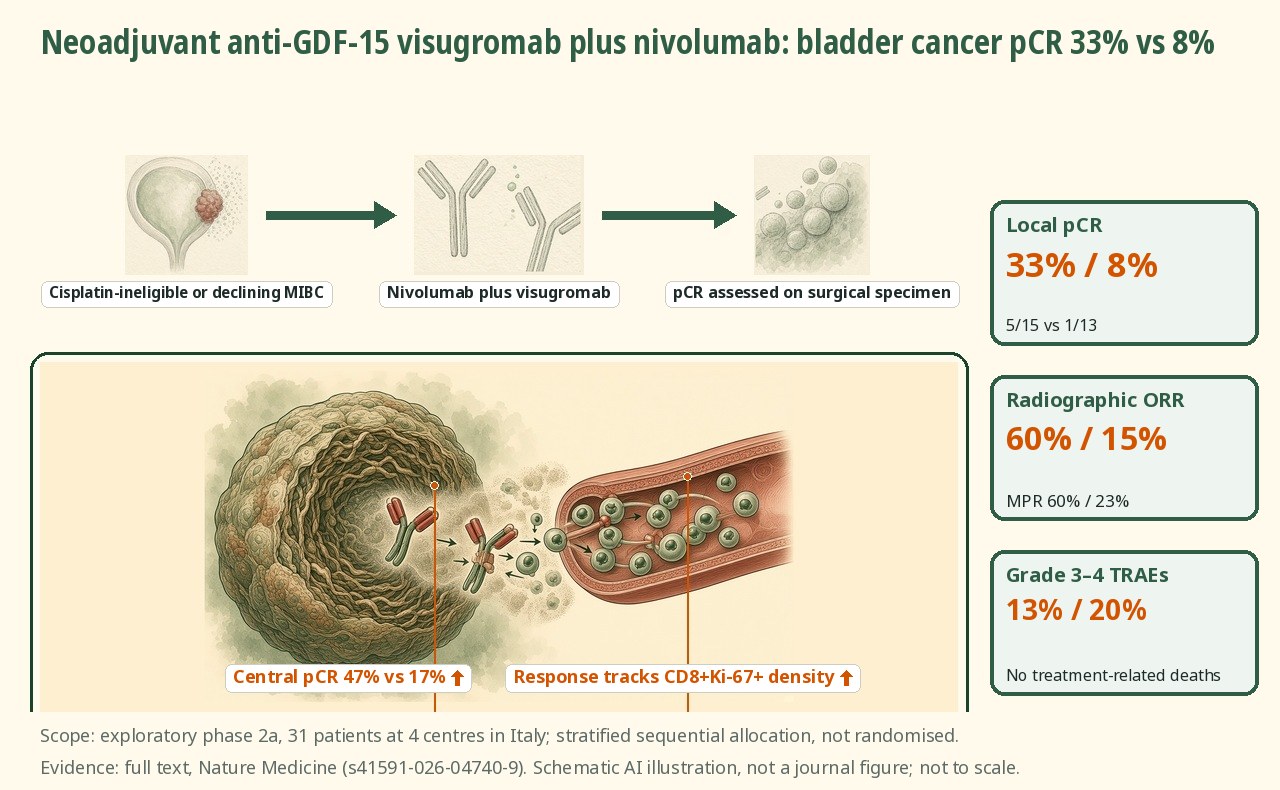
In the exploratory phase 2a GDFATHER-NEO trial, 31 patients with muscle-invasive bladder cancer (MIBC) who were ineligible for or declined cisplatin received three cycles of neoadjuvant nivolumab plus the neutralising anti-GDF-15 antibody visugromab or nivolumab plus placebo: locally assessed pCR was 33% (5/15) vs 8% (1/13), MPR 60% vs 23%, radiographic ORR 60% vs 15% and centrally reviewed pCR 47% vs 17%; grade 3–4 treatment-related adverse events occurred in 13% vs 20%. Response was associated with baseline CD8⁺ and proliferating CD8⁺Ki-67⁺ T cell density, not with PD-L1 CPS or baseline GDF-15 levels.
Background and open questions
Perioperative treatment of MIBC is at a turning point. Durvalumab plus gemcitabine–cisplatin (pCR rose from 27.5% to 37.3% in NIAGARA) and enfortumab vedotin plus pembrolizumab (EVP) have both been approved on the basis of phase 3 trials; EVP reached a pCR of 57.1% in patients ineligible for or declining cisplatin (KEYNOTE-905/EV-303) and is the new benchmark in that population. At the same time, an estimated ≥50% of patients with MIBC cannot receive neoadjuvant cisplatin chemotherapy, and neoadjuvant PD-1/PD-L1 inhibitors alone give pCR rates of only 29%–37%, or 46% for nivolumab plus ipilimumab. More than half of patients still do not achieve a pathologic response, and safe opportunities for bladder preservation are few. How to strengthen PD-1 blockade in a well-tolerated, chemotherapy-free way is the central question in the field.
GDF-15 belongs to the TGF-β superfamily and has clear physiological roles in pregnancy and tissue stress. It is overexpressed in many cancers, including bladder cancer, and has been shown to be a potent local immunosuppressant and T cell exclusion factor, as well as a determinant of resistance to PD-1/PD-L1 blockade. In the first-in-human GDFATHER-01 trial, visugromab plus nivolumab was active in advanced cancers that had progressed on PD-1/PD-L1 blockade, with an ORR of 18.5% (95% CI 6.3–38.1%) in urothelial cancer and a median duration of response of 28.8 months. The open questions were whether adding GDF-15 neutralisation substantially amplifies PD-1 blockade in untreated, checkpoint-inhibitor-naive early MIBC, roughly how large the effect is, and which patients are more likely to benefit.
Study design
Eligible patients were aged ≥18 years with newly diagnosed cT2–T4a N0 M0 MIBC, were ineligible for cisplatin by modified Galsky criteria or declined cisplatin chemotherapy, had ECOG 0–1, and were considered fit for RC after 12 weeks of neoadjuvant treatment. Prior systemic anticancer therapy, bladder radiotherapy or partial cystectomy, and refusal of RC at enrolment were exclusions. One notable detail: because metformin alters circulating GDF-15 concentrations, patients with type 2 diabetes had to stop metformin and switch drugs before treatment, a design consideration specific to GDF-15-targeted trials.
The 31 patients were assigned to 4 strata by T stage and PD-L1 CPS and, within strata, allocated centrally by the sponsor in an A–B–A–B sequence until each arm had at least 12 efficacy-evaluable patients. The authors chose sequential allocation with patient blinding rather than randomisation because the strata were too small and arm imbalance had to be avoided, and because this was the first use of dual GDF-15/PD-1 blockade in early-stage patients treated with curative intent. Investigators and the sponsor knew the allocation, patients did not, and local and central pathologists and imaging reviewers assessed outcomes blind. Visugromab (CTL-002) is a humanised, hinge-stabilised IgG4 monoclonal antibody that binds GDF-15 with high affinity. PK/PD modelling from the first-in-human trial indicated that 20 mg/kg every 3–4 weeks fully neutralises circulating GDF-15, so an every-4-week schedule synchronised with nivolumab 480 mg was chosen. Imaging restaging and RC followed 4–8 weeks after the last dose; patients who declined RC could, after multidisciplinary discussion, have re-TURBT instead (an option introduced by protocol amendment). Pathologic endpoints pool RC and re-TURBT specimens. The translational programme quantified baseline intratumoral immune cells by 6+1-colour multiplex immunofluorescence (CD4, CD8, Ki-67, FoxP3, PD-L1, GDF-15, plus pan-cytokeratin) and measured serum GDF-15, intratumoral pro-GDF-15 H-score, CXCL9/CXCL10/IFN-γ, visugromab serum concentrations and anti-drug antibodies.
Key results
Baseline characteristics and treatment completion
Stratification kept key characteristics broadly balanced: 19/31 (61%) had cT2 N0 M0 disease and 22 (71%) were men; CPS ≥10 in 8/15 (53%) controls and 9/16 (56%) combination patients; 6/15 (40%) and 5/16 (31%) were cisplatin-ineligible because of impaired renal function or hearing loss, and the rest declined cisplatin. Twenty-eight patients completed all 3 cycles (arm A 13, arm B 15); 3 (arm A 2, arm B 1) stopped neoadjuvant treatment after cycle 1 because of adverse events. For surgery, 19 (61%) had RC only (arm A 10, arm B 9) and 9 (29%) had re-TURBT (arm A 3, arm B 6), one of whom in arm B later had RC; 3 did not have protocol surgery. Five patients received adjuvant therapy, all in the control arm.
Pathologic response: local and central review agree in direction
Locally assessed pCR was 5/15 (33%) with the combination and 1/13 (8%) in controls; adding patients with residual ypTa, ypTis or ypT1 N0 disease (2 controls, 4 combination patients) gave MPR of 60% vs 23%. Central pathology review broadly agreed with local assessment and showed a wider pCR gap: 7/15 (47%) with the combination vs 2/12 (17%) in controls, with MPR 9/15 (60%) vs 4/12 (33%). Pathologic response rates were higher with the combination in every T-stage subgroup and every centrally assessed PD-L1 CPS subgroup, though each subgroup was very small. The authors summarise this as pathologic and radiographic response rates about 3–4 times those with nivolumab alone. One point calls for a sober reading: a pCR of 33% falls within the range reported for earlier chemotherapy-free neoadjuvant immunotherapy regimens and does not yet exceed new standards such as EVP.
Radiographic response does not fully track pathology
By local RECIST v1.1 assessment, the combination arm had 7 complete and 2 partial responses, an ORR of 9/15 (60%) and a complete response rate of 47% (95% CI 21–73%); controls had 2 partial responses, an ORR of 2/13 (15%). Central imaging review gave an ORR of 8/16 (50%, including 2 complete responses, 13%) vs 4/12 (33%). There is a clinically important contrast here: in the combination arm the centrally assessed radiographic complete response rate (13%) was far below the centrally assessed pCR (47%), whereas local assessment showed the opposite relationship. The authors therefore state plainly that, in this setting, radiographic response cannot substitute for pathologic response and may depend on centre experience and imaging modality, an important caution for future bladder-preservation strategies based on clinical complete response. Four evaluable patients (2 per arm) had disease progression as best overall response; in each arm, 1 of them stopped treatment early for adverse events and counted as a non-responder per the analysis plan.
Event-free survival: early and descriptive
By 15 July 2026, 6 EFS events had been recorded, 3 in each arm, and median EFS was not reached in either arm. No patient with pCR had an event, including 4 combination patients who had re-TURBT only, without cystectomy; all 6 events occurred in pathologic non-responders or patients who did not complete protocol surgery. With few events, short follow-up and adjuvant therapy in 5 control patients (none in the combination arm), these data are descriptive only and cannot show long-term benefit.
Translational findings: response tracks a pre-existing proliferating CD8⁺ T cell state
Baseline intratumoral immune cell densities and phenotypes did not differ significantly between arms, although median densities of total T cells, CD8⁺ and CD8⁺Ki-67⁺ T cells were numerically higher in the combination arm. Within the combination arm, patients with any MPR (including pCR) had higher baseline densities of total CD8⁺ T cells and proliferating CD8⁺Ki-67⁺ T cells than non-responders (P = 0.008 and P = 0.003); no such association was seen in the control arm. To rule out bias from higher baseline infiltration in the combination arm, the authors restricted the comparison to the baseline CD8⁺ density range covered by both arms (≤300 cells/mm²), where pCR was still 4/11 with the combination vs 1/12 in controls. Responses occurred across the full range of centrally assessed CPS, so PD-L1 did not separate responders; baseline serum GDF-15 and intratumoral GDF-15 H-scores were similar in the two arms, were unrelated to T cell infiltration and did not predict pathologic response. On-treatment CXCL9 and IFN-γ concentrations were mostly below the lower limit of quantification, and CXCL10 varied widely between individuals with no consistent between-arm difference, so no clear peripheral pharmacodynamic signal was captured.
Pharmacokinetics and safety
Visugromab serum concentrations were similar across patients and consistent with GDFATHER-01; mean concentrations fell over the dosing interval but stayed above 100 µg/mL throughout the 4 weeks, suggesting sustained GDF-15 neutralisation over the treatment period. All patients had adverse events of some grade; grade 3–4 treatment-emergent adverse events (TEAEs) occurred in 12/15 (80%) controls and 8/16 (50%) combination patients. Any-grade TRAEs were more common with the combination (88% vs 53%), mainly fatigue, pruritus and hypothyroidism, but grade 3–4 TRAEs were less common (13% vs 20%). These included transaminase elevations in both arms, hypothyroidism and myalgia in controls, and interstitial lung disease in the combination arm (the liver enzyme elevations in the combination arm occurred in the setting of immune-mediated liver disease). Immune-related adverse events occurred in 4/15 (27%) controls and 5/16 (31%) combination patients, grade 3–4 in 3/15 (20%) and 2/16 (13%). Surgery was delayed in 5 controls and 6 combination patients; apart from 1 control with non-treatment-related toxicity, the causes were disease progression (1 per arm) or logistics. One combination patient had pre-existing, transiently detectable anti-drug antibodies with no apparent effect on PK or clinical outcome. The authors saw no visugromab-specific safety signal.
Clinical and industry implications
For patients with MIBC who cannot or will not receive cisplatin, this study gives the first estimate of effect size for dual GDF-15 and PD-1 blockade in a checkpoint-inhibitor-naive population treated with curative intent: a chemotherapy-free regimen of 3 cycles every 4 weeks achieved a pCR of 33% (47% on central review) without additive toxicity. Objectively, now that EVP has raised pCR in this population to 57.1%, visugromab plus nivolumab on its own is not enough to challenge the new standard. Its more realistic value is as a well-tolerated immune sensitiser whose mechanism, the authors expect, is not tied to a particular PD-(L)1 backbone: added to stronger regimens such as EVP, it could raise clinical complete response rates and give more patients access to bladder-preservation or de-escalation pathways. The 4 combination patients with pCR after re-TURBT alone have not relapsed; the numbers are tiny but consistent with this direction. For industry, visugromab, an IgG4 cytokine-neutralising antibody, is in randomised phase 2b trials in non-small cell lung cancer and hepatocellular carcinoma that are recruiting. GDFATHER-NEO suggests that patient selection may depend more on a pre-existing proliferating CD8⁺ T cell state than on GDF-15 abundance itself. Larger, randomised neoadjuvant trials with long follow-up are still needed to test effects on bladder preservation, cure rates and overall survival.
Mechanistic interpretation
Demonstrated in the paper: In this small, non-randomised but stratified and patient-blinded trial, 3 neoadjuvant cycles of nivolumab plus visugromab gave higher pathologic and radiographic response rates than nivolumab plus placebo under both local and central assessment, without more grade 3–4 TRAEs, and visugromab exposure was enough to keep serum concentrations high across the 4-week interval. Responders in the combination arm had higher baseline CD8⁺ and proliferating CD8⁺Ki-67⁺ T cell densities, whereas neither PD-L1 CPS nor baseline GDF-15 levels predicted response.
Author hypotheses: The authors propose that GDF-15 suppresses the activity of CD8⁺ T cells already present in the tumour and that neutralising GDF-15 lets these cells mount a more effective antitumour response; the higher pCR with the combination within the shared CD8⁺ density range is used to argue that the combination effect is not explained by baseline differences in immune infiltration alone. In early disease with short treatment, functional immune state may be more informative than static measurements of PD-L1 or GDF-15. From an antibody-drug perspective, this partly conflicts with GDFATHER-01, where high GDF-15 accompanied low CD8⁺ infiltration and blockade induced CXCL9/CXCL10; the authors note that baseline GDF-15 levels here were clearly lower than in the advanced melanoma and non-small cell lung cancer cohorts of GDFATHER-01, so the meaning of GDF-15-related biomarkers may be highly context dependent. Because the combination arm had a high pCR rate and few post-treatment specimens with tumour were available, this study cannot say what GDF-15 blockade actually changes inside the tumour; the model remains hypothesis generating.
Limitations and uncertainties
- Each arm had only 15–16 patients, with no hypothesis testing and no sample-size calculation, so all between-arm comparisons are descriptive. Allocation was sequential within strata rather than randomised, with no allocation concealment on the sponsor side, so selection bias and period effects are possible, and unobserved confounders cannot be balanced.
- Local pCR in the control arm was only 8%, lower than generally expected. Citing a pCR of 17% and MPR of 25% in 12 patients given nivolumab alone in PrE0807, the authors argue the control arm did not clearly underperform, but this cannot be excluded with such small numbers.
- pCR pools RC and re-TURBT specimens, and N stage is uncertain in patients without lymph node dissection (1 combination patient was found to be N1 at RC after re-TURBT), which limits comparability with other neoadjuvant trials; efficacy analyses used the protocol-defined evaluable population.
- With only 6 EFS events and follow-up limited to 1 year after surgery, long-term benefit cannot be assessed; adjuvant therapy in the control arm further confounds EFS. Biomarker analyses were not corrected for multiple comparisons, and on-treatment tumour samples were insufficient.
- The trial ran at only 4 centres in Italy. It was funded by CatalYm, the developer of visugromab, which took part in data management and analysis; several authors are current or former employees or hold related patents and equity.
Authors and source
Necchi A, Mercinelli C, Maiorano BA, et al. Neoadjuvant nivolumab with or without visugromab in muscle-invasive bladder cancer: the phase 2a GDFATHER-NEO trial. Nature Medicine. Submitted 7 September 2026, accepted 6 October, published online 24 October 2026. https://doi.org/10.1038/s41591-026-04740-9 (open access, CC BY-NC-ND 4.0). ClinicalTrials.gov: NCT06059547.
Numbers are as reported by the authors. Corrections: contact@
Related science
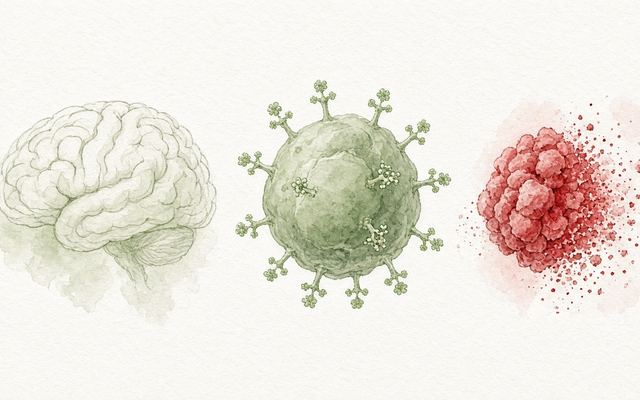
Restoring IL-15 signalling boosts innate immunity in brain metastasis
The brain starves innate lymphoid cells of IL-15; restoring it locally lets them control metastasis without T cells
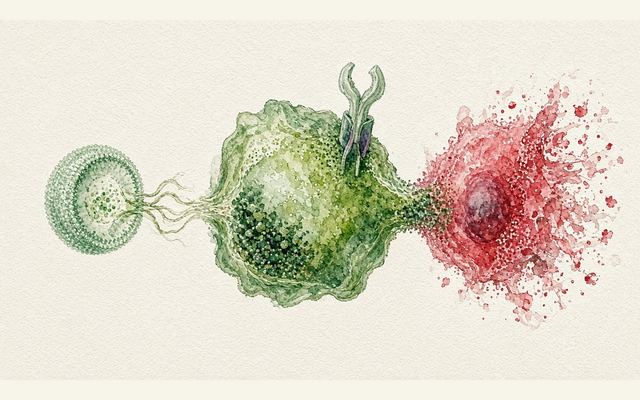
In vivo BCMA CAR-T phase 1: 15 months of follow-up, one ongoing sCR
Green CAR-T cells attacking a red myeloma cell at right
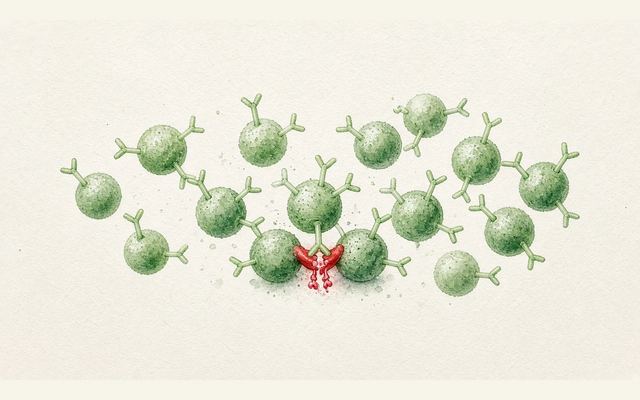
Synthetic TCR library: on average only 56% of VDJdb TCRs reproduce their annotated reactivity
Green peptide-MHC complexes binding synthetic TCRs, with one non-reproducing case marked in red
One email, with links to every paper. Reports and custom landscapes: contact@inlightbio.com.
Opens your email app with a pre-filled request; we add you by hand. Free, unsubscribe any time.