Antibody reactome profiling links herpesvirus responses to autoantigens and chronic disease
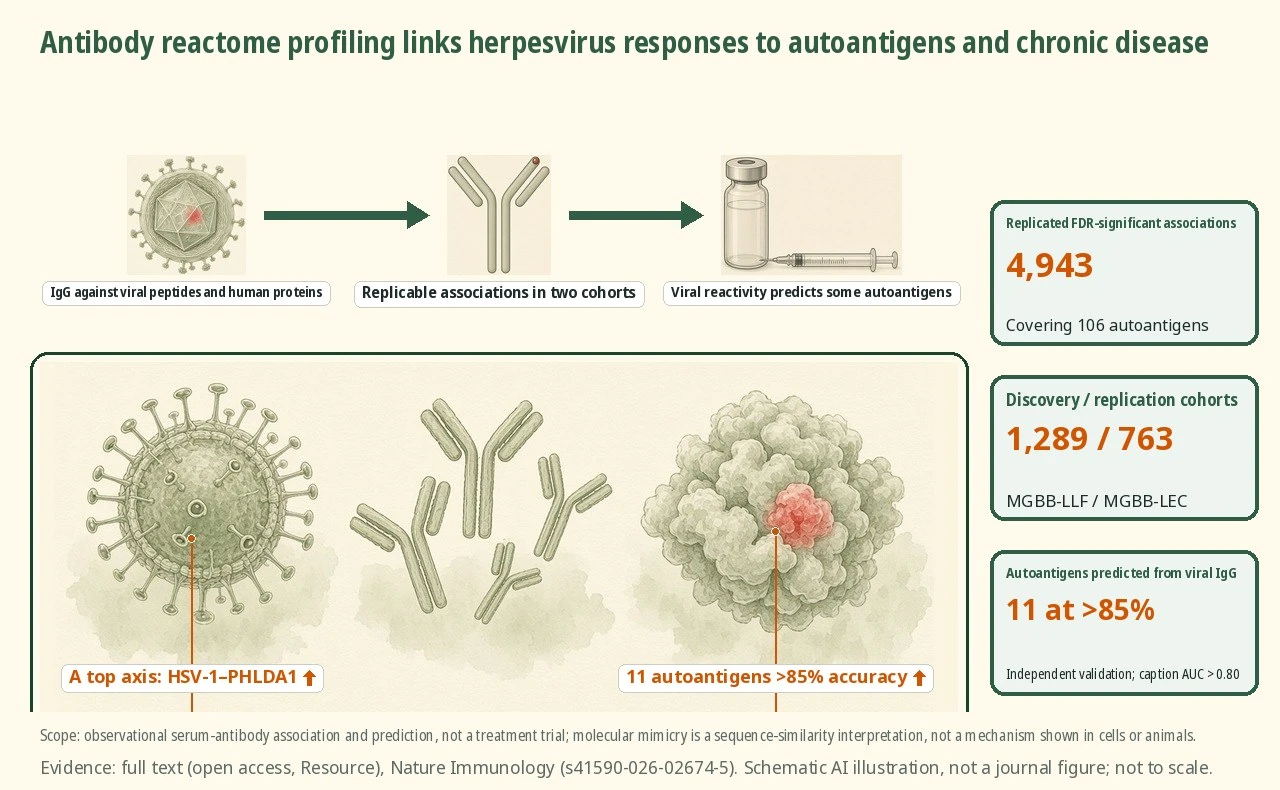
Investigators at Brigham and Women’s Hospital and collaborating institutions measured IgG to more than 4,600 herpesvirus peptides and more than 15,000 human proteins in two Mass General Brigham biobank cohorts: a discovery cohort (MGBB-LLF, n = 1,289) and a replication cohort (MGBB-LEC, n = 763). The study identified and replicated 4,943 FDR-significant associations across 106 autoantigens, including previously less-characterized virus–autoantigen axes such as PHLDA1 and ZNF550. Eleven autoantigens were predicted from viral reactivities with greater than 85% accuracy in independent validation; two of these showed viral–host sequence homology consistent with possible molecular mimicry. CMV formed the largest multimorbid network, EBV converged on pleiotropic autoimmune hubs, and HSV formed partially overlapping networks.
Background and open questions
Herpesvirus infection has long been suspected of links to autoimmunity and chronic disease, but which virus-specific antibody responses connect to which autoantigens and disease trajectories has lacked a large, reproducible map. Using methods including molecular indexing of proteins by self-assembly, the authors measured IgG against a herpesvirus peptide library and a human proteome in two independent biobank cohorts.
Study design
The discovery cohort was the Mass General Brigham biobank longitudinal lung-function cohort (MGBB-LLF, n = 1,289); the replication cohort was a longitudinal electronic-health-record cohort (MGBB-LEC, n = 763). Assays covered IgG to more than 4,600 herpesvirus peptides and more than 15,000 human proteins. Prediction models in both cohorts were adjusted for age, race, sex, BMI, alcohol use, smoking, the Charlson comorbidity index, and antiviral, immunosuppressive and anticancer drugs within 24 months of the blood draw; MGBB-LLF was also adjusted for inhaled corticosteroids. The authors then built networks of viral peptides, autoantigens and diseases, and used sequence-similarity analysis on a subset of autoantigens to discuss molecular mimicry.
Key results
Replicated virus–autoantigen associations
The strongest reactome-wide associations were between HSV-1 peptides and the adaptor protein PHLDA1: adjusted P values ranged from 2.7×10−78 to 0.05 (β = 0.5–3.0) in MGBB-LLF and from 3.8×10−37 to 0.04 (β = 0.5–4.3) in MGBB-LEC. Other highly significant, replicated associations included HSV-2–PHLDA1, CMV–ZNF550, CMV–FUT8, CMV–IQCB1, EBV–P3H4, HHV-6A/6B–PLEKHA8, VZV–ELMO2, VZV–NPRL2 and VZV–MAP3K3. Several CMV-associated autoantigens had large effect sizes in MGBB-LEC (βmax > 5), including ZNF550, HEXIM2, IQCB1 and SLC30A4. Overall, the study identified and replicated 4,943 FDR-significant associations across 106 autoantigens.
Viral reactivities predict autoantigens
Reactivities to CMV, EBV and HSV-1 predicted some autoantigens. In independent validation, 11 autoantigens were predicted with greater than 85% accuracy. A figure caption lists 11 autoantigens with AUC > 0.80 in MGBB-LEC: DNAJC12, ZNF550, HEXIM2, IQCB1, CFHR1, R3HDM2, SLC30A4, ANKRD16, PHLDA1, PSMB6 and KCNMB3. Two of these showed viral–host sequence homology consistent with possible molecular mimicry; sequence similarity is not the same as a demonstrated causal mechanism.
Disease networks
Autoantigens linked herpesviruses to incident diseases. The abstract reports that CMV formed the largest multimorbid network, EBV converged on pleiotropic autoimmune hubs, and HSV formed partially overlapping networks. Different herpesviruses may therefore connect to different chronic-disease combinations through incompletely shared autoantigen axes.
Mechanistic interpretation
What the paper shows: In two independent biobank cohorts, herpesvirus-specific IgG responses associate with a reproducible autoantigen set; some autoantigens can be predicted from viral reactivities with high discrimination in a held-out cohort; a minority show sequence homology that offers candidate mimicry; and virus–autoantigen–disease networks can be drawn, with different shapes for CMV, EBV and HSV.
What still needs testing: Association and prediction are not causation. Molecular mimicry has sequence-level support for only two autoantigens and needs functional experiments. Biobank cohorts carry treatment, comorbidity and sampling biases, and disease endpoints depend on electronic records; prospective clinical cohorts are still required.
Limitations and uncertainties
- Observational serology cannot prove that viral infection causes autoimmunity.
- Coverage is large but is still not a complete virome or autoantigen set.
- Predictive performance comes from specific cohorts and covariate models and needs re-validation in other health systems.
- Molecular mimicry here is a sequence-similarity interpretation, not a mechanism shown in cells or animals.
Clinical and industry implications
For antibody and autoimmunity drug development, the value of this Resource is a reproducible virus–autoantigen map, not a ready-to-use clinical assay. Less-discussed axes such as PHLDA1 and ZNF550, and the 11 autoantigens predictable from viral reactivities, offer new serological hypotheses. Turning them into tests or stratification tools will require prospective studies with clinical endpoints in the intended diseases, and a cautious reading of mimicry claims.
Authors and source
Nature Immunology (Resource, 2026). Published online 20 November 2026; open access. https://doi.org/10.1038/s41590-026-02674-5. A research briefing published the same day (DOI 10.1038/s41590-026-02679-0) is not summarized separately here.
Numbers are as reported by the authors. Corrections: contact@
Featured
AI Drug R&D Platforms

Related science
Oral JAK1 inhibitor povorcitinib meets primary endpoint in two phase 3 vitiligo trials
F-VASI75 was 18.9% vs 6.8% (STOP-V1) and 18.9% vs 3.1% (STOP-V2) at 52 weeks.
CD19 CAR-engineered Tregs promote durable tolerance in lupus models
A CD19 CAR plus constitutive FOXP3 turns CD4 T cells into regulatory cells that both deplete B cells and suppress autoimmunity
TEM1657 suppresses NFKBIZ and eases psoriasis-like inflammation in mice
A plant-derived small molecule tunes mitochondrial dynamics to switch off the NFKBIZ program that drives psoriatic inflammation
One email, with links to every paper. Reports and custom landscapes: contact@inlightbio.com.
Opens your email app with a pre-filled request; we add you by hand. Free, unsubscribe any time.