Oral JAK1 inhibitor povorcitinib meets primary endpoint in two phase 3 vitiligo trials
In two randomized, double-blind, placebo-controlled phase 3 trials, once-daily oral povorcitinib 30 mg met the primary endpoint of at least 75% improvement in facial Vitiligo Area Scoring Index at 52 weeks: 18.9% vs 6.8% in STOP-V1 (P = 0.0003) and 18.9% vs 3.1% in STOP-V2 (P < 0.0001).

Background and open questions
Vitiligo is an autoimmune condition characterized by loss of melanocytes and depigmented patches. The JAK–STAT pathway, particularly interferon-gamma signaling through JAK1/JAK2, plays a central role in melanocyte destruction. Topical JAK inhibitors have shown efficacy, but an oral option could offer more convenient treatment for patients with widespread disease.
Study design
STOP-V1 and STOP-V2 were two randomized, double-blind, placebo-controlled phase 3 trials enrolling adults with moderate-to-severe nonsegmental vitiligo. Patients were randomized 1:1 to receive once-daily oral povorcitinib 30 mg or placebo for 52 weeks. The primary endpoint was the proportion achieving at least 75% improvement in facial Vitiligo Area Scoring Index (F-VASI75) at week 52.
Key results
- In STOP-V1 (467 patients, 1:1 randomization), 18.9% of povorcitinib patients achieved F-VASI75 versus 6.8% with placebo (OR 3.1, P = 0.0003).
- In STOP-V2 (449 patients, 1:1 randomization), 18.9% achieved F-VASI75 versus 3.1% with placebo (OR 7.5, P < 0.0001).
- Overall treatment-emergent adverse event rates were similar between groups (68.7%/66.7% vs 63.7%/62.7%).
- The most common adverse events with povorcitinib were nasopharyngitis, acne, and upper respiratory infection.
- No MACE, tuberculosis, or deaths occurred; 4 cases of basal cell carcinoma and 1 case of pulmonary embolism/deep vein thrombosis (grade 3, judged treatment-related, leading to discontinuation) occurred in the povorcitinib group.
Mechanistic interpretation
JAK1 inhibition blocks the interferon-gamma signaling that drives T-cell-mediated melanocyte destruction. By suppressing this pathway systemically, oral povorcitinib may allow melanocytes to repigment affected areas. The facial response rates, while modest in absolute terms, represent a clinically meaningful benefit in a condition with limited treatment options.
Limitations
- Rare-event and longer-term safety cannot be settled by these results alone; JAK inhibitors carry known class-wide risks including infection and thrombosis. One treatment-related PE/DVT occurred.
- The absolute response rate (~19%) means most patients do not achieve the primary endpoint at 52 weeks.
- The trials enrolled adults; efficacy and safety in pediatric populations remain to be studied.
- T-VASI75 (total body) did not reach statistical significance in STOP-V1 (2.6% vs 1.3%).
Authors and source
Nature Medicine (2026). Published online 2 November 2026. https://doi.org/10.1038/s41591-026-04739-2.
Numbers are as reported by the authors. Corrections: contact@
Related science
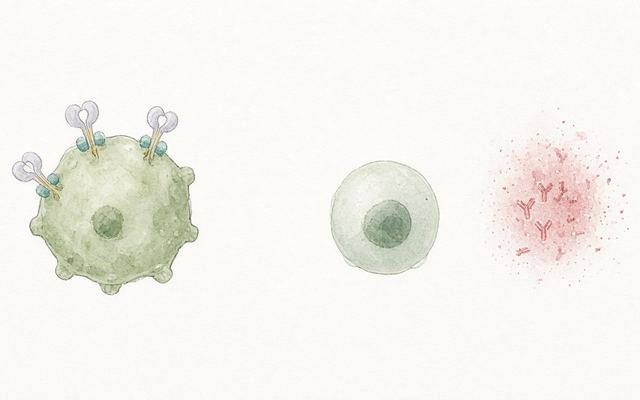
CD19 CAR-engineered Tregs promote durable tolerance in lupus models
A CD19 CAR plus constitutive FOXP3 turns CD4 T cells into regulatory cells that both deplete B cells and suppress autoimmunity
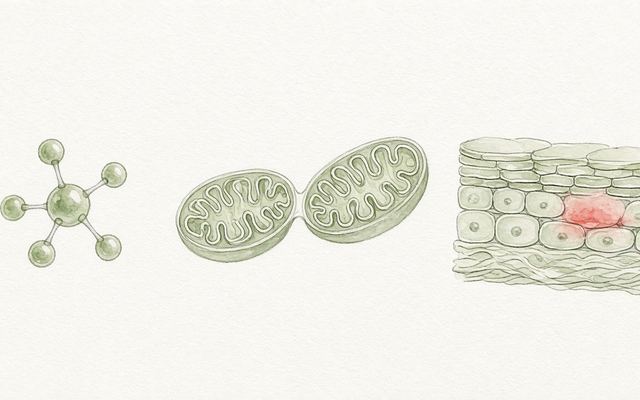
TEM1657 suppresses NFKBIZ and eases psoriasis-like inflammation in mice
A plant-derived small molecule tunes mitochondrial dynamics to switch off the NFKBIZ program that drives psoriatic inflammation
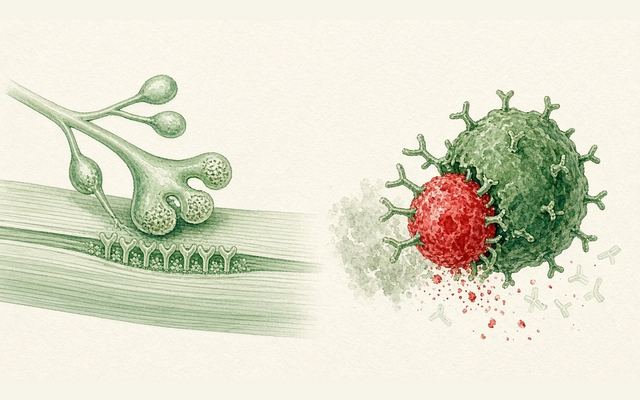
Anti-CD19 CAR-T in refractory MG: 3 patients in treatment-free remission for at least 19 months
The neuromuscular junction at left, CAR-T cells clearing red B cells at right
One email, with links to every paper. Reports and custom landscapes: contact@inlightbio.com.
Opens your email app with a pre-filled request; we add you by hand. Free, unsubscribe any time.