TEM1657, a mitochondria-modulating small molecule, suppresses NFKBIZ and eases psoriatic inflammation
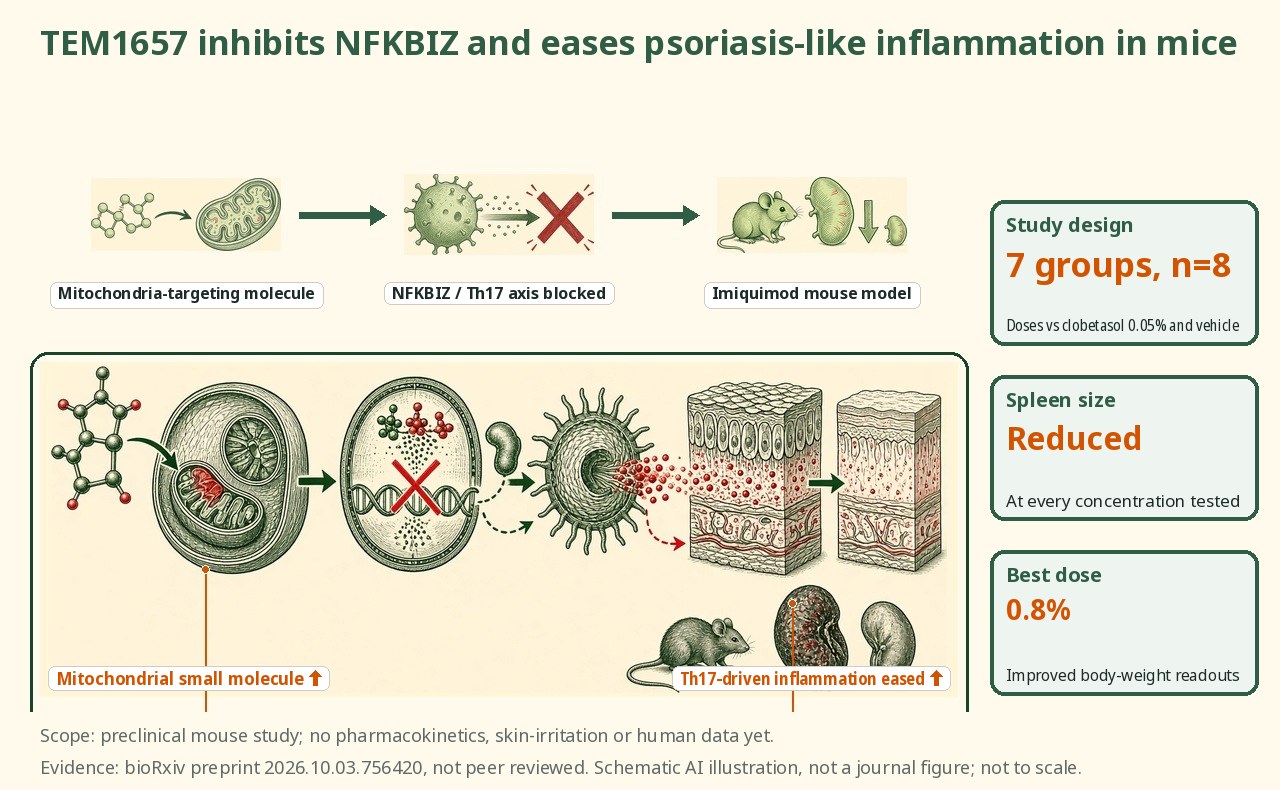
A preprint describes TEM1657, a small molecule derived from 3,5-dicaffeoylquinic acid that reduces inflammation in the imiquimod-induced psoriasis mouse model and in Th17-stimulated keratinocytes; it acts through mitochondrial dynamics via OPA1 and rapidly suppresses transcription of NFKBIZ and other psoriasis-associated genes, with mice randomised to seven groups of eight, all tested doses reducing spleen size and a 0.8% dose improving body-weight-related readouts.
Preprint. This study has not yet been peer reviewed; findings may change.
TEM1657, a small molecule derived from 3,5-dicaffeoylquinic acid, was tested in the imiquimod-induced psoriasis mouse model and in Th17-stimulated keratinocytes. Mechanistically its action is reported to be mediated through modulation of mitochondrial dynamics, specifically via OPA1, an inner mitochondrial membrane protein that alters mitochondrial calcium influx and in turn affects cellular bioenergetics; the molecule rapidly suppresses transcription of NFKBIZ and various other psoriasis-associated genes. In the animal study described in the weekly brief, mice were randomised into seven groups of eight (n=8 per group) comparing several TEM1657 concentrations with a clobetasol propionate 0.05% positive control and a vehicle control; all tested concentrations reduced spleen size, and the 0.8% dose improved body-weight-related readouts. Other quantitative endpoints are not available in the preprint abstract.
Background and open questions
Psoriasis is a chronic inflammatory skin disease characterised by red, scaly plaques, with plaque psoriasis the most common form. The disease is driven largely by dysregulated T cells, particularly the Th17 axis, which provoke keratinocytes to proliferate and secrete inflammatory mediators in a self-reinforcing loop. Modern biologics targeting IL-17 and IL-23, together with topical therapies, have substantially improved disease management, but they typically provide only temporary relief and often fail to prevent recurrence once treatment stops, leaving room for new mechanisms of action.
NFKBIZ, which encodes the protein IκBζ, is an increasingly recognised node in psoriasis: it sits downstream of IL-17 signalling in keratinocytes and helps drive the transcription of psoriasis-associated inflammatory genes. The open question the authors pursue is whether an upstream, metabolism-linked intervention, rather than direct cytokine blockade, can shut down this program. Specifically, they ask whether tuning mitochondrial dynamics can suppress NFKBIZ and the broader psoriatic transcriptional response, offering a different kind of lever on Th17-driven skin inflammation. Mitochondria are increasingly understood not only as energy sources but as hubs that shape immune and inflammatory signalling through calcium handling, reactive oxygen species and metabolic intermediates, which makes mitochondrial dynamics a biologically plausible, if unconventional, point of intervention in an inflammatory skin disease.
Study design
The authors describe TEM1657, a novel small molecule derived from 3,5-dicaffeoylquinic acid, a naturally occurring caffeoylquinic acid. They evaluated it in two complementary systems. In vitro, they used keratinocytes stimulated with a Th17 cytokine milieu to recreate the inflammatory keratinocyte phenotype central to psoriasis, then tested whether TEM1657 could blunt that response and probed the molecule's effect on mitochondrial biology and on NFKBIZ transcription. In vivo, they used the imiquimod-induced psoriasis mouse model, a widely used short-term model in which topical imiquimod provokes psoriasis-like skin inflammation.
According to the weekly brief that accompanies this study, the animal experiment randomised mice into seven groups of eight, comparing several concentrations of TEM1657 against a clobetasol propionate 0.05% positive control, a potent topical corticosteroid, and a vehicle control. Readouts included skin pathology together with systemic indices such as spleen size and body-weight-related measures. Mechanistic experiments focused on mitochondrial dynamics and on OPA1, an inner mitochondrial membrane protein involved in membrane fusion and cristae organisation, and on the transcriptional response of NFKBIZ and other psoriasis-associated genes. The full experimental detail, including exact concentrations and statistical methods, is in the preprint and is only partially captured in the available abstract.
Key results
Anti-inflammatory activity in model skin and keratinocytes
TEM1657 showed anti-inflammatory potency both in the imiquimod-induced psoriasis mouse model and in Th17-stimulated keratinocytes, the two systems the authors used to represent, respectively, whole-skin psoriatic inflammation and the keratinocyte-intrinsic inflammatory response. The convergence of an in vivo effect with an in vitro cellular effect strengthens the case that the molecule acts on a core inflammatory mechanism rather than producing a non-specific readout in one assay.
Systemic indices in the animal model
According to the weekly brief, all tested concentrations of TEM1657 reduced spleen size in the treated mice, an index that reflects systemic immune activation in the imiquimod model. The 0.8% dose additionally improved body-weight-related readouts, another systemic measure affected by the inflammatory challenge. These results indicate activity across a range of doses, with a benefit on additional systemic measures at the higher concentration tested, benchmarked against a standard topical corticosteroid and a vehicle control. Spleen size and body weight are systemic rather than skin-specific endpoints, so their movement suggests the treatment influenced the overall inflammatory state of the animals and not only the local skin lesion.
A mitochondrial mechanism through OPA1
Mechanistically, the authors report that TEM1657 acts through modulation of mitochondrial dynamics, and specifically via OPA1. OPA1 is an inner mitochondrial membrane protein, and the authors link its modulation to altered mitochondrial calcium influx and, in turn, to changes in cellular bioenergetics. This positions TEM1657 as a metabolism-linked anti-inflammatory agent: rather than blocking a cytokine or its receptor at the cell surface, it appears to act inside the cell on the mitochondrial machinery that shapes the inflammatory state of keratinocytes.
Rapid suppression of the NFKBIZ program
A key molecular readout was transcription. TEM1657 rapidly suppressed transcription of NFKBIZ and of various other psoriasis-associated genes. Because NFKBIZ/IκBζ is a central driver of IL-17-induced inflammatory gene expression in keratinocytes, its rapid downregulation ties the mitochondrial mechanism to a defined, disease-relevant transcriptional output and offers a plausible explanation for the anti-inflammatory effects observed in cells and in the mouse model. The speed of the transcriptional suppression also argues for a relatively direct link between the mitochondrial changes and the inflammatory gene program, rather than a slow, secondary consequence of reduced inflammation.
Mechanistic interpretation
Demonstrated in the paper: TEM1657, a 3,5-dicaffeoylquinic-acid-derived small molecule, reduces inflammation in the imiquimod psoriasis model and in Th17-stimulated keratinocytes. Its activity is reported to be mediated by modulation of mitochondrial dynamics via OPA1, altering mitochondrial calcium influx and bioenergetics, and it rapidly suppresses transcription of NFKBIZ and other psoriasis-associated genes. In the animal experiment summarised in the weekly brief, all tested doses reduced spleen size and the 0.8% dose improved body-weight-related readouts.
Author hypotheses: The authors propose that the mitochondria-to-NFKBIZ axis they describe represents an innovative therapeutic target in psoriasis and potentially in other NFKBIZ-related inflammatory disorders. They frame TEM1657 as a first-in-class candidate working through a mechanism distinct from current cytokine-directed biologics, with the implication that metabolism-linked control of the IκBζ program could complement or offer an alternative to existing therapies.
Limitations and uncertainties
- This is a bioRxiv preprint and has not been peer reviewed; conclusions and any numeric values may change on revision.
- The data are preclinical, from the imiquimod mouse model and cultured keratinocytes; the imiquimod model does not fully reproduce human plaque psoriasis.
- Quantitative effect sizes, the full concentration range, pharmacokinetics, skin irritation and the magnitude of benefit relative to the clobetasol control are not available in the abstract, and head-to-head efficacy against standard topicals and relapse after stopping are not established.
- There is a relevant competing interest: the corresponding author has received honoraria from Temisis Therapeutics, which is developing TEM1657, and several co-authors are affiliated with Temisis and Plant Advanced Technologies.
Clinical and industry implications
TEM1657 is interesting precisely because it is not another cytokine blocker. By targeting mitochondrial dynamics and the NFKBIZ/IκBζ program, it offers a mechanistically distinct way to quieten Th17-driven keratinocyte inflammation, which could in principle be developed as a topical agent and, if it proves durable, address the recurrence problem that limits current therapies. The use of a potent corticosteroid comparator (clobetasol 0.05%) signals an intent to benchmark against the current topical standard. For industry, the molecule is a plant-derived, first-in-class candidate from a focused European consortium (Temisis and academic partners in Nancy) under the PsoriaCure programme, and NFKBIZ as a druggable node may have relevance beyond psoriasis to other IκBζ-dependent inflammatory conditions, since IκBζ participates in inflammatory gene regulation in tissues beyond skin. The immediate contribution, though, is preclinical: a mechanism and early efficacy signals in a mouse model and in cells. Pharmacokinetics, skin safety, dose-response quantification and ultimately human trials are all still required before any clinical claim can be made.
Authors and source
Preeti Gautam (Université de Lorraine, CNRS, IMoPA, Nancy, France) is first author. Co-authors include Aleksander Salwinski, Paul Hannewald and Jean-Francois Ginglinger (Plant Advanced Technologies, Vandœuvre-lès-Nancy); Ahmed B. Abdelwahab and Gaël Jalce (Temisis Therapeutics, Vandœuvre-lès-Nancy); Laura Boulangé, Jessica Bettinger, Jordan Brouard, Alizée Etlicher, Romain Perouf, Julia Halper, Marie Millard, Natalia de Isla, Marie-Thérèse Rubio and Jean-Yves Jouzeau (Université de Lorraine, CNRS, IMoPA); and Frédéric Bourgaud (Université de Lorraine, CNRS, LRGP). The corresponding author is David Moulin (Université de Lorraine, CNRS, IMoPA; Université de Lorraine, CHRU-Nancy, Inserm, IHU INFINY). Declared funding is from Europe Eurostars (PSORIACURE), Région Grand Est and FEDER. The corresponding author discloses honoraria from Temisis Therapeutics.
Preprint (not peer reviewed): https://doi.org/10.64898/2026.10.03.756420 ; https://www.biorxiv.org/content/10.64898/2026.10.03.756420v1 . Posted 10 October 2026; a reuse licence is not stated on the available abstract page.
Numbers are as reported by the authors. Corrections: contact@
Related science
CD19 CAR-engineered Tregs promote durable tolerance in lupus models
A CD19 CAR plus constitutive FOXP3 turns CD4 T cells into regulatory cells that both deplete B cells and suppress autoimmunity
Anti-CD19 CAR-T in refractory MG: 3 patients in treatment-free remission for at least 19 months
The neuromuscular junction at left, CAR-T cells clearing red B cells at right
GPR15 guides regulatory CD8 T cells to the colon, with a 42% reduction in sporadic UC
Green regulatory T cells homing to the intestinal epithelium, with red dots marking homing receptors
One email, with links to every paper. Reports and custom landscapes: contact@inlightbio.com.
Opens your email app with a pre-filled request; we add you by hand. Free, unsubscribe any time.