Long-term follow-up of anti-CD19 CAR-T cases in refractory myasthenia gravis: all 3 patients maintained treatment-free clinical remission for at least 19 months
Three patients with AChR-positive refractory generalized myasthenia gravis received KYV-101 (1×10^8 cells) and maintained clinical remission off MG-specific immunotherapy at 24, 19 and 19 months of follow-up; anti-AChR antibodies did not fully disappear, and adverse events were transient and manageable.
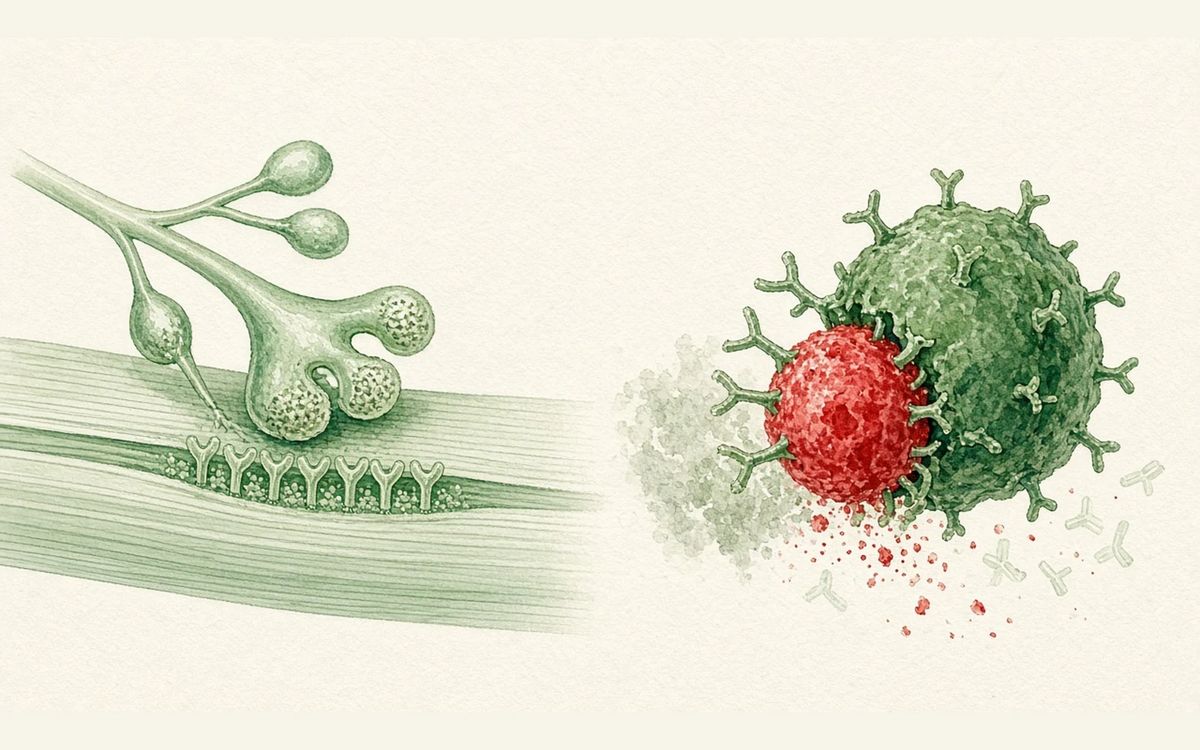
Three patients with acetylcholine receptor-positive refractory generalized myasthenia gravis (2 women, 1 man) received autologous anti-CD19 chimeric antigen receptor T cells (1×10^8 cells), with lymphodepletion using fludarabine 30 mg/m^2 plus cyclophosphamide 300 mg/m^2 for 3 consecutive days. All maintained clinical remission off disease-specific immunotherapy at 24, 19 and 19 months of follow-up. In one case the quantitative myasthenia gravis score fell from 15/39 to 2, and the activities of daily living scale fell to 0 within a week. Adverse events were transient and manageable, with no immune effector cell-associated neurotoxicity in any of the three. Anti-receptor antibodies did not fully disappear.
Key data card
- Study type: A case series of individual treatment attempts (individueller Heilversuch) under German law, not a clinical trial; descriptive long-term follow-up
- Sample size n: 3 patients with anti-AChR-positive, refractory generalized MG (2 women, 1 man)
- Controls: None (no concurrent control arm)
- Intervention/dose: The autologous fully human anti-CD19 CAR-T product KYV-101, all at 1×10^8 cells; lymphodepletion with fludarabine 30 mg/m^2 plus cyclophosphamide 300 mg/m^2 for 3 consecutive days (days −6/−5/−4 for MG1 and days −5/−4/−3 for MG2 and MG3)
- Follow-up: Table 1: 24 months for MG1 and 19 months each for MG2 and MG3
- Primary endpoint: No registered trial-prespecified endpoint. The core readouts are long-term clinical remission, whether MG-specific immunotherapy could be stopped, and long-term safety
- Primary endpoint result: All 3 achieved treatment-free clinical remission for at least 19 months; adverse events were transient and manageable; only descriptive individual data are provided, with no statistical analysis
- Statistics: n=3, with no hypothesis testing or inferential statistics; CRS/ICANS graded by ASTCT consensus; haematological toxicity additionally graded by CTCAE v.5 (per table notes)
- Safety: Table 2: grade 1 CRS in MG2 and MG3 (within 3 months) and grade IV neutropenia in MG2; no ICANS and no opportunistic infections in any of the three; MG3 had persistent grade II low IgG without immunoglobulin replacement
- Evidence level: Full text
- Verification record: Europe PMC full-text XML (PMC13589498): Abstract, Results, Discussion, STAR Methods, legends for Figures 1–2, Tables 1–2
- Autologous anti-CD19 CAR-T infused after lymphodepletion
- Deep depletion of circulating CD19-positive B cells
- Clinical remission in MG with MG-specific immunotherapy stopped
- Autoantibodies persist; the authors discuss immune reset
Background and open questions
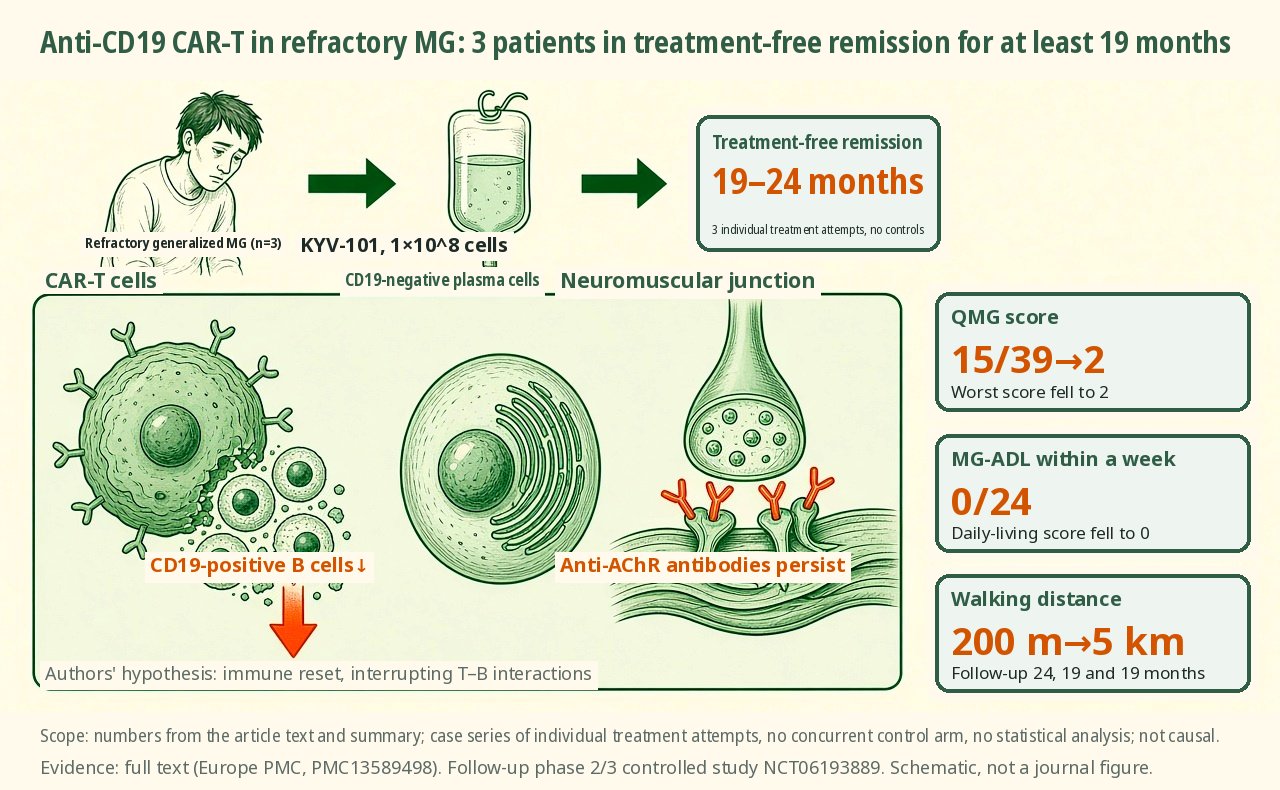
Myasthenia gravis (MG) is a chronic, fluctuating weakness caused by autoantibodies such as anti-acetylcholine receptor (AChR) antibodies damaging the neuromuscular junction. The paper notes that complement inhibition and neonatal Fc receptor (FcRn) blockade improve the quantitative MG score (QMG) by about 3–5 points in randomized controlled trials, with anti-CD19 monoclonal antibodies performing similarly, but all require continuous dosing and carry infection risk. Autologous haematopoietic stem cell transplantation has produced near-complete or treatment-free remission in some patients with MGFA IIIb–V disease, with toxicities including febrile neutropenia, viral reactivation, secondary autoimmunity and conditioning-related organ injury.
KYV-101 is an autologous CAR-T with a fully human CD19 binding domain, a CD8α hinge/transmembrane region, CD28 costimulation and a CD3ζ activation domain, already moving from oncology indications into B cell-driven autoimmunity. The question here is whether anti-CD19 CAR-T can induce durable, treatment-free remission in refractory, seropositive generalized MG rather than only short-term symptomatic improvement.
Study design
All 3 patients met consensus criteria for refractory generalized MG: persistent symptoms despite adequate corticosteroids plus at least two other immunosuppressants, or treatment-limiting adverse effects, with inadequate response to standard immunomodulatory therapy including B cell-depleting antibodies. Treatment was delivered as individual treatment attempts under German law rather than as a clinical trial. Disease severity was measured by QMG and daily function by MG-ADL, with walking distance self-reported by patients. For MG3, who also had rheumatoid arthritis (RA), DAS-28 and CDAI were added. CRS and ICANS (ASTCT criteria) were monitored daily for the first 10 days after infusion. Bone marrow toxicity was defined as grade III or IV neutropenia or leukopenia lasting more than 28 days. Given the small sample, the paper does not stratify by sex and performs no statistical analysis.
Table 1 baseline: MG1 was a 33-year-old woman with 11 years of disease, MGFA IIb, QMG 18, MG-ADL 12, walking 200 m, baseline anti-AChR 2,434 nmol/mL, thymectomy in 2022 and 5 prior ICU admissions; MG2 was a 76-year-old man with 0.75 years of disease, no thymectomy, MGFA IVb, QMG 8, MG-ADL 3, walking 5,000 m, antibodies 7,020 nmol/mL and 1 ICU admission; MG3 was a 37-year-old woman with 10 years of disease, thymectomy in 2013, MGFA IIIa, QMG 21, MG-ADL 14, walking 1,000 m, antibodies 11 nmol/mL, no ICU admission and ACPA-positive RA since 2020. All three received KYV-101 at 1×10^8 cells.
Key results
Clinical remission and treatment discontinuation
The Discussion gives treatment-free clinical remission of 24 months for MG1 and 19 months each for MG2 and MG3; the abstract states at least 19 months, with MG-specific immunotherapy stopped in all cases within the first few weeks. In MG1, QMG fell further to 2 by day 132 (the main text refers to an "initial 15/39" alongside the Table 1 baseline of 18, and both figures are kept here); MG-ADL fell to 0/24 within a week and walking distance rose from 200 m to 5 km. MG2 improved more gradually: the PEG tube was removed after 3 months and full walking ability returned by day 208. MG3 regained full walking ability by day 29; the paper also states that, lacking concurrent electrophysiological confirmation, a functional overlay cannot be entirely excluded.
Anti-AChR antibodies track clinical course only partly
In MG1, antibodies fell markedly from >2,000 nmol/mL and plateaued at 550–650 nmol/mL while clinical remission continued. In MG2 antibodies fell roughly tenfold in step with clinical improvement. In MG3 antibody levels remained stable, though at much lower absolute values than in MG1 and MG2. In none of the 3 did antibodies become undetectable during long-term remission.
The course of RA in MG3
RA in MG3 remitted rapidly after CAR-T, then at about 12 months, while MG remained asymptomatic, inflammatory arthritis of both wrists and pain in both hips appeared: tender joint count (TJC) 4, swollen joint count (SJC) 1, CDAI 10, with ultrasound confirming mild synovitis and tenosynovitis. Methotrexate was given subcutaneously at 10 mg weekly and increased to 15 mg/week at 14 months for continued progression (TJC 6, SJC 0, CDAI 11); clinical remission was reached at 17 months and maintained at 22 months (TJC/SJC 0, VAS 0, CDAI and SDAI both 0).
Safety
Table 2 summarizes adverse events: grade 1 CRS in MG2 and MG3 (both within 3 months) and none in MG1; no ICANS in any of the three. MG2 developed grade IV neutropenia within the first 3 months, requiring no further medication after a single dose of G-CSF at 32.000 IU (as written in the paper, i.e. 32,000 IU); after recovery, grade I neutropenia recurred and resolved spontaneously within 90 days. No other patient had prolonged neutropenia. MG1 had a transient grade 1 transaminase elevation that resolved spontaneously. Infections were few and mild: MG1 had SARS-CoV-2 infection during follow-up (within 12 months in Table 2) and MG3 had an uncomplicated upper respiratory infection later (within 24 months); MG2 had no infections. MG3's low IgG was grade II and persisted across the 3-, 12- and 24-month windows without replacement. Palmoplantar pustulosis was recorded in MG1 in the 24-month window. No opportunistic infections and no new secondary autoimmunity occurred during follow-up in any of the three; the RA relapse was pre-existing disease. Neither tocilizumab nor corticosteroids were used to manage CRS.
CAR-T expansion, B cell depletion and reconstitution
CAR-T cells were detectable to day 76 in MG1; peaked at day 10 in MG2 and persisted at low levels to day 453; and showed a double peak in MG3, remaining detectable to day 144. CD19-positive B cells were deeply depleted: through day 104 in MG1, day 144 in MG3, and still depleted at day 547 in MG2. The paper states that immunoglobulin levels were preserved and vaccine-specific antibody titres maintained; this coexists with the persistent low IgG for MG3 in Table 2, and both are reported here per their respective sources. Reconstituted B cells were predominantly of an exhausted phenotype in MG1 and MG3; CD19-negative plasma cells were detectable throughout the observation period in those two cases. Leukocytes fell transiently after lymphodepletion. Classical monocytes reappeared 3–4 days after infusion; CD4/CD8 T cells, NK cells and γδ T cells reappeared at 3–6 days in MG1 and 9–11 days in MG3; MG2 was slower, with CD4/CD8 and NK cells reappearing at 12–18 days and γδ T cells still low at day 547. B cells reconstituted within a time window similar to oncology patients in 2 of the 3 cases.
Mechanistic interpretation
Demonstrated in the paper: Clinical remission coincided with deep depletion of circulating CD19-positive B cells, yet anti-AChR antibodies did not become undetectable and CD19-negative plasma cells persisted in MG1 and MG3. This pattern argues directly against the explanation that rapid clinical improvement comes mainly from rapid clearance of circulating antibodies, and contrasts with the mode of action of IVIG, plasma exchange and FcRn blockade. MG1 and MG2 showed broadly parallel clinical and serological courses, while MG3 improved rapidly with stable antibody levels; these are case observations, not causal proof. The anti-AChR ELISA used by the authors was not run with serial dilutions, and they note that results can be variable relative to RIA at low concentrations.
Author hypotheses: They propose that transient B cell aplasia may induce a so-called immune reset, and that persistent antibodies may come from CD19-negative long-lived plasma cells. Clinical remission with antibodies still present could also reflect preferential depletion of pathogenic subclones or a change in the proportion of complement-fixing IgG, but the paper lacks longitudinal subclass data. Rapid improvement may stem at least partly from the cyclophosphamide plus fludarabine lymphodepletion starting on day −6, which reduces effector cells mediating antibody-dependent inflammation. The authors further hypothesize that abruptly depleting CD19-positive B cells may interrupt pathogenic T–B interactions, particularly in MG3, while stating explicitly that this is a hypothesis and that a functional overlay, placebo effect and contributions from prior eculizumab cannot be excluded. The remission of MG alongside RA relapse at about 1 year is interpreted as RA depending more on synovial T cells, myeloid cells, fibroblasts and local CD19-negative plasma cells, which are not direct targets of CD19 CAR-T.
Limitations and uncertainties
- Only 3 individual treatment attempts, with no controls, no registered trial-prespecified endpoints and no statistical analysis, so the findings cannot be extrapolated to other CAR constructs, doses or MG subtypes.
- Although pathological repetitive nerve stimulation was documented at diagnosis, no standardized serial electrophysiology was performed before and after CAR-T, making it hard to separate residual weakness from a functional overlay, particularly in MG3.
- The mechanism behind clinical remission with persistent anti-AChR antibodies, especially in MG3, remains unresolved; antibody testing was not run with serial dilutions, and the authors consider RIA the more reliable approach.
- Walking distance was self-reported; follow-up is limited; the Discussion additionally mentions one episode of pneumonia in MG3 related to B cell aplasia and low IgG, whereas the corresponding infection entry in Table 2 is an upper respiratory infection, and because the two are reported differently they are not merged into a single event here.
- The Discussion cites the EMA's identification of 38 suspected secondary T cell malignancies in oncology indications and notes that none have been reported in autoimmune indications, which still warrants long-term vigilance and is not an observed endpoint of this series.
Clinical and industry implications
If reproduced in later controlled studies, anti-CD19 CAR-T could become an option for the small group of patients with refractory, seropositive generalized MG who sit between repeated targeted therapy and high-toxicity transplantation. The hardest observation here is that treatment-free remission can be sustained for 19–24 months despite B cell reconstitution and persistent antibodies. That suggests efficacy readouts cannot rely on total antibody titre alone, and that targeting CD19 alone may not suffice to clear long-lived plasma cells. The authors note that KYV-101 is in an open-label, randomized controlled phase 2/3 MG study (NCT06193889). The RA relapse in MG3 is a reminder that different autoimmune diseases in the same patient can differ in how durably they respond to deep B cell depletion.
Authors, source and verification
Evidence level: Full text; verification record: Europe PMC full-text XML (PMC13589498): Abstract, Results, Discussion, STAR Methods, legends for Figures 1–2, Tables 1–2
Hegelmaier T, Motte J, Walther D, Feist E, Duscha A, Desel C, et al. Long-term outcomes of anti-CD19 CAR T cell therapy in refractory myasthenia gravis: A case series. Cell Rep Med. 2026;7(9):103000. doi: https://doi.org/10.1016/j.xcrm.2026.103000
Primary field: Autoimmunity & transplant · Related: Anti-CD19 CAR-T, Myasthenia gravis, KYV-101, Immune reset, B cell depletion, Long-term follow-up
Summary of a published paper or preprint, written from the original text; numbers are as reported by the authors. Not medical or investment advice. Corrections: contact@
Related science
GPR15 guides regulatory CD8 T cells to the colon, with a 42% reduction in sporadic UC
Green regulatory T cells homing to the intestinal epithelium, with red dots marking homing receptors
Two highly sensitized patients transplanted after dual-target CAR-T
Five green CAR-T cells and one red target cell, with a kidney at right
Hashimoto's thyroiditis: 135 distinct TNFRSF14 mutations in a single donor
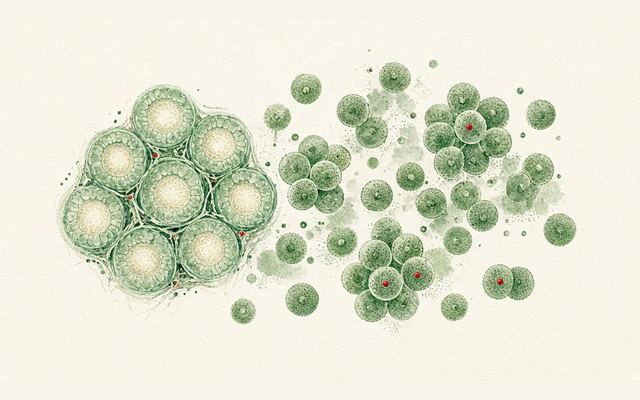
Thyroid follicles at left, B cell clones at right, with red dots marking mutations
One email, with links to every paper. Reports and custom landscapes: contact@inlightbio.com.