Relatlimab plus nivolumab at 5 years: overall survival 48% vs 38%
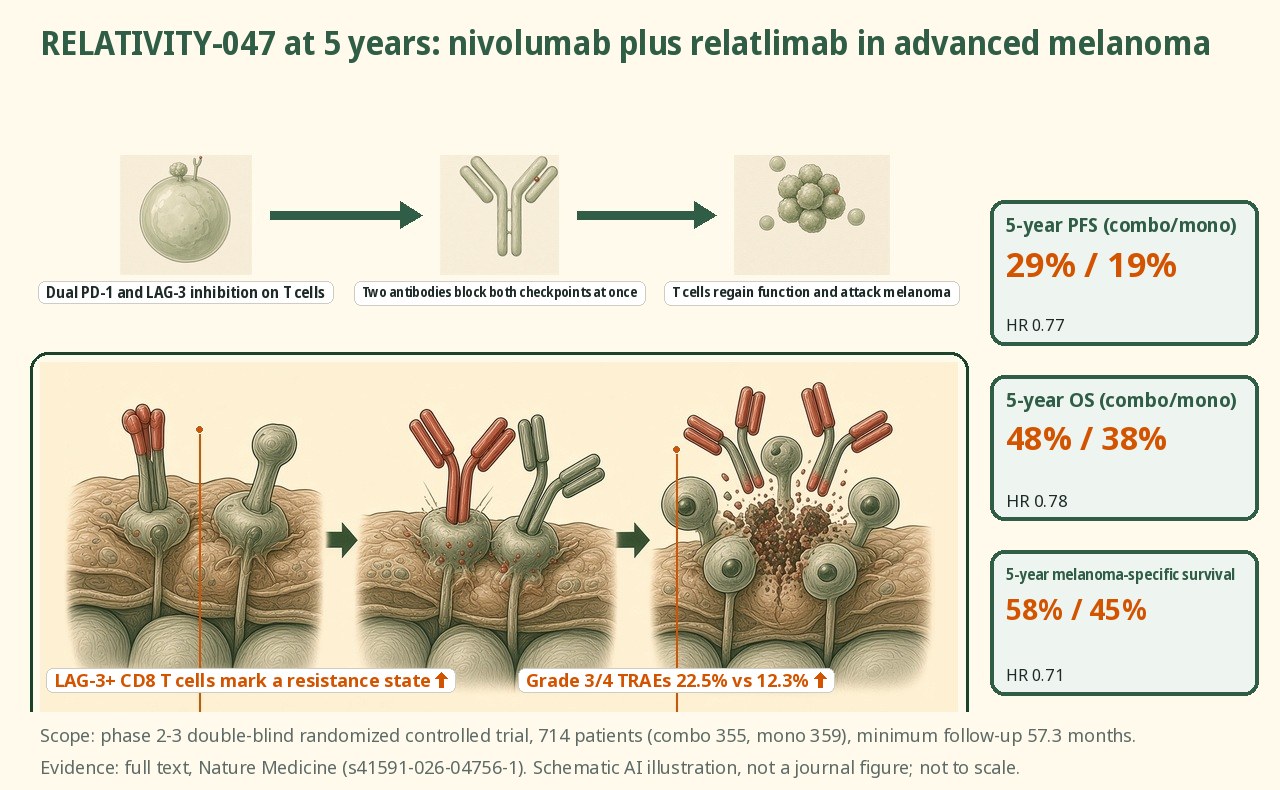
A prespecified 5-year analysis of RELATIVITY-047 (minimum follow-up 57.3 months) in previously untreated unresectable or metastatic melanoma shows sustained benefit for nivolumab plus the anti-LAG-3 antibody relatlimab over nivolumab alone: 5-year PFS 29% vs 19% (HR 0.77), 5-year OS 48% vs 38% (HR 0.78) and 5-year melanoma-specific survival 58% vs 45% (HR 0.71). Exploratory analyses suggest that LAG-3⁺ CD8 T cells mark a state of resistance to PD-1 blockade that relatlimab can partly overcome.
Background and open questions
Immune checkpoint inhibitors are standard treatment for advanced melanoma. As a reference point, nivolumab plus ipilimumab (CheckMate 067) improved OS and MSS over nivolumab alone by absolute differences of 6% and 8% at 10 years, but with grade 3/4 TRAE rates as high as 59%–63%, which is why clinicians keep looking for combinations with durable efficacy and less toxicity. LAG-3 is an inhibitory checkpoint distinct from PD-1; the two are co-expressed on tumour-infiltrating lymphocytes and jointly contribute to T cell dysfunction. Relatlimab was the first anti-LAG-3 inhibitor, and its fixed-dose combination with nivolumab is described by the authors as the first dual-checkpoint combination to show superiority over nivolumab alone; it was approved on the basis of the RELATIVITY-047 PFS result (HR 0.75, 95% CI 0.62–0.92).
Two questions remained. First, does the benefit persist with longer follow-up, and does the OS curve plateau? At 4 years the absolute improvements in PFS, OS and MSS were 10.6%, 13.8% and 13.7%. Second, and more mechanistically interesting: in patients with tumour PD-L1 ≥1%, OS benefit was clearly delayed (appearing only at 3-year follow-up and still present at 4 years), whereas patients with PD-L1 <1% benefited early. Why does the same regimen follow such different timelines in the two subgroups? This paper uses 5-year data and peripheral blood, tumour tissue and transcriptomic biomarkers to address the question.
Study design
Eligible patients had previously untreated, histologically confirmed unresectable stage III or stage IV melanoma, ECOG performance status 0 or 1, and tumour tissue evaluable for LAG-3 and PD-L1; active brain metastases, uveal melanoma and active autoimmune disease were exclusions. Patients were randomised 1:1 to the fixed-dose combination of nivolumab 480 mg + relatlimab 160 mg or to nivolumab 480 mg, both every 4 weeks, until progression, unacceptable toxicity or withdrawal of consent. Randomisation was stratified by LAG-3, PD-L1, BRAF V600 status and metastasis stage. Tumours were assessed by blinded independent central review (BICR) per RECIST v1.1 at week 12, every 8 weeks through week 52 and every 12 weeks thereafter.
The biomarker work had several layers. Baseline tumours were assessed by IHC for LAG-3 (immune cells as a percentage of all nucleated cells) and tumour-cell PD-L1 (28-8 pharmDx), and LAG-3⁺ CD8 T cells were quantified by LAG-3/CD8/PD-L1 triple IHC with HALO image analysis (split into tertiles). Peripheral blood at baseline (C1D1) and after 4 weeks of treatment (C2D1) was analysed with a 25-colour flow cytometry panel for PD-1⁺ and LAG-3⁺ CD8 subsets (dichotomised at the median within each PD-L1 subgroup). Baseline tumour RNA sequencing was used to compute 60 immune, tumour-microenvironment and non-immune oncogenic pathway signatures; unsupervised clustering separated "hot" from "cold" tumours, and patients were classified as primary resistance, acquired resistance or durable response per the SITC 2020 consensus. The authors also ran post hoc multistate models in the PD-L1 subgroups, splitting follow-up into progression-free, post-progression and death states, to explain the decoupling of OS from PFS.
Key results
Five-year survival: all three curves keep separating
Median PFS was 10.2 vs 4.6 months (HR 0.77, 95% CI 0.65–0.92), with 5-year PFS of 29% vs 19%. Median OS was 54.8 vs 33.2 months (HR 0.78, 95% CI 0.64–0.95), with 5-year OS of 48% vs 38%. In a post hoc analysis, median MSS was not reached vs 46.9 months (HR 0.71, 95% CI 0.57–0.88), with 5-year MSS of 58% vs 45%. Confirmed ORR was 43.9% vs 33.7%, a difference of 10.1%; median duration of response was not reached with the combination and 56.0 months with monotherapy. The authors stress that the absolute between-arm differences in OS and MSS at 5 years were the largest at any time point so far, each widening to at least 10%. Clinically, the shape of the curves deserves more attention: as in CheckMate 067, a long plateau begins at about 3 years. Patients alive and progression-free at 3 years (83 on the combination, 72 on monotherapy) had 5-year OS of 94% and 93% and MSS of 99% and 97%. Once patients reach this plateau, few further events occur; the difference between arms lies mainly in how many patients get there.
Subgroups and depth of response
PFS, OS, MSS and ORR favoured the combination in most clinically relevant subgroups. Improvements in PFS and MSS were significant in BRAF-mutant patients, and PFS improved significantly whether tumour LAG-3 was <1% or ≥1%. By histology, responses were deepest in cutaneous non-acral melanoma, where target lesions shrank by ≥80% in 42.1% of combination patients and 35.6% of monotherapy patients; acral and mucosal subgroups were small, and the authors consider between-arm comparisons there hard to interpret. In both arms, deeper responses went with better long-term survival.
PD-L1 ≥1%: OS benefit is delayed and comes after progression
In patients with PD-L1 ≥1%, the PFS curves separated only minimally at about 6 months, but the OS and MSS curves began to diverge in favour of the combination about 3 years after randomisation, reaching absolute differences of 11% and 12% at 5 years. Median OS was 80.3 vs 42.0 months (HR 0.81, 95% CI 0.59–1.11) and median MSS not reached vs 69.3 months (HR 0.75, 95% CI 0.52–1.08); both confidence intervals cross 1. The multistate analysis unpacks this decoupling. The HR for the transition from progression-free to progression was 0.60 (95% CI 0.47–0.75) in the PD-L1 <1% subgroup but 0.95 (95% CI 0.70–1.30) in the PD-L1 ≥1% subgroup, meaning similar risk of progression in both arms. In PD-L1 ≥1% patients, however, the HR for progression to death was 0.71 (95% CI 0.49–1.04), and the restricted mean time in the post-progression state over 7 years was 1.54 vs 1.19 years. In other words, the OS advantage in this subgroup does not come from delaying first progression but from living longer after it. Among patients who received second-line nivolumab plus ipilimumab or BRAF/MEK inhibitors, those coming from the combination arm also had longer second-line PFS and OS (small numbers), which the authors take to mean that adding relatlimab in the first line does not impair later-line therapy.
CNS progression and safety
Among patients without baseline CNS lesions, new CNS lesions appeared during follow-up in 16 (4.6%) combination and 26 (7.5%) monotherapy patients, at a median of 10.9 vs 7.6 months. Among patients with disease progression (190 vs 229), CNS progression occurred in 8% vs 10%, with an HR for CNS-metastasis-free survival of 0.65 (95% CI 0.34–1.24), a numerical trend. Safety was consistent with earlier reports: grade 3/4 TRAEs 22.5% vs 12.3%, with discontinuation for them in 10.1% vs 4.2%, and no new treatment-related deaths since the first OS analysis. In descriptive analyses, patients who discontinued for TRAEs or had grade 3/4 TRAEs actually had higher long-term survival than the intention-to-treat population, but the authors caution that such analyses are subject to immortal-time bias and are descriptive only.
Biomarkers: LAG-3⁺ CD8 T cells mark resistance to PD-1 blockade
Among 231 patients with PD-L1 ≥1% and peripheral CD8 data, the combination was favoured at every time point in those with peripheral PD-1⁺ CD8 T cells below the median; in those above the median, the curves crossed early and favoured the combination only after about 30 months. In patients with peripheral LAG-3⁺ CD8 T cells above the median, OS curves separated early in favour of the combination; below the median, they separated only after about 48 months. Within the monotherapy arm, high peripheral LAG-3⁺ CD8 was associated with worse OS, but there was no such association in the combination arm. Tumour tissue (161 patients) showed a continuum in the same direction: with low tumour LAG-3⁺ CD8 (23 patients, 12 and 11 per arm) the curves crossed without clear separation, with intermediate levels (47) they separated after about 30 months, and with high levels (91) they separated early and stayed apart. In the baseline peripheral immune cell analysis (556 patients), high LAG-3⁺ NK, CD4 and CD8 cells in the PD-L1 ≥1% monotherapy group were associated with worse OS (trend), PFS and ORR; these associations were absent in the combination arm and in the PD-L1 <1% subgroup. On-treatment analysis (457 patients) showed that peripheral LAG-3⁺ CD8 memory T cells rose after 4 weeks of combination treatment but not with monotherapy; in the PD-L1 ≥1% combination group, these cells were enriched in patients who survived more than 30 months. Transcriptomic clustering (366 patients) showed durable responses enriched in "hot" tumours and mainly primary resistance in "cold" tumours, with exceptions in both. In the PD-L1⁺ subgroup, initial response (durable response plus acquired resistance) occurred in 63% of combination and 50% of monotherapy patients, and primary resistance fell from 50% to 38%; in the PD-L1⁻ subgroup, primary resistance fell from 67% to 53%.
Clinical and industry implications
Clinically, these 5-year data move nivolumab plus relatlimab from "approved on PFS" to "clear long-term OS and MSS benefit with a plateau in the curves": 5-year OS 48% vs 38%, with grade 3/4 TRAEs of 22.5%. That gives patients who are unsuited to, or unwilling to accept, the high toxicity of nivolumab plus ipilimumab a first-line dual-checkpoint option backed by long-term data (although there is no head-to-head randomised comparison between the two combinations). The lesson from the PD-L1 ≥1% subgroup matters too: looking only at PFS, one would almost conclude there was no benefit in this subgroup, yet an OS advantage gradually emerged after progression. This is a reminder that, when evaluating combinations with new checkpoints such as LAG-3, PFS may not fully capture long-term survival benefit. For industry, peripheral blood LAG-3⁺ CD8 T cells, as a non-invasive, quantifiable candidate stratification marker, deserve prospective validation. If their predictive value is confirmed, they could help identify patients most likely to benefit early from adding LAG-3 blockade and inform trial design for other LAG-3 drugs and next-generation checkpoint combinations.
Mechanistic interpretation
Demonstrated in the paper: At 5 years, in the intention-to-treat population, dual PD-1 and LAG-3 blockade gave sustained benefit over PD-1 blockade alone in PFS, OS and MSS, and the between-arm gap widened rather than narrowed over time; toxicity was higher than with monotherapy but manageable, with no new safety signals. In the PD-L1 ≥1% subgroup, post hoc multistate analysis showed that the OS advantage arose mainly after progression rather than as fewer first progressions.
Author hypotheses: The authors propose a "resistance state" model: enrichment of LAG-3⁺ immune cells marks a clinically relevant state of resistance to PD-1 blockade. On monotherapy, high LAG-3⁺ CD8 is associated with poor outcomes; with relatlimab added, the association disappears, primary resistance falls and the curves separate early. They interpret the earlier combination benefit with low peripheral PD-1⁺ CD8 as meaning that the less PD-1/PD-L1-driven biology dominates, the easier the contribution of LAG-3 blockade is to detect, and they read the delayed separation in patients with low LAG-3⁺ as resistance to nivolumab being acquired over time. The rise of LAG-3⁺ CD8 memory T cells on treatment and their enrichment in long-term survivors is used to suggest that memory T cells contribute to durable benefit. These are exploratory, hypothesis-generating associations, not proof of causation; the authors themselves note that bulk-tissue gene expression methods lack granularity, with primary resistance in some "hot" tumours and durable responses in some "cold" ones.
Limitations and uncertainties
- The 5-year update is descriptive. MSS, the multistate models, second-line efficacy and the analysis of patients progression-free at 3 years are all post hoc, and the OS and MSS HR confidence intervals in the PD-L1 ≥1% subgroup cross 1.
- The biomarker analyses are exploratory, were not designed for formal statistical comparison and were not corrected for multiple comparisons. Sample sizes vary across analyses and some subgroups are very small (for example, only 12 and 11 patients per arm in the low tumour LAG-3⁺ CD8/PD-L1⁺ subgroup), so they may not represent the overall population.
- Post-progression data collection was limited, so different explanations for the post-progression survival benefit (such as differences in later-line therapy) cannot be distinguished. Transcriptomic samples were all from baseline and can reflect only a pre-existing state "prone to relapse", not escape mechanisms at progression.
- Toxicity comparisons with CheckMate 067 are cross-trial, and management of immune-related toxicity has improved over time, so they need cautious interpretation.
- This is an Accelerated Article Preview that has not completed copyediting. The study was funded by Bristol Myers Squibb; sponsor employees took part in design, analysis, writing and the decision to submit, and several authors are sponsor employees or have consulting relationships with it.
Authors and source
Long GV, Dolfi S, Hodi FS, et al. Nature Medicine (Accelerated Article Preview). Submitted 11 September 2026, accepted 12 October, published online 24 October 2026. https://doi.org/10.1038/s41591-026-04756-1 (open access, CC BY-NC-ND 4.0). ClinicalTrials.gov: NCT03470922.
Numbers are as reported by the authors. Corrections: contact@
Related science

Restoring IL-15 signalling boosts innate immunity in brain metastasis
The brain starves innate lymphoid cells of IL-15; restoring it locally lets them control metastasis without T cells

In vivo BCMA CAR-T phase 1: 15 months of follow-up, one ongoing sCR
Green CAR-T cells attacking a red myeloma cell at right
Synthetic TCR library: on average only 56% of VDJdb TCRs reproduce their annotated reactivity
Green peptide-MHC complexes binding synthetic TCRs, with one non-reproducing case marked in red
One email, with links to every paper. Reports and custom landscapes: contact@inlightbio.com.
Opens your email app with a pre-filled request; we add you by hand. Free, unsubscribe any time.