Computational-pathology TROP2 membrane ratio predicts Dato-DXd benefit in NSCLC: PFS HR 0.40
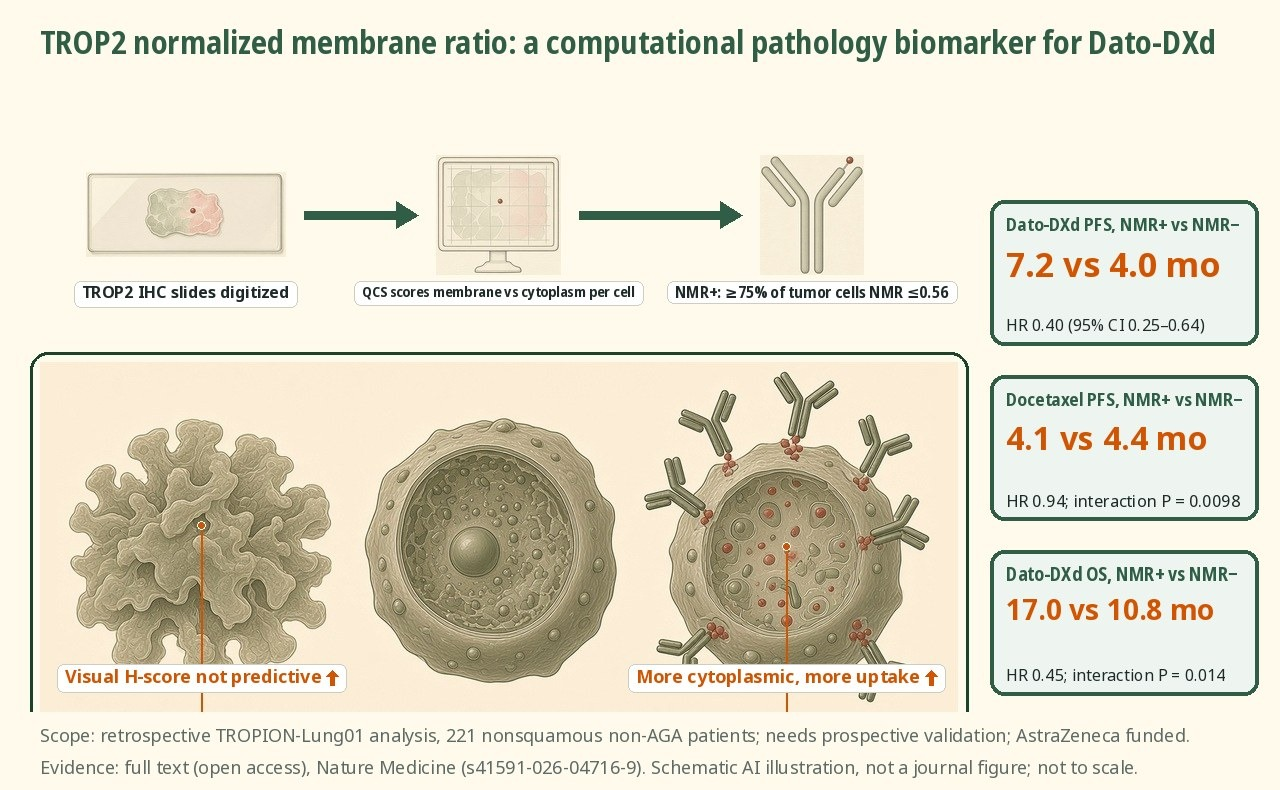
Using a fully supervised computational-pathology method (QCS) to quantify membrane and cytoplasmic TROP2 cell by cell on immunohistochemistry slides, the authors defined a normalized membrane ratio (NMR). In the TROPION-Lung01 biomarker population with nonsquamous NSCLC without actionable genomic alterations (n = 221), NMR-positive patients treated with datopotamab deruxtecan (Dato-DXd) had median progression-free survival of 7.2 vs 4.0 months (HR 0.40, 95% CI 0.25–0.64), with no difference on docetaxel (4.1 vs 4.4 months, HR 0.94); treatment-by-biomarker interaction P = 0.0098. Median overall survival was 17.0 vs 10.8 months (HR 0.45, interaction P = 0.014). Conventional visual H-scores had no predictive value. The analysis is retrospective and exploratory and needs prospective validation.
Background and open questions
Datopotamab deruxtecan (Dato-DXd) is a TROP2-directed antibody–drug conjugate. In the phase 3 TROPION-Lung01 trial it significantly prolonged PFS versus docetaxel in previously treated advanced NSCLC, but the overall-survival improvement was not statistically significant; patients with nonsquamous histology and those with actionable genomic alterations appeared to benefit most. About 90% of NSCLC samples express TROP2, yet pathologist-scored TROP2 immunohistochemistry (such as the H-score) has not predicted benefit.
This study asked whether computational pathology can extract a quantitative feature from routine TROP2 immunohistochemistry slides that predicts Dato-DXd efficacy.
Study design
The work had three steps. First, in 115 NSCLC samples from TROPION-PanTumor01 (phase 1, Dato-DXd monotherapy), seven classes of interpretable QCS features were tested for association with PFS; NMR showed the strongest association. Second, cell lines and mouse xenografts were used to test how NMR relates to datopotamab internalization and Dato-DXd cytotoxicity. Third, in TROPION-Lung01 samples (phase 3, Dato-DXd vs docetaxel), a locked TROP2 immunohistochemistry assay (Roche Tissue Diagnostics) was used to retrospectively optimize and validate the cut-point, with the docetaxel arm used to determine whether the marker is predictive or prognostic.
Key results
Discovery
In TROPION-PanTumor01, 73% (84/115) of samples were NMR-positive; NMR-positive vs negative median PFS was 5.5 vs 2.9 months (HR 0.39, 95% CI 0.22–0.68) and ORR 22.6% vs 3.2%. Membrane or cytoplasmic TROP2 levels alone showed no association, and the visual H-score was unrelated to objective response, PFS or tumor shrinkage.
Preclinical validation
TROP2 knockout abolished Dato-DXd activity, but TROP2 overexpression added little extra tumor shrinkage. Across NSCLC cell lines, lower NMR (relatively more cytoplasmic TROP2) correlated significantly with greater datopotamab internalization, and Dato-DXd-sensitive lines had significantly lower median NMR; membrane or cytoplasmic expression alone showed no significant association.
TROPION-Lung01 validation
In the nonsquamous population without actionable genomic alterations (221 patients), NMR-positive patients on Dato-DXd had better PFS, OS and ORR than NMR-negative patients, with no difference on docetaxel, indicating that NMR is predictive rather than prognostic. Results were similar across all 352 evaluable patients: Dato-DXd NMR-positive vs negative median PFS 6.9 vs 2.9 months and ORR 32.7% vs 16.9%. Repeat testing on adjacent sections showed that NMR calls were reproducible. In samples from two first-line immunotherapy phase 3 trials (NEPTUNE and POSEIDON), NMR positivity rates were similar but unrelated to PFS in any arm, further supporting that it is not prognostic.
Clinical and industry implications
This is the first computational-pathology biomarker with the potential to predict benefit from a TROP2 ADC, and a concrete example of AI pathology moving from reading assistance to companion diagnostics. AstraZeneca and Roche Diagnostics are co-developing the VENTANA TROP2 (EPR20043) RxDx companion diagnostic incorporating QCS, which received FDA Breakthrough Device designation in April 2025. Prospective testing is under way: TROPION-Lung17 enrolls previously treated, NMR-positive patients with nonsquamous NSCLC without actionable alterations, and first-line phase 3 trials including AVANZAR, TROPION-Lung07 and TROPION-Lung10 will add validation data. For other TROP2 ADC developers, subcellular distribution, not just expression level, may become a new dimension for patient selection.
Mechanistic interpretation
What the paper shows: in retrospective analyses NMR separated patients with different benefit from Dato-DXd but not from docetaxel, and in cell lines NMR correlated with ADC internalization. The authors' explanation is that Dato-DXd uses a plasma-stable cleavable linker and must be internalized into lysosomes to release its topoisomerase I inhibitor payload; cytoplasmic TROP2 enrichment may reflect more active receptor trafficking and internalization.
What still needs testing: NMR does not measure internalization directly. Whether it applies to other TROP2 ADCs (especially those with less stable linkers or different bystander effects), to other tumor types, and to squamous or alteration-positive NSCLC is unknown.
Limitations and uncertainties
- The TROPION-Lung01 analysis is retrospective and exploratory, and the cut-point was optimized in the same dataset; despite cross-validation, prospective confirmation is needed.
- The biomarker-evaluable population is a subset of the original trial, and the overall-survival improvement in the full TROPION-Lung01 population was itself not statistically significant.
- Conclusions apply mainly to nonsquamous NSCLC without actionable genomic alterations; mechanistic data for squamous and alteration-positive subtypes are limited.
- The NMR threshold requires precise computational assessment, strongly positive samples are hard to call by eye, and clinical use depends on a validated computational-pathology platform.
- The study was funded by AstraZeneca; the original trials were sponsored by Daiichi Sankyo and co-funded with AstraZeneca, and several authors are employees of the two companies.
Authors and source
Nature Medicine (2026). Published online 11 November 2026. Open access, CC BY 4.0. https://doi.org/10.1038/s41591-026-04716-9.
Numbers are as reported by the authors. Corrections: contact@
Related science
Perioperative ivonescimab in resectable NSCLC: combination MPR 70.1% (operated) / 59.5% (FAS)
Neoadjuvant ivonescimab alone or with chemotherapy met the primary MPR endpoint in phase 2.
PHERGain 5-year data: PET-guided chemotherapy de-escalation in HER2-positive early breast cancer
PHERGain: PET-guided de-escalation with trastuzumab and pertuzumab.
First-in-class METTL1 inhibitor STM9005 cuts tRNA m7G and slows AML and solid-tumor models
STM9005 blocks METTL1–WDR4, lowering tRNA m7G and translation of oncogenic mRNAs.
One email, with links to every paper. Reports and custom landscapes: contact@inlightbio.com.
Opens your email app with a pre-filled request; we add you by hand. Free, unsubscribe any time.