A biobank of 256 tumour organoids is established, with 162 completing genome-wide CRISPR screens to map gene dependencies
A UK multicentre team established 256 tumour organoids from 907 samples (28% efficiency), and 162 completed genome-wide CRISPR–Cas9 screens that passed quality control (85% success rate).
A UK multicentre effort established 256 tumour organoids from 907 samples (878 donors) at 28% efficiency, covering colorectal, oesophageal, pancreatic, gastric and ovarian cancers. Across 171 organoid–tumour WGS pairs, mutational burden showed a PCC of 0.786 and genome-wide SCNA a median PCC of 0.78. Genome-wide CRISPR–Cas9 screens passed quality control in 162 models (85% success rate), with an AUROC of 0.97. Linear regression identified 1,841 significant gene–biomarker associations. WRN dependency was associated with RNF43 mutation (effect size −0.747, adjusted P=0.01). The data are publicly available through Cell Model Passports.
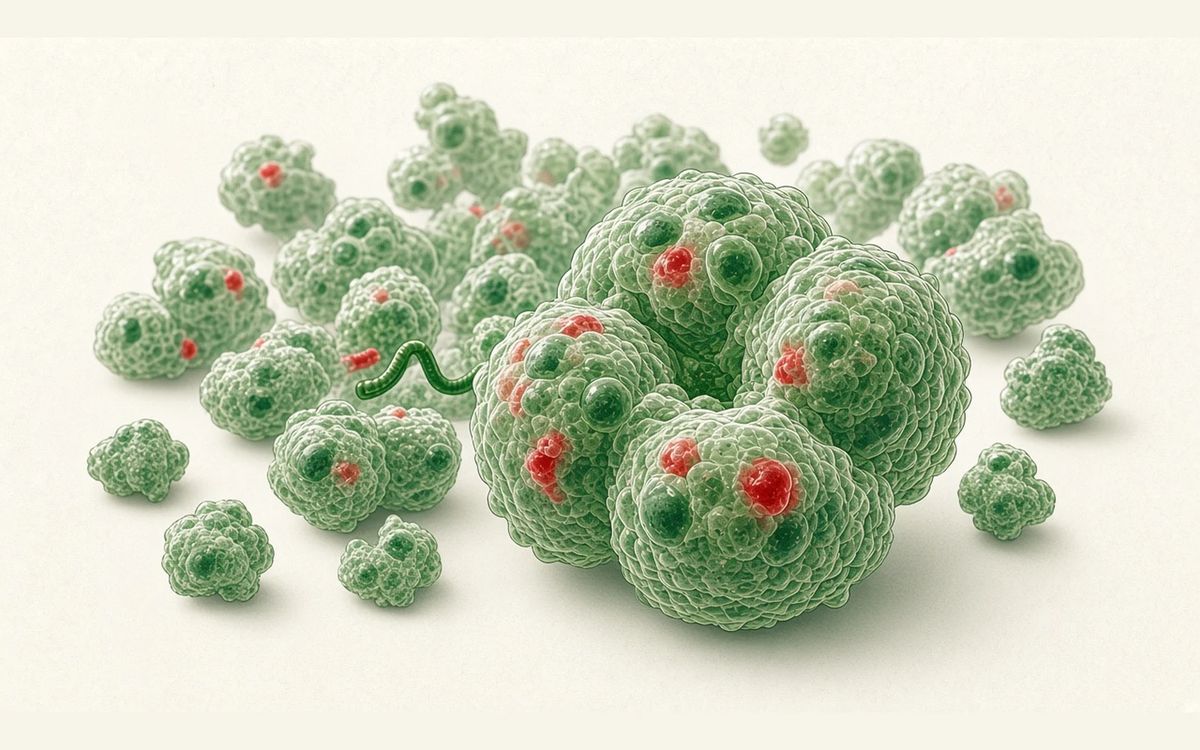
Key data card
- Study type: Resource study: a patient-derived tumour organoid biobank with whole-genome sequencing, genome-wide CRISPR–Cas9 screening and drug-sensitivity validation (not a clinical trial)
- Sample size n: 907 samples (878 donors) → 256 organoids; 171 organoid–tumour WGS pairs; 162 CRISPR screens passing quality control; drug sensitivity in 21 colorectal organoids (17 KRAS-mutant plus 4 wild-type)
- Controls: Cell line reference (published data): AUROC 0.92, AUPR 0.9; median of 2,507 fitness genes (930 lines)
- Intervention/dose: Genome-wide CRISPR–Cas9 knockout (mainly MinLibCas9, with Yusa v1.1 used in parallel for some models), 5% BME-2 suspension culture, 21 days total; drug sensitivity to pan-RAS, KRAS-specific, EGFR and other inhibitors
- Primary endpoint: No protocol-specified primary endpoint; the core readouts are organoid derivation efficiency and the CRISPR screen quality-control pass rate
- Primary endpoint result: Organoids were established from 256/907 samples, an efficiency of 28% (65% when short-term cultures are counted and low-cellularity samples excluded); 162 screens passed quality control, an 85% success rate. Both are descriptive readouts with no between-group comparison
- Statistics: Pearson correlation; Fisher's exact test; linear regression (likelihood ratio test, multiple-testing correction); Wilcoxon rank-sum test
- Evidence level: Full text
- Verification record: Read the Europe PMC fullTextXML (PMC13581617) abstract, Main, Results subsections, Discussion, Methods and the legends for Figs. 1–5 and Extended Data Figs. 1–10; Supplementary materials were not read.
- Sampling at five centres, with centralized derivation of 256 organoids
- 171 pairs: 142 with SCNA PCC≥0.5
- CRISPR screens completed in 162 organoids
- G12X and Q61H differ in EGFR dependency
- Dependency differences in paired ESCA models confirmed by drug sensitivity
Background and open questions
Cancer cell lines underpin tumour research and drug discovery, but the roughly 1,000 commonly used human cancer lines are biased toward or missing certain subtypes, lack matched germline data needed to identify somatic variants accurately, lack patient clinical information, and mostly acquire poorly understood adaptive changes during in vitro culture.
Tumour organoids are three-dimensional cultures derived from patient tissue, but the two largest existing academic collections contain only 115 and 96 models, many without comprehensive genomic annotation. It was also unclear whether culturing a larger, more complex and heterogeneous organoid biobank could support systematic mapping of cancer dependencies. This study addressed that question in collaboration with the Human Cancer Models Initiative (HCMI).
Study design
This is a resource study rather than a clinical trial, and the paper reports no power calculation for between-group comparisons. Five clinical centres supplied surgical or biopsy tumours and matched germline normal samples, sent to the Sanger Institute for centralized derivation between May 2016 and November 2023. Five cancer types were covered: COAD/READ, ESCA, OV, PAAD and STAD. Success was defined as expansion beyond 25 million cells with 25 vials frozen, passing freeze–thaw quality control, and SNP concordance with the original tumour.
Every organoid underwent whole-genome sequencing, with 171 having matched tumour tissue for comparison; organoids were also RNA sequenced. CRISPR–Cas9 screens were run in 5% BME-2 suspension culture, mainly with MinLibCas9, over 21 days in triplicate. Drug sensitivity testing was performed in 17 KRAS-mutant and 4 wild-type colorectal organoids, covering pan-RAS, KRAS-specific and variant-specific inhibitors as well as EGFR inhibitors.
Key results
Derivation efficiency and genomic fidelity
The 256 organoids came from 907 samples and 878 donors, an overall efficiency of 28%; counting short-term cultures and excluding low-cellularity samples gives 65%, comparable to previous studies, and 93% passed freeze–thaw quality control after banking. Across the 171 organoid–tumour pairs, mutational burden showed a PCC of 0.786, structural variants a PCC of 0.823, and genome-wide SCNA a median PCC of 0.78, with 142 pairs (83%) at PCC of at least 0.5, indicating high genomic fidelity.
Scale and quality of CRISPR screens
The platform relied mainly on 5% BME-2 suspension culture and the MinLibCas9 library, with 16 models also screened using Yusa v1.1. CRISPR–Cas9 screens passed quality control in 162 organoids (85 COAD/READ, 59 ESCA, 11 OV, 4 PAAD, 3 STAD), an 85% success rate. Discrimination between reference essential and non-essential genes gave an AUROC of 0.97 and AUPR of 0.973, versus 0.92 and 0.9 for cell lines; however, the median number of fitness genes per organoid was 1,440 (range 297–2,160), below the 2,507 seen across 930 cell lines.
Core fitness genes and biomarkers
ADaM analysis identified 654 core fitness genes shared with cell lines plus 97 core fitness genes unique to organoids, the latter enriched for steroid biosynthesis (P = 1.38 × 10⁻⁶). Linear regression yielded 1,841 significant gene–biomarker associations; in COAD/READ, WRN dependency was associated with RNF43 mutation (effect size −0.747, adjusted P = 0.01), although 4 MSI organoids were not WRN-dependent and also lacked expanded TA dinucleotide repeats.
KRAS alleles and EGFR dependency
Among the 85 COAD/READ organoids, KRAS dependency was strongest for G12X, which also showed higher EGFR and PTPN11 dependency. In drug testing of 17 KRAS-mutant and 4 wild-type organoids, wild-type and G12X models were more sensitive to EGFR inhibitors while Q61H organoids did not respond; the G12C-specific inhibitor sotorasib acted selectively on G12C organoids (P = 0.044). All organoids were highly sensitive to RMC-6236 (mean IC50 0.042 μM) and RMC-7977 (0.023 μM); mean IC50 values for BI-2865 and ACBI3 were both at least 10 μM.
Paired pre- and post-treatment organoids
In paired ESCA organoids from a 69-year-old man before and after chemotherapy, the post-treatment organoid lost MYC amplification and showed reduced MYC dependency; CRISPR also indicated reduced KRAS and DNMT1 dependency and increased PSMB5 dependency. Drug sensitivity agreed: the post-treatment organoid was less sensitive to two pan-RAS inhibitors and two DNMT1 inhibitors and more sensitive to two proteasome inhibitors. TOP2A dependency and sensitivity to etoposide (a TOP2A inhibitor) showed no difference and served as controls.
Mechanistic interpretation
Demonstrated in the paper: Regression analysis showed that in COAD/READ, WRN dependency was associated with the SBS44 signature (effect size −0.823, adjusted P = 0.0009), and CCNE1 amplification with CCNE1 dependency in ESCA organoids (effect size −0.645, adjusted P = 3.65 × 10⁻⁵). These are statistical gene–feature associations, not gene-by-gene interventional validation.
EGFR dependency and drug sensitivity corroborated one another: organoids with high EGFR dependency in CRISPR screens were among the most sensitive to afatinib and gefitinib; on EGF withdrawal, viability of Q61H organoids did not fall while that of G12X or wild-type organoids did. In the paired ESCA organoids, the dependency differences predicted by CRISPR were confirmed by drug sensitivity testing.
Author hypotheses: The authors propose that G12X tumours remain responsive to upstream receptor activation whereas Q61X variants, which do not depend on signalling input, do not, which may explain the enrichment of Q61X mutations in acquired resistance to EGFR inhibitors in colorectal cancer. They also suggest that the enrichment of steroid biosynthesis among organoid-specific core genes may relate to cholesterol regulation of intestinal stem cells, and interpret the post-treatment loss of MYC amplification as clonal evolution under chemotherapy pressure.
Limitations and uncertainties
- Somatic mutation concordance between organoids and tumours was limited: only 76 of 171 pairs (44%) shared at least 75% of somatic mutations; concordance rose with tumour purity and may be underestimated at low purity, and SCNA correlation was also lower for MSI colorectal tumours.
- The core fitness gene set covers only three cancer types (PAAD and STAD were excluded) and is not pan-cancer; the authors note that standardized culture conditions may alter dependencies, and that matched normal cells were scarce, making therapeutic windows hard to assess.
- Sample sizes across screened cancer types were very uneven (11 OV, 4 PAAD, 3 STAD), and KRAS drug testing covered only 21 models; the pre- and post-treatment analysis came from a single pair of organoids with no statistical testing and no in vivo validation, so it can only be treated as hypothesis-generating.
- The median number of organoid fitness genes, 1,440, is lower than the 2,507 seen in cell lines, but the two were not formally compared statistically.
Clinical and industry implications
If confirmed by later work, this public organoid resource could address gaps left by cell lines in cancer-type representation (such as ESCA and OV), matched germline data and clinical annotation, providing a basis for selecting models by genotype such as KRAS allele or MSI status. The models are distributed through ATCC (the HCMI collection) and EMD Millipore, and the data can be accessed via Cell Model Passports and DepMap Miner.
For drug development, if the allele selectivity of RAS inhibitors and EGFR combination strategies are validated in more models and in vivo, organoid dependency maps could help identify patient groups likely to benefit; at present, however, all conclusions come from in vitro models and have not been validated in patients.
Authors, source and verification
Evidence level: Full text; verification record: Read the Europe PMC fullTextXML (PMC13581617) abstract, Main, Results subsections, Discussion, Methods and the legends for Figs. 1–5 and Extended Data Figs. 1–10; Supplementary materials were not read.
Herranz-Ors C, Bhosle SG, Beck AE, Gilbert JGR, Picco G, Espejo Valle-Inclan J, et al. A tumour-derived organoid biobank maps cancer gene dependencies. Nature. 2026. https://doi.org/10.1038/s41586-026-10830-y
Primary field: Precision oncology & translation · Related: Organoids, Tumour organoid biobanks, Genome-wide CRISPR screens, Gene dependency maps, KRAS variant alleles, Paired pre- and post-treatment models
Summary of a published paper or preprint, written from the original text; numbers are as reported by the authors. Not medical or investment advice. Corrections: contact@
Related science
HCMI resource: 97.8% of 421 matched pairs retain at least two classes of DNA features
Tumour and model tissue masses linked by a DNA strand, with red dots marking retained DNA features
SEZ6-targeting ADC phase 1: a 52% response rate in relapsed/refractory SCLC
An antibody binds a cell surface receptor and carries a red drug into the cell
TSC2 loss produces astrocyte reactivity in organoids at all 3 time points
Astrocytes in a brain organoid cross-section, with reactive cells in red
One email, with links to every paper. Reports and custom landscapes: contact@inlightbio.com.