Phase 1 of the SEZ6-targeting ADC ABBV-706: a 52% objective response rate in relapsed/refractory SCLC, with a recommended dose of 1.8 mg/kg
Among 124 patients with relapsed/refractory small cell lung cancer treated with monotherapy, ABBV-706 given every 3 weeks produced a confirmed ORR of 52% (65/124), and after randomized dose optimization 1.8 mg/kg was selected as the recommended phase 2 dose.
In the first-in-human phase 1 trial of the SEZ6-targeting ADC ABBV-706, 288 patients were enrolled, 240 of whom received monotherapy, including 124 with relapsed/refractory small cell lung cancer (R/R SCLC), at a median follow-up of 16.9 months. After randomized dose optimization in Part 2a, the recommended phase 2 dose was set at 1.8 mg/kg Q3W, and the R/R SCLC cohort had a confirmed ORR of 52% (65/124), a median duration of response of 5.3 months, median PFS of 5.4 months and median OS of 11.3 months. ORR was 56% in the 1.8 mg/kg group and 59% in the 2.5 mg/kg group, with grade ≥3 adverse events in 54% versus 77%. Among the 240 monotherapy patients, grade ≥3 TRAEs occurred in 61%, most commonly anaemia (61%) and fatigue (38%); adjudicated pneumonitis/interstitial lung disease occurred in 10 patients (4%).
Key data card
- Study type: First-in-human, open-label, multi-part phase 1 clinical trial (NCT05599984), including randomized dose optimization in Part 2a
- Sample size n: 288 patients enrolled; 240 on monotherapy, including 124 with R/R SCLC; 80 in Part 2a (41 at 1.8 mg/kg, 39 at 2.5 mg/kg)
- Controls: No standard-of-care control arm; Part 2a randomized two doses in parallel
- Intervention/dose: Intravenous ABBV-706 Q3W; dose escalation from 1.3 to 3.5 mg/kg, dose optimization at 1.8 or 2.5 mg/kg
- Follow-up: Median follow-up of 16.9 months in R/R SCLC; 17.5 and 16.8 months in the 1.8 and 2.5 mg/kg groups
- Primary endpoint: The primary objectives were safety, tolerability, pharmacokinetics, immunogenicity, antitumour activity and the RP2D; the main efficacy measure was investigator-assessed confirmed ORR (RECIST v1.1)
- Primary endpoint result: ORR of 52% (65/124) in R/R SCLC; 56% (23/41) versus 59% (23/39) in Part 2a; RP2D of 1.8 mg/kg Q3W
- Statistics: All analyses were descriptive, with no formal hypothesis testing and no sample size or power calculation
- Safety: Grade ≥3 TRAEs in 61% of the 240 monotherapy patients; adjudicated pneumonitis/interstitial lung disease in 10 patients (4%); 3 deaths judged drug related
- Evidence level: Full text
- Verification record: Europe PMC full-text XML (PMC13472869): Abstract, Results, Discussion, Methods and legends for Figs. 2–3
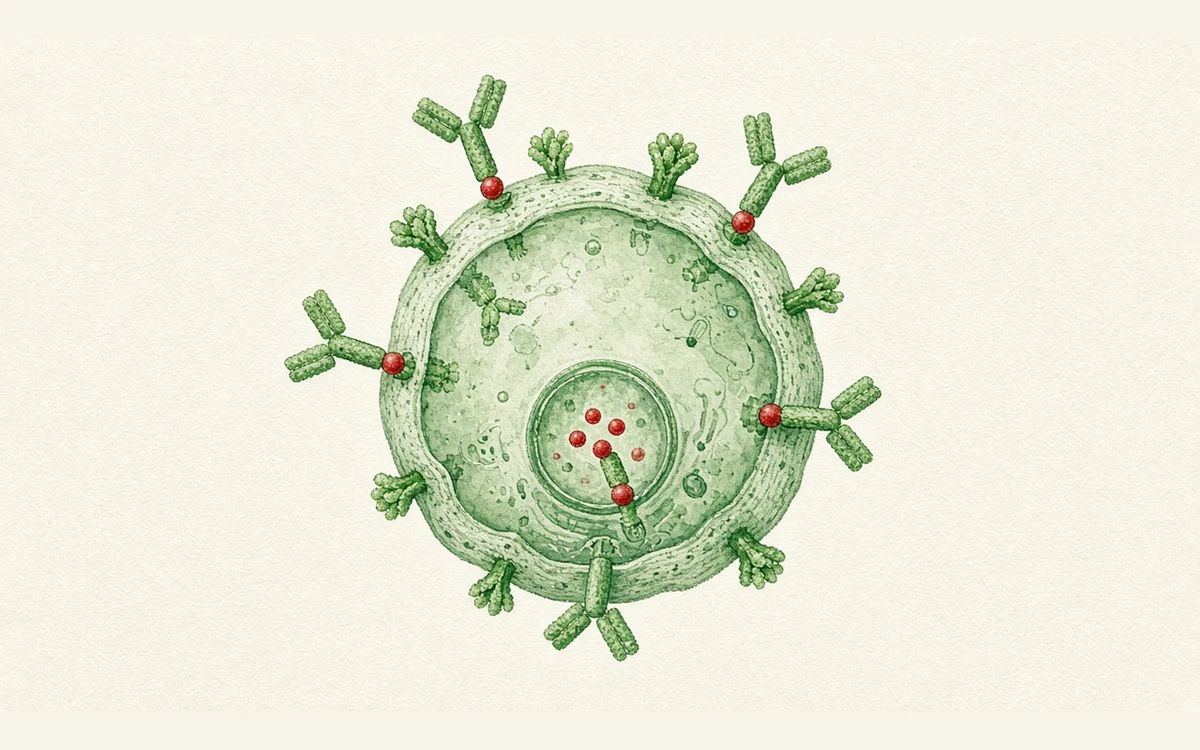
- A SEZ6 antibody carries a Top1i payload
- Intravenous dosing every 3 weeks
- Tumours shrink, with an ORR of 52%
- 1.8 mg/kg selected after randomized comparison
Background and open questions
Small cell lung cancer (SCLC) accounts for about 11% of lung cancers, and although most patients respond initially to first-line treatment, nearly 50% progress within 6 months, with a 5-year overall survival of only about 12% in extensive-stage disease. Standard chemotherapies after relapse include topotecan, amrubicin and lurbinectedin, and the authors note that historical response rates to these agents are below 20% in platinum-resistant or refractory patients.
SEZ6 is a neural lineage type I transmembrane protein expressed highly selectively in SCLC and high-grade neuroendocrine carcinomas. ABBV-706 conjugates a SEZ6 monoclonal antibody through a stable linker to a topoisomerase 1 inhibitor (Top1i) at a drug-to-antibody ratio of 6, releasing the payload in lysosomes after internalization. Byers et al. report its first-in-human phase 1 results in Nature Medicine.
Study design
This is a first-in-human, open-label phase 1 trial of ABBV-706 given intravenously every 3 weeks (Q3W). Part 1 escalated from 1.3 to 3.5 mg/kg in advanced solid tumours using a Bayesian optimal interval design; Part 2a randomized patients with SCLC progressing after platinum chemotherapy and immunotherapy equally to 1.8 or 2.5 mg/kg without stratification; Part 4 was an expansion in high-grade neuroendocrine tumours. As of 27 September 2025, 288 patients had been enrolled.
Of these, 240 received monotherapy, 124 had relapsed/refractory (R/R) SCLC, and 80 entered Part 2a (41 at 1.8 mg/kg, 39 at 2.5 mg/kg). The main efficacy measure was investigator-assessed confirmed ORR, that is complete or partial response by RECIST v1.1 confirmed on repeat assessment at least 4 weeks later. All analyses were descriptive, with no planned formal hypothesis testing and no sample size or power calculation.
Key results
An overall response rate of 52%
Among the 124 R/R SCLC monotherapy patients, investigator-assessed ORR was 52% (65/124), with a median duration of response of 5.3 months (95% CI 4.1–6.7). At a median follow-up of 16.9 months, median PFS was 5.4 months and median OS 11.3 months (95% CI 9.1–14.8), with 15-month overall survival estimated at 40%.
Similar responses at the two doses
In the randomized dose optimization of Part 2a, ORR was 56% (23/41) at 1.8 mg/kg and 59% (23/39) at 2.5 mg/kg, with median duration of response of 5.9 months (95% CI 3.6–11.1) versus 4.9 months (3.5–6.9). Median PFS was 6.4 versus 5.6 months and median OS 12.4 versus 11.9 months, with 15-month overall survival of 44% versus 38%; these long-term measures are exploratory and were not tested between groups in the paper.
Toxicity rises with dose
Among the 240 monotherapy patients, 93% had treatment-related adverse events and 61% had grade ≥3 events, most commonly anaemia (61%) and fatigue (38%); the abstract reports grade ≥3 events by dose at 39% for 1.8 mg/kg and 70% for 2.5 mg/kg. In Part 2a, any-grade events occurred in 88% versus 97% and grade ≥3 in 54% versus 77%. Adjudicated pneumonitis/interstitial lung disease occurred in 10 patients (4%), and 3 deaths were judged drug related.
1.8 mg/kg selected
Taking safety, preliminary efficacy and pharmacokinetics together, 1.8 mg/kg Q3W was established as the recommended phase 2 dose for R/R SCLC. In Part 2a, treatment-related interruptions and dose reductions occurred in 51% and 33% at 2.5 mg/kg versus 24% and 16% at 1.8 mg/kg. In a post hoc analysis, the second-line subgroup at 1.8 mg/kg (17 patients) had an ORR of 82% with a median duration of response of 6.6 months (95% CI 3.1–12.5).
SEZ6 expression does not stratify response
Among available tissue samples, 93% (108 patients) were SEZ6 positive by immunohistochemistry, with a median H score of 145; median H scores were 153 versus 130 in the 1.8 and 2.5 mg/kg groups, with similar distributions (P=0.7424). Responses were observed across SEZ6 expression levels in both dose groups, and expression did not correlate with PFS or OS. ctDNA fell rapidly as early as cycle 2 day 1, with significantly greater reductions in responders than non-responders.
Mechanistic interpretation
Demonstrated in the paper: This is a clinical trial with no direct mechanistic experiments; what the data directly support are the pharmacological characteristics. Pharmacokinetics were linear across 1.3–3.5 mg/kg with no evident target-mediated disposition; exposure curves for the conjugate and total antibody largely overlapped, which the authors take as evidence of linker stability. After the first dose, terminal half-lives were about 7 days for the conjugate and total antibody and about 10 days for free Top1i, with less than 1.5-fold accumulation in cycle 3 relative to cycle 1.
Toxicity was likewise dose dependent: grade ≥3 treatment-related adverse events rose from 40% at 1.3 mg/kg to 100% at 3.5 mg/kg, predominantly cytopenias. Median relative dose intensity in Part 2a was 98.9% (1.8 mg/kg) versus 85.3% (2.5 mg/kg); anti-drug antibodies were detected in 8.3% (20/240) of patients with no apparent effect on conjugate pharmacokinetics.
Author hypotheses: The authors suggest that more frequent interruptions and dose reductions at 2.5 mg/kg lowered relative dose intensity and may have affected the efficacy observed between the two doses. In the 1.8 mg/kg group, ORR was 62% in Top1i-naive patients versus 42% in previously exposed patients, which the authors take to suggest that patients previously treated with a Top1i may be intrinsically resistant to the payload because of the shared mechanism of action.
Limitations and uncertainties
- The authors acknowledge that, as a phase 1 study, the trial is overall non-randomized and open label, was not powered for efficacy and included no hypothesis testing or standard-of-care control arm, which they say will be addressed in phase 2/3 studies; differences in DOR, PFS and OS between doses can only be read as numerical differences.
- Biomarker evidence is limited: the legend for Fig. 2 states that 38 of 47 patients at 1.8 mg/kg and 37 of 42 at 2.5 mg/kg had evaluable SEZ6 data, while the Results state 38/48 and 37/44, an inconsistency in reporting; the relationship between SEZ6 and efficacy must be re-assessed in randomized controlled studies.
- As for generalizability, few enrolled patients had received prior tarlatamab; intracranial response rate was not a prespecified endpoint; the 82% second-line ORR comes from a post hoc subgroup of 17 patients, and time-to-event endpoints still require confirmation in larger randomized phase 2/3 trials.
Clinical and industry implications
If confirmed in randomized trials, ABBV-706 could offer a SEZ6-targeted ADC option in relapsed/refractory SCLC; responses were seen across expression levels in this study, suggesting that pre-screening by SEZ6 level may not be required for enrolment. Historical data cited in the paper give ORRs of 17–24% for topotecan and 35% for lurbinectedin, though these are cross-trial comparisons.
For dose selection, the trial demonstrates a randomized dose optimization route in which, with similar response rates, the lower dose is chosen on toxicity, dose intensity and long-term measures; a first-line trial of ABBV-706 combined with atezolizumab has already begun.
Authors, source and verification
Evidence level: Full text; verification record: Europe PMC full-text XML (PMC13472869): Abstract, Results, Discussion, Methods and legends for Figs. 2–3
Byers LA, Cho BC, Cooper AJ, Chiang AC, Han JY, Furqan M, et al. SEZ6-targeting antibody−drug conjugate ABBV-706 in advanced small cell lung cancer and solid tumors: a phase 1 trial. Nat Med. 2026 Jun 1. doi: https://doi.org/10.1038/s41591-026-04452-0
Primary field: Precision oncology & translation · Related: Antibody engineering, Antibody-drug conjugates, SEZ6, Small cell lung cancer, Topoisomerase 1 inhibitors, Dose optimization
Summary of a published paper or preprint, written from the original text; numbers are as reported by the authors. Not medical or investment advice. Corrections: contact@
Related science
A 256-model tumour organoid biobank, with 162 genome-wide CRISPR screens completed
Clustered tumour organoids, with red dots marking dependency genes hit in CRISPR screens
HCMI resource: 97.8% of 421 matched pairs retain at least two classes of DNA features
Tumour and model tissue masses linked by a DNA strand, with red dots marking retained DNA features

A pIgR bispecific raises cynomolgus BAL exposure 5.5-fold
A bispecific crossing airway epithelial cells and released at the airway surface
One email, with links to every paper. Reports and custom landscapes: contact@inlightbio.com.