HCMI resource: 97.8% of 421 matched tumour–model pairs retain at least two classes of DNA features
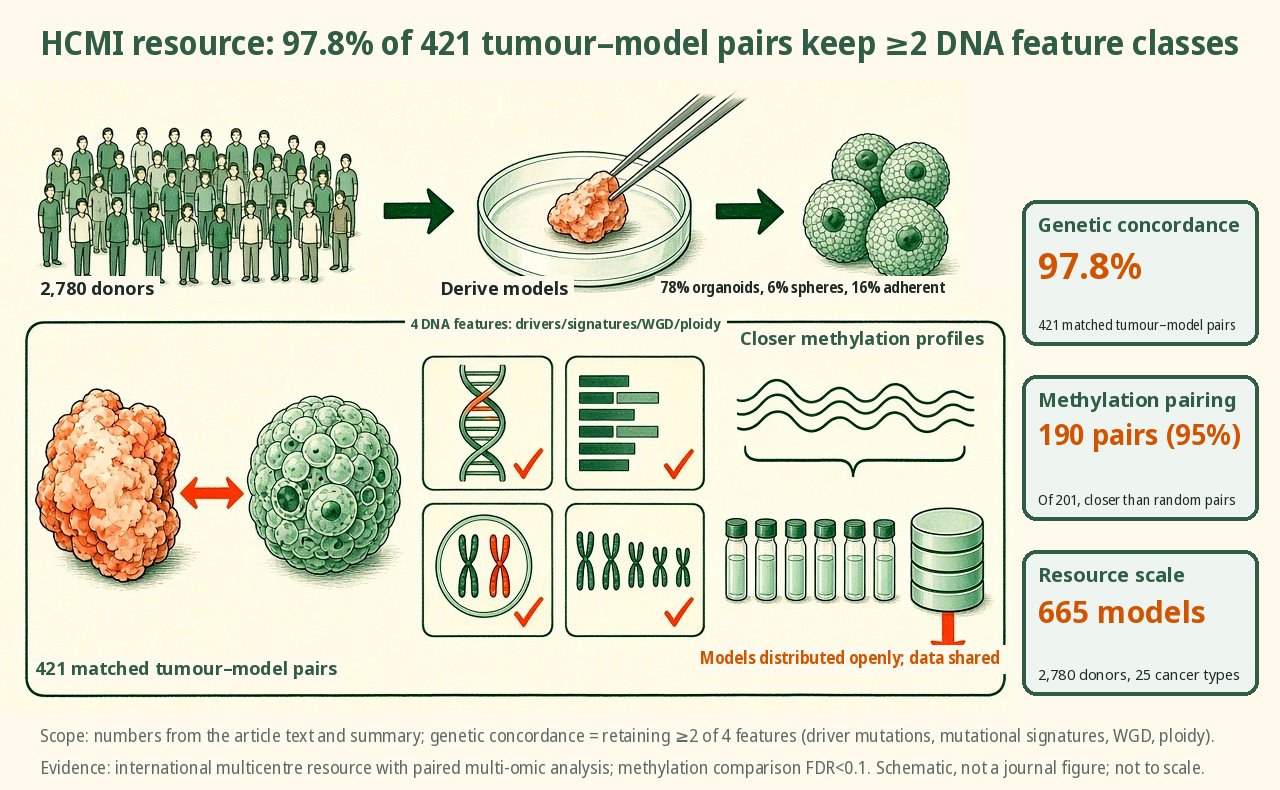
Across 665 patient-derived models spanning 25 cancers, analysis of 421 matched pairs showed that 97.8% retained at least two classes of DNA features, with 95% concordance for methylation.
The international multicentre HCMI effort established 665 patient-derived cancer models from 2,780 donors across 25 cancers, of which 78% are 3D organoids, 6% spheroids and 16% 2D adherent cell lines. Among 421 matched tumour–model pairs, 97.8% retained at least two of four DNA features: driver mutations, mutational signatures, WGD and ploidy; among 201 methylation pairs, 190 (95%) were closer than random pairings (FDR<0.1). Clinical data cover 522 models, including treatment history and survival outcomes. Models are distributed through ATCC and EMD Millipore, and the data are publicly available through Cancer Models.
Key data card
- Study type: International multicentre construction of a patient-derived cancer model resource with paired multi-omic analysis
- Sample size n: 2,780 donors; 665 models; 421 matched tumour-model pairs for the core concordance analysis
- Controls: Parental tumours, random pairing background, the CCLE model collection (n=1,377)
- Follow-up: Clinical data cover 522 models; overall survival follow-up ranges from 0 to 34 years; median post-treatment follow-up 1.5 years
- Primary endpoint: Core readout: genetic and epigenetic concordance between models and parental tumours; genetic concordance was defined as retaining at least two of four DNA features: driver mutations, mutational signatures, WGD and ploidy
- Primary endpoint result: Analysis of 421 matched pairs showed 97.8% genetic concordance; among 201 methylation pairs, 190 (95%) were closer than random pairings (FDR<0.1)
- Statistics: Methylation FDR<0.1; GBM medium Fisher's exact test P=1.5×10⁻⁴; SBS11 drug sensitivity Wilcoxon P<0.05
- Safety: A non-therapeutic resource study with no patient dosing or safety endpoints
- Evidence level: Full text
- Verification record: Read the Europe PMC fullTextXML PMC13581597 Abstract, Results, Discussion, Methods and legends for Figs. 1–6
- Built a patient-derived model collection
- Assessed fidelity by paired sequencing
- Pinpointed medium-related drift
- Linked clinical history to drug resistance
Background and open questions
Cancer atlases have accumulated a wealth of driver events, transcriptional states and resistance hypotheses, but validating these mechanisms still depends on experimental models that can be expanded long term, distributed, and that retain the features of the parental tumour. More than 1,000 cell lines already exist, yet they are often criticized for limited phenotypic complexity, unclear relationships to the primary specimen, and insufficient clinical treatment history.
Patient-derived organoids, neurospheres and new cell lines could close that gap, but there has been no large-scale test of whether they systematically retain genetic, epigenetic and transcriptional states after long-term culture, and whether they cover rare cancers and populations of non-European ancestry. ElHarouni et al. report the HCMI resource in Nature, with the goal of releasing distributable models together with paired multi-omic data.
Study design
The project enrolled 2,780 consenting participants between 2016 and 2021 and ultimately established 665 models from 637 patients across 25 cancers; 522 carry comprehensive clinical data, 153 come from rare cancers, and 71 come from donors of predominantly non-European ancestry. By format, 78% are 3D organoids (n=519), 6% are 3D spheroids (n=37) and 16% are 2D adherent patient-derived cell lines (n=109); the genetic fidelity analysis also notes that the models had been cultured in vitro for at least 1 year.
The study involved no clinical intervention or randomization and was not powered for between-group efficacy comparisons. The main readout is multi-omic concordance between matched parental tumours and models: WGS/WES assessed driver mutations, SNVs/indels, LOH, WGD and ploidy, while methylation, RNA-seq, Celligner and MOMA/OncoMatch assessed state retention, with the 1,377 CCLE models used as a reference for resource coverage.
Key results
Core fidelity
Analysis of 421 matched pairs produced the main readout: aggregating DNA features, 97.8% of models retained at least two classes; among the 201 pairs with methylation data, 190, or 95%, were closer than random pairings (FDR<0.1). The 97.8% figure is not a single mutation overlap rate but, after excluding 22 low-purity models and leaving 643 priority models, the share retaining at least two of four DNA features: driver mutations, mutational signatures, WGD and ploidy.
DNA-level detail
Among the 420 models with estimable purity, 406 exceeded 80% purity and only 9 showed aneuploidy patterns differing from the parental tumour; of 388 pairs, 361 had LOH concordance above 80%, averaging 94%. WGD status was reproduced in 88% of pairs; 10% showed model-specific WGD and 2% tumour-specific WGD, and model-specific WGD occurred later on the mutational timeline (P=0.047), consistent with culture-related clonal selection or differences in spatial sampling.
Epigenome and transcriptome
Among the 201 pairs with methylation data, 190, or 95%, were closer than random pairings (FDR<0.1); 9 of the 11 epigenetically discordant models came from tumours with purity below 60%, suggesting discordance may skew toward sample artefacts. Transcriptionally, Celligner judged 242 of 297 pairs, or 81%, significantly concordant; among 286 models assessed by at least 4 methods, 263, or 92%, were called discordant by at most 1 method.
Drift and culture medium
Medium effects were concentrated in GBM: models cultured in NeuroCult NSA were closer to their parental tumours than models in Propagenix conditioned medium (P=1.5×10⁻⁴), though the overall comparison involved only 3 CM pairs and 37 NSA pairs; among 16 single-nucleus RNA sequencing pairs, conditioned-medium GBM models shifted almost entirely toward a mesenchymal-like state. ecDNA was a weak point for fidelity: of 212 events, 93, or 43.9%, were model-specific and 69, or 32.5%, tumour-specific; the authors attribute most discordance to low sequencing coverage.
Translational coverage
Compared with the 1,377 CCLE models, HCMI performed better on OncoMatch in 11 of 19 cancers and CCLE in 6; 4 of those were small HCMI cohorts of ≤10 models. Combining the two collections, 77.3% of TCGA tumours (n=6,902) had at least 1 high-fidelity model (NES≥10). GBM models carrying SBS11 were less sensitive to temozolomide than non-SBS11 models (Wilcoxon P<0.05), independently of MGMT promoter methylation status.
Mechanistic interpretation
Demonstrated in the paper: The first chain the paper directly demonstrates is "retention across pairs": tumours and models from the same donor resemble one another on multiple DNA, methylation and RNA metrics. The aggregate DNA metric built from driver mutations, mutational signatures, WGD and ploidy gives 97.8% concordance; methylation was significantly closer than the random background in 190/201 pairs; transcriptionally, 263/286 models were not consistently called drifted by multiple methods.
The second chain is that "culture conditions can change cell state". In GBM, the difference in Celligner similarity between NSA and conditioned medium was statistically tested; after HCM-BROD-0416-C71 was switched from NSA to formulated conditioned medium, it showed morphological changes, reduced nuclear SOX2 intensity and transcriptional marker changes at 72 hours and 2 weeks. Single-nucleus RNA sequencing further showed that some GBM models shift toward a mesenchymal-like state.
Author hypotheses: The authors suggest that the few discordant cases arise from three processes: loss during culture of the stromal and immune infiltrate present in the parental tumour, amounting to "purification"; selective expansion of minor clones in vitro; and medium-induced epigenetic and transcriptional plasticity. For ecDNA discordance they point mainly to low coverage, while also proposing that in vivo versus in vitro growth conditions may select for or against ecDNA amplification.
Limitations and uncertainties
- First, generalizability is limited by cohort composition. The 665 models span 25 cancers, but 85% are of European ancestry and only 71 models come from donors of predominantly non-European ancestry, limiting extrapolation to non-European populations.
- Second, the endpoints are molecular fidelity and model coverage, not patient benefit. Clinical data accompany 522 models, with median post-treatment follow-up of 1.5 years and overall survival spanning 0 to 34 years, but there is no prospective clinical validation of model-guided treatment.
- Third, the model formats carry methodological limits. The authors state explicitly that HCMI models lack stromal and immune cells, limiting their use in studying immune responses; diversity also remains insufficient, despite 153 rare-cancer models and 38 models from patients of recent African ancestry.
- Fourth, some conclusions rest on small subgroups or sequencing conditions. The GBM medium comparison involved only 3 CM pairs and 37 NSA pairs; for ecDNA, 43.9% of events were model-specific and 32.5% tumour-specific, which the authors attribute mainly to low sequencing coverage.
Clinical and industry implications
For researchers choosing patient-derived models for drug screening, CRISPR dependency mapping or resistance studies, HCMI links 665 distributable models to parental tumour multi-omics and clinical treatment history. For fields where models are scarce, including rare cancers, pancreatic, oesophageal and colorectal cancer, it offers candidate systems that sit closer to the parental tumour.
Still, this work is infrastructure rather than therapeutic discovery. DNA fidelity may translate into an actionable advantage only when the experimental question matches the models' boundaries, for example studying tumour cell-intrinsic genetic dependencies, SBS11-associated temozolomide resistance, or using OncoMatch to find representative models.
Authors, source and verification
Evidence level: Full text; verification record: Read the Europe PMC fullTextXML PMC13581597 Abstract, Results, Discussion, Methods and legends for Figs. 1–6
ElHarouni D, Al-Jazrawe M, Choi S, Dede M, Hinoue T, Misek SA, et al. A compendium of next-generation patient-derived models for diverse cancers. Nature. 2026. https://doi.org/10.1038/s41586-026-10806-y
Primary field: Precision oncology & translation · Related: Organoids, Patient-derived organoids, Whole-genome sequencing, DNA methylation, Single-nucleus RNA sequencing, OncoMatch
Summary of a published paper or preprint, written from the original text; numbers are as reported by the authors. Not medical or investment advice. Corrections: contact@
Related science
A 256-model tumour organoid biobank, with 162 genome-wide CRISPR screens completed
Clustered tumour organoids, with red dots marking dependency genes hit in CRISPR screens
SEZ6-targeting ADC phase 1: a 52% response rate in relapsed/refractory SCLC
An antibody binds a cell surface receptor and carries a red drug into the cell
TSC2 loss produces astrocyte reactivity in organoids at all 3 time points
Astrocytes in a brain organoid cross-section, with reactive cells in red
One email, with links to every paper. Reports and custom landscapes: contact@inlightbio.com.