Targeting ZMYND8 reshapes exhausted T cells in mice and enhances responses to immunotherapy
In LCMV and melanoma models, targeting ZMYND8 biased P14 cells toward an effector-like exhausted state and enhanced killing and responses to immunotherapy.
In LCMV and B16-OVA models, targeting ZMYND8 biased P14 CD8+ T cells toward an effector-like exhausted state and reduced terminal exhaustion. An in vivo scCRISPR screen recovered 19,032 P14 cells; validation used n=7 per group for effector-like/Tex term and n=5–8 per group for tumour treatment. Loss of ZMYND8 enhanced IL-2R–STAT5 signalling. ZMYND8-knockout CD8+ T cells controlled virus better in chronic infection and produced stronger antitumour effects in tumours. Effector-like and terminal exhaustion phenotypes can be distinguished by flow cytometry and transcriptomics.
Key data card
- Study type: Preclinical mechanistic study; in vivo CRISPR screens, mouse chronic infection and melanoma models, and in vitro validation in human CD8+ T cells
- Sample size n: 19,032 P14 cells recovered in the in vivo scCRISPR screen; n=7 per group for effector-like/Tex term validation and n=9 per group for Tex KLR validation; n=5–8 per group for tumour treatment
- Controls: sgNTC, GFP spike cells in the same host, PBS, IgG isotype control, single-agent treatment groups
- Intervention/dose: Zmynd8/ZMYND8-targeting sgRNA or Cas9-RNP; rhIL-2; anti-PD-L1; some epistasis experiments co-deleted STAT5B, CD25, CD122 or p300
- Follow-up: LCMV experiments were mostly read out at 7, 21, 28, 36 or 90 dpi; tumour volume was measured every 2 days
- Primary endpoint: Preclinical core readout: differentiation of exhausted CD8+ T cells toward effector-like Tex int/Tex KLR rather than Tex term after ZMYND8 loss, accompanied by enhanced IL-2R–STAT5 signalling
- Primary endpoint result: In the in vivo screen, Zmynd8 was a top negative regulator of effector-like cells and a positive regulator of Tex term; flow cytometry at multiple time points confirmed more effector-like cells and fewer Tex term cells, and co-deletion of p300 blocked the effect
- Statistics: Not a clinical power design; per the figure legends, Student's t tests, one-way or two-way ANOVA, Fisher's exact test, Wilcoxon rank-sum tests and log-rank tests were used
- Evidence level: Full text
- Verification record: Read the Nature open-access full-text Abstract, Results, Methods, figure legends, Discussion and Limitations; source identifier DOI 10.1038/s41586-026-11059-5
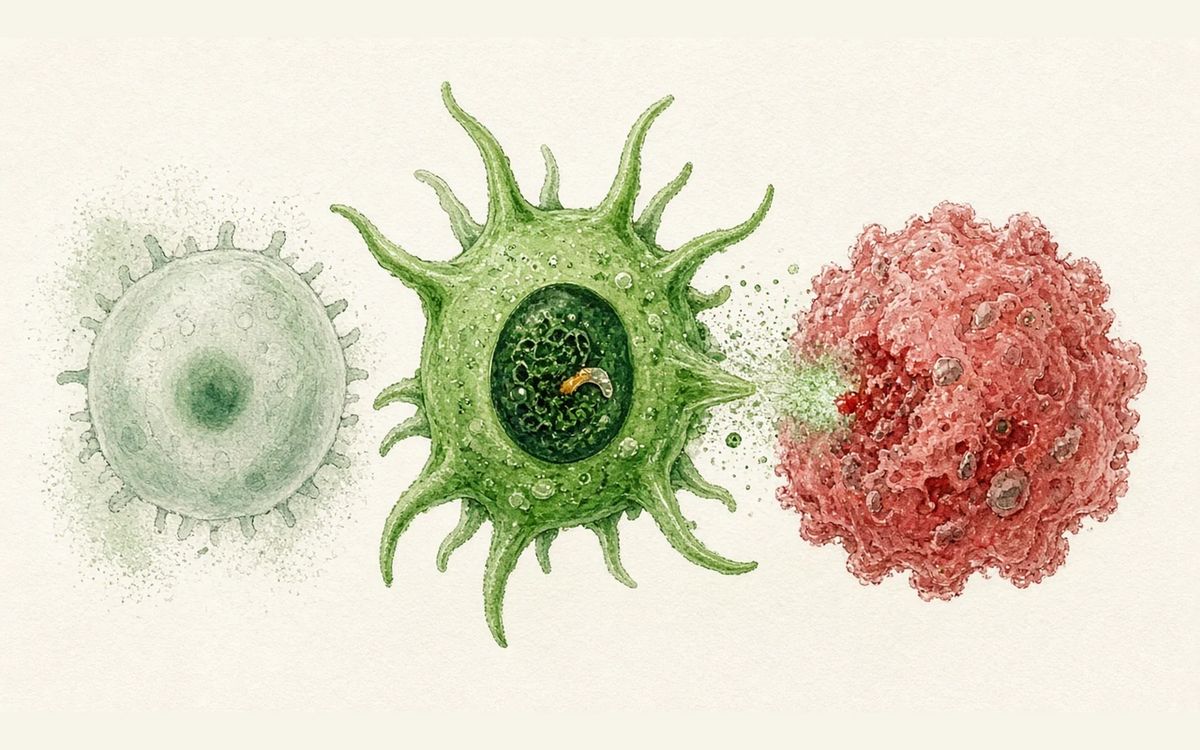
- Chronic stimulation upregulates ZMYND8
- ZMYND8 suppresses p300 enhancers
- IL-2R–STAT5 is released
- Tex KLR and killing increase
Background and open questions
Chronic infection and tumours drive CD8+ T cells into an exhaustion programme: high-affinity IL-2 receptor subunits decline, STAT5 activation becomes insufficient, and cells move from a progenitor-like exhausted state toward terminal exhaustion rather than forming more cytotoxic effector-like populations. Immune checkpoint blockade can transiently promote effector-like cells, but terminal differentiation and signal decay still limit efficacy.
In Nature, Wang et al. pursue an upstream question: how persistent antigen stimulation suppresses the IL-2R–STAT5 axis through epigenetic mechanisms. Their approach is not to add cytokines directly but to screen chromatin regulators in exhausted T cells in vivo, looking for a brake whose release can free effector-like states such as Tex KLR from terminal exhaustion.
Study design
The authors first ran in vivo scCRISPR and bulk CRISPR screens in Cas9 P14 cells. The library contained 91 epigenetic factors and 9 known transcription factors, with 3 sgRNAs per gene plus 30 non-targeting controls, for 330 sgRNAs in total; P14 cells were transferred into mice infected with LCMV Cl13 and read out at 28 dpi, with scCRISPR recovering 326 sgRNAs and annotating 4 exhaustion states.
Subsequent validation used dual-colour transfer and single-colour treatment systems. Dual-colour transfer mixed Ametrine-labelled sgZmynd8 P14 cells with GFP-labelled sgNTC spike cells 1:1 and transferred them into the same host; frequencies, gMFI and cell numbers were normalized to the spike and to the pre-transfer input ratio to reduce host-to-host variation. This is a preclinical comparison and was not powered between groups in the manner of a clinical trial.
Key results
The screen pinpoints ZMYND8
In the in vivo screen at 28 dpi, 4 exhaustion states were annotated as Tex prog, Tex int, Tex KLR and Tex term. Zmynd8 ranked as a top negative regulator of effector-like cells and a positive regulator of Tex term; the bulk CRISPR screen further confirmed it as the top hit for effector-like versus Tex term cells. A separate IL-2 signalling screen showed that weakening IL-2 signalling reduced effector-like and total P14 cells, while relieving negative regulation increased them.
Fate biased toward effector-like states
scRNA-seq and flow cytometry confirmed that ZMYND8 loss selectively accumulated P14 cells as Tex int and Tex KLR and reduced Tex term; this shift appeared across multiple time points. Among 3 independent sgRNAs, g1 and g2 had clear effects while g3 was weaker; Cas9-RNP editing of naive P14 cells reproduced the same direction. Increased Tex KLR was still seen at 90 dpi, consistent across tissues.
Limited antiviral gains
Antiviral readouts showed that deleting ZMYND8 alone improved killing of gp33 target cells: ex vivo killing increased across exhausted subsets, and in vivo clearance of gp33-pulsed splenocytes was faster. Viral load, however, fell only slightly, which the authors describe as a modest reduction, indicating that targeting this factor alone does not fully restore control of chronic infection.
Synergy with IL-2
IL-2 was given daily from 30 to 35 dpi, for 6 doses in total, with in vivo killing and cell states assessed at 36 dpi. Mice receiving ZMYND8-deficient P14 cells plus IL-2 had lower viral loads than with either treatment alone and stronger 3 h in vivo killing; at the cellular level, the combination further increased effector-like cells and Tex KLR and reduced Tex term, consistent with the interpretation that IL-2 responsiveness is released.
Extension to tumours and ICB
In the B16-gp33 model, ZMYND8-deficient P14 cells reduced tumour burden and prolonged survival, and combination with IL-2 further improved control and survival. pmel cells in B16F10 pointed the same way. In a CD19 CAR T model, ZMYND8 loss likewise raised CD25, CD122 and p-STAT5 and lowered TOX. In anti-PD-L1 experiments, ZMYND8 loss sustained elevated CD25 and p-STAT5, and the combination improved tumour control, P14 infiltration and survival.
Mechanistic interpretation
Demonstrated in the paper: The screen also ranked ZMYND8 as a top negative regulator of STAT5 activity; in ZMYND8-deficient cells, the STAT5CA Up signature rose and the STAT5CA Down signature fell. After IL-2 stimulation, p-STAT5 increased in both mouse and human CD8+ T cells, as did CD25 and CD122, indicating that ZMYND8 constrains IL-2R–STAT5 signalling.
CUT&RUN defined 2,863 core ZMYND8 binding peaks, with IL-2–STAT5 signalling the most enriched pathway, including Il2ra and Il2rb. ZMYND8 binds H3K4me1/H3K27Ac active enhancers and co-occupies them with p300; co-deletion of STAT5B reversed the accumulation of effector-like and Tex KLR cells caused by ZMYND8 loss, along with the GZMA, GZMB, IFNγ and TOX phenotypes, and co-deletion of CD25 or CD122 had broadly similar effects. Co-deletion of p300 blocked the increase in effector-like and Tex KLR cells induced by ZMYND8 loss, corrected the reduction in Tex prog or Tex term, and reversed the rise in CD25 and CD122.
Author hypotheses: The authors propose that persistent TCR stimulation induces ZMYND8 expression, creating an epigenetic feedback loop in which chronic signal-1 antigen stimulation suppresses signal-3 IL-2 signalling through ZMYND8, pushing cells toward terminal exhaustion. Public patient data support only an association between ZMYND8 expression or signatures and exhaustion and ICB response, and cannot by themselves establish causality in patients.
Limitations and uncertainties
- First, the boundaries of generalization are clear. The core causal validation comes mainly from LCMV Cl13, B16-gp33 and B16F10 melanoma models and from in vitro chronic stimulation of human CD8+ T cells from healthy donors; the authors state explicitly that applicability beyond chronic LCMV infection and melanoma remains to be tested.
- Second, the endpoints remain preclinical phenotypes and model efficacy. The flow cytometry validation examples used n=7 per group for effector-like/Tex term and n=9 per group for Tex KLR, and tumour treatment used 5–8 mice per group per the Methods; these data come from animal and in vitro systems and cannot substitute for dose, durability and efficacy endpoints in patients.
- Third, methodologically, the tumour experiments rely on cell lines such as B16-gp33 and B16F10; the Methods state that the cell lines were not independently authenticated or tested for mycoplasma. Tumour growth curves were measured every 2 days with ethical limits of 3,000 mm3 or ≤20% of body weight, which bound the animal readouts.
Clinical and industry implications
If reproduced across more tumour types and engineered T cell systems, ZMYND8 could become a candidate target for "releasing an intracellular brake": rather than simply raising a single effector molecule, it pulls the fate of exhausted T cells from Tex term toward effector-like states such as Tex KLR and enhances responsiveness to IL-2R–STAT5 signalling.
For cell therapy, the results suggest editing ZMYND8 in antigen-specific cells such as P14 or pmel and pairing it with IL-2 or PD-L1 blockade; the CD19 CAR T work shows only IL-2R–STAT5, TOX and NKG2D phenotypes. The current evidence remains confined to preclinical systems and should not be read as validated patient efficacy.
Authors, source and verification
Evidence level: Full text; verification record: Read the Nature open-access full-text Abstract, Results, Methods, figure legends, Discussion and Limitations; source identifier DOI 10.1038/s41586-026-11059-5
Wang Y, Shi H, Chapman NM, KC A, Sun R, Song H, et al. Targeting ZMYND8 unleashes IL-2 signalling to override T cell exhaustion. Nature. 2026 Sep 23. doi: https://doi.org/10.1038/s41586-026-11059-5
Primary field: Tumor immunology & cell therapy · Related: T cell exhaustion, IL-2R-STAT5, CRISPR screens, p300 enhancers, PD-L1 blockade
Summary of a published paper or preprint, written from the original text; numbers are as reported by the authors. Not medical or investment advice. Corrections: contact@
Related science
In vivo BCMA CAR-T phase 1: 15 months of follow-up, one ongoing sCR
Green CAR-T cells attacking a red myeloma cell at right

Synthetic TCR library: on average only 56% of VDJdb TCRs reproduce their annotated reactivity
Green peptide-MHC complexes binding synthetic TCRs, with one non-reproducing case marked in red

12 diet models: 4/6 obesogenic diets associated with anti-PD-1 response
Intestinal villi and microbiota at left, T cells and a red tumour at right
One email, with links to every paper. Reports and custom landscapes: contact@inlightbio.com.