B cells acquire checkpoint mutations polyclonally in thyroid autoimmunity: 135 distinct TNFRSF14 mutations in one donor
Single-molecule sequencing showed 135 distinct TNFRSF14 mutations in donor H1 with Hashimoto's thyroiditis, with many B cell clones independently inactivating immune checkpoint genes.
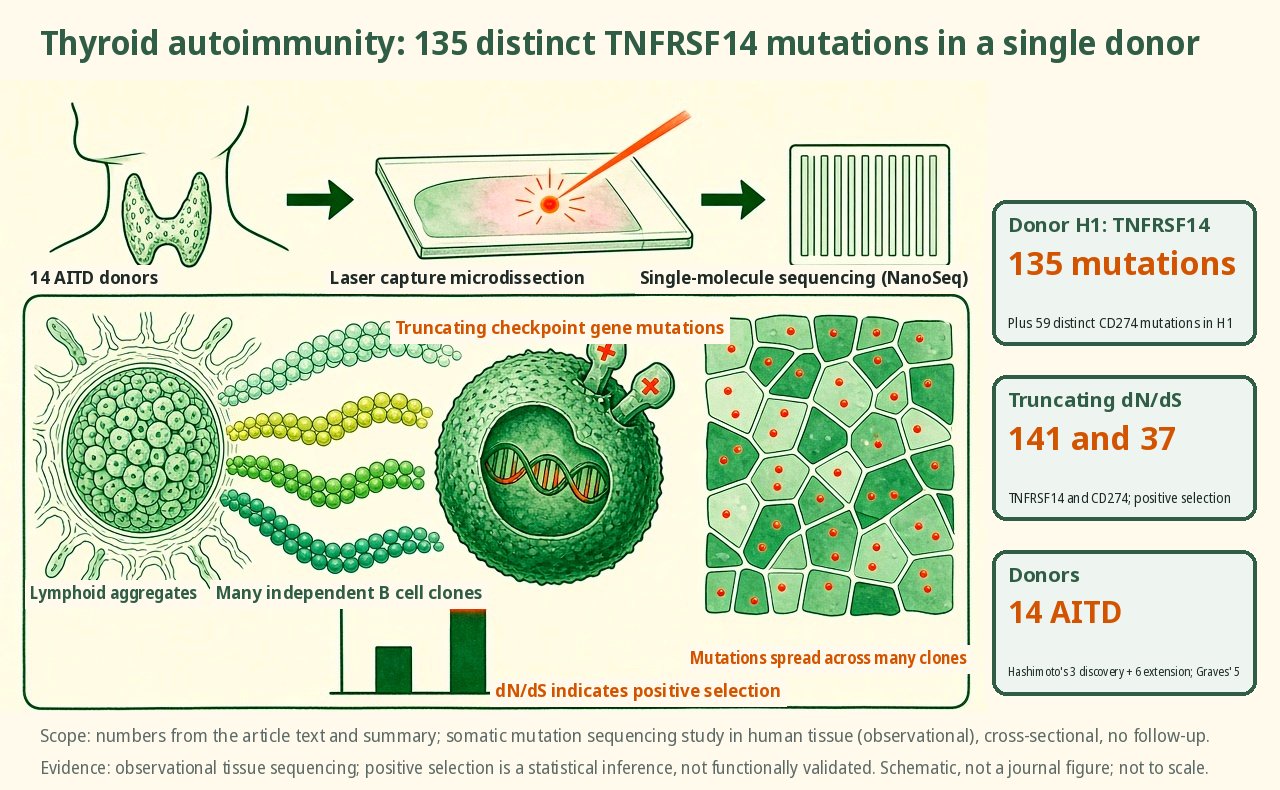
Single-molecule sequencing of 14 donors with autoimmune thyroid disease showed 135 distinct TNFRSF14 mutations and 59 distinct CD274 mutations in donor H1 with Hashimoto's thyroiditis. The truncating-to-nonsynonymous ratios for these two checkpoint genes were 141 and 37, indicating positive selection. The mutations were distributed across many B cell clones rather than dominated by a single clone. The work traces somatic mutations in thyroid autoimmune tissue.
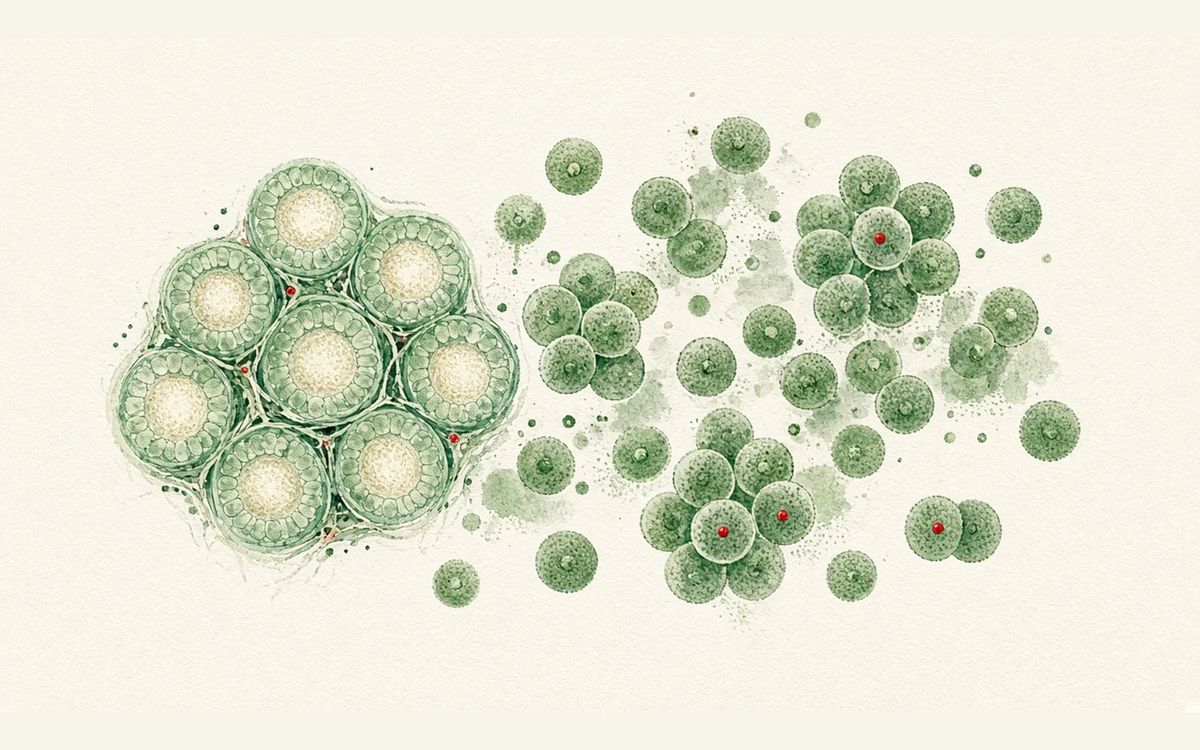
Key data card
- Study type: Somatic mutation sequencing study in human tissue (observational)
- Sample size n: 14 AITD donors: a discovery cohort of 3 with Hashimoto's thyroiditis (H1–H3) and an extension cohort of 6 with Hashimoto's and 5 with Graves' disease
- Controls: Non-autoimmune controls: peripheral blood memory B and T cells from 20 donors over 50 years old, plus data from lymph node, spleen, chronic tonsillitis and non-AITD nodular goitre
- Intervention/dose: Methods: whole-exome and 725-gene targeted NanoSeq, laser capture microdissection, methylation sequencing, Xenium spatial transcriptomics, single-nucleus PTA sequencing, and recombinant antibodies from BCRs
- Follow-up: A cross-sectional tissue study with no follow-up
- Primary endpoint: Core readout: strength of positive selection (dNdSshm) on somatic mutations in immune checkpoint genes and the number of independent mutant clones
- Primary endpoint result: dN/dS for truncating mutations was 141 for TNFRSF14 and 37 for CD274; donor H1 alone carried 135 distinct TNFRSF14 and 59 distinct CD274 mutations
- Statistics: dNdSshm positive selection testing (Q<0.01 for significance, Q<0.1 as a permissive threshold)
- Safety: Not applicable (a tissue sequencing study)
- Evidence level: Full text
- Verification record: Europe PMC full-text XML (PMC13233322): Abstract, Main, Results sections, Discussion and figure legends
- Autoreactive B cells aggregate in the thyroid
- Many clones independently acquire checkpoint mutations
- Biallelic TNFRSF14 loss and multiple drivers
- Author hypothesis: escape from tolerance with cascading amplification
Background and open questions
Autoimmune diseases affect 5–10% of people worldwide. Somatic recombination during B and T cell development generates lymphocytes that can recognize self-antigens, and the immune system suppresses them through multiple checkpoints, but how some cells escape remains unclear. A long-standing hypothesis holds that somatic mutations in immune regulatory genes allow autoreactive lymphocytes to bypass tolerance checkpoints, but technical limits have made it hard to test.
Autoimmune thyroid disease (AITD) is one of the most common autoimmune diseases, including Hashimoto's thyroiditis, characterized by thyroid destruction and hypothyroidism, and Graves' disease, in which stimulating autoantibodies cause hyperthyroidism; Hashimoto's thyroiditis is also associated with increased risk of MALT lymphoma. In Nature, Nicola et al. report using single-molecule sequencing to search for somatic driver mutations in AITD thyroid tissue.
Study design
The study first took biopsies from 3 patients with Hashimoto's thyroiditis and extensive lymphocytic infiltration (H1–H3) for whole-exome NanoSeq (accurate single-molecule sequencing), accumulating 3,125 dx of duplex coverage and yielding 28,855 coding mutations; the extension cohort then added 6 Hashimoto's donors (H4–H9) and 5 Graves' disease donors (G1–G5), sequenced on a targeted panel of 725 immune and lymphoma-related genes, with 72,977 dx of cumulative coverage across the 14 donors and positive selection detected with dNdSshm.
Controls included sorted peripheral blood memory B and T cells from 20 non-autoimmune donors over 50 years old, plus data from lymph node, spleen, chronic tonsillitis and non-AITD nodular goitre. The study also laser capture microdissected 221 lymphoid aggregate microregions from 3 donors and performed PTA sequencing on 112 single nuclei from H1 (median 314× across the 725 genes, median 18× whole-genome for 86 nuclei), reconstructing BCRs to synthesize antibodies.
Key results
Strong positive selection on four genes
In the exome data from the 3 Hashimoto's biopsies, TNFRSF14 (HVEM), CD274 (encoding PD-L1), TET2 and TNFAIP3 (encoding A20) were under strong positive selection, the first two at Q<1×10⁻¹⁵. Combining exome and targeted data, 229 TNFRSF14, 125 CD274, 84 TET2 and 48 TNFAIP3 nonsynonymous mutations were detected; donor H1 alone carried 135 distinct TNFRSF14 mutations and 59 distinct CD274 mutations.
Individually small clones, substantial in aggregate
Individual clones were small: TNFRSF14 mutations had a median VAF of 0.002 (maximum 0.024) and CD274 mutations a median of 0.0006 (maximum 0.019), nearly all under 1% of the cells in a biopsy. Summed, at least 32.7% of cells in H1 carried a TNFRSF14 mutation and 5.0% a CD274 mutation; in H2 and H3 the proportions of TNFRSF14-mutant cells were 3.0% and 5.5%.
Extension cohort and controls
In the extension data, 15 genes were under positive selection at Q<0.01, with dN/dS for truncating mutations of 141 for TNFRSF14 and 37 for CD274, far stronger than for other genes; they were detected in 10 and 11 of the 14 donors respectively. In the control data these two genes were rarely mutated and showed no significant selection (Q>0.1), while some driver genes such as TET2 and TNFAIP3 were also under selection in normally aged memory B cells.
Driver mutations found only in B cells
Of the 112 nuclei from H1, 66 were B cells and 38 T cells, and driver mutations were found only in B cells: 41 cells carried 31 distinct nonsynonymous TNFRSF14 mutations (about 62% of H1 B cells), 8 cells carried 7 distinct CD274 mutations, and 6 cells carried TET2 Q345*. Of the 41 TNFRSF14-mutant B cells, 30 lost the second allele through CN-LOH and 8 through two independent point mutations.
Some mutant clones are autoreactive
After synthesizing recombinant antibodies from complete BCRs of 32 B cells, at least 7 clones recognized thyroid peroxidase (6) or thyroglobulin (1), and 4 of these carried driver mutations. Laser capture microdissection also showed that one large lymphoid aggregate in Graves' donor G5 was composed of two large clones, each with biallelic TNFRSF14 loss.
Mechanistic interpretation
Demonstrated in the paper: The mutation types point to loss of function: both TNFRSF14 and CD274 were enriched for truncating mutations including nonsense, essential splice site and frameshift changes as well as start codon mutations, and for missense mutations disrupting disulfide-bonded cysteines; selection on TNFRSF14 missense mutations fell mainly in CRD1, which mediates the inhibitory BTLA interaction. Immunohistochemistry confirmed loss of TNFRSF14 expression in that aggregate in G5.
All mutant B cells showed somatic hypermutation, indicating they had passed through a germinal centre reaction, and 90% (37/41) of TNFRSF14-mutant B cells had class switched. One six-cell branch first acquired TET2 Q345* (possibly in a bone marrow stem or progenitor cell), then split into lineages with different V(D)J rearrangements that each lost TNFRSF14 biallelically, showing that driver mutations accumulate stepwise, with some clones carrying as many as 4–6 drivers.
Author hypotheses: The authors suggest that inactivation of TNFRSF14 and CD274 on B cells may dysregulate helper T cells, turning B cells into unrestrained antigen-presenting cells that continuously stimulate TPO- and TG-specific T cells. They propose a polyclonal cascade model in which one or a few autoreactive clones carrying tolerance-escape mutations first trigger a weak local response, which then intensifies as new clones continually join.
Limitations and uncertainties
- The authors state explicitly that the results are not definitive evidence of causality; it remains unclear whether this mechanism is necessary or sufficient for disease onset in most patients, or whether it acts mainly in established disease, and functional and mechanistic studies in animal models are still needed.
- Sample sizes are small: the full cohort includes only 14 donors, and the single-cell whole-genome data come mainly from one donor, H1; the few donors with no detected TNFRSF14 or CD274 mutations all had lower lymphocytic infiltration, so detection is limited by degree of infiltration and sequencing depth.
- Some driver genes are not disease specific: TET2, DNMT3A and TNFAIP3 are also under selection in normally aged memory B cells. Autoreactivity was tested against only the two classic antigens TPO and TG, and some BCR sequences may have been reconstructed inaccurately.
Clinical and industry implications
If confirmed, this model could explain several clinical observations: the large number of clones carrying thyroid MALT lymphoma driver mutations may explain the increased risk of that lymphoma in AITD patients, and a polyclonal cascade also fits the long subclinical phase and epitope spreading.
The results echo the association of germline CD274 mutations with AITD and the frequent induction of thyroid autoimmunity by PD-1–PD-L1 inhibitors; if activated B cells in other autoimmune diseases also frequently carry driver mutations, that may help explain why deep B cell depletion therapies work in some conditions.
Authors, source and verification
Evidence level: Full text; verification record: Europe PMC full-text XML (PMC13233322): Abstract, Main, Results sections, Discussion and figure legends
Nicola PA, Lawson ARJ, Tidd A, Imbert J, Ishida Y, Wylie LA, et al. Polyclonal selection of immune checkpoint mutations in thyroid autoimmunity. Nature. 2026 Apr 14. doi: https://doi.org/10.1038/s41586-026-10493-9
Primary field: Autoimmunity & transplant · Related: Somatic mutation, Hashimoto's thyroiditis, B cells, Immune checkpoints, NanoSeq, Peripheral tolerance
Summary of a published paper or preprint, written from the original text; numbers are as reported by the authors. Not medical or investment advice. Corrections: contact@
Related science
Anti-CD19 CAR-T in refractory MG: 3 patients in treatment-free remission for at least 19 months
The neuromuscular junction at left, CAR-T cells clearing red B cells at right
GPR15 guides regulatory CD8 T cells to the colon, with a 42% reduction in sporadic UC
Green regulatory T cells homing to the intestinal epithelium, with red dots marking homing receptors
Two highly sensitized patients transplanted after dual-target CAR-T
Five green CAR-T cells and one red target cell, with a kidney at right
One email, with links to every paper. Reports and custom landscapes: contact@inlightbio.com.