Kidney transplantation after dual-target CD19/BCMA CAR-T desensitization: both patients with cPRA≥99.9% in the safety run-in cohort were transplanted
In the safety run-in cohort of a phase I trial, 2 extremely highly sensitized kidney transplant candidates received dual-target CD19 and BCMA CAR-T at 5×10^7 CAR+ cells each, with cPRA falling and crossmatch-compatible kidney transplants performed on days 229 and 93 after infusion; no dose-limiting toxicity was seen during the reporting period.
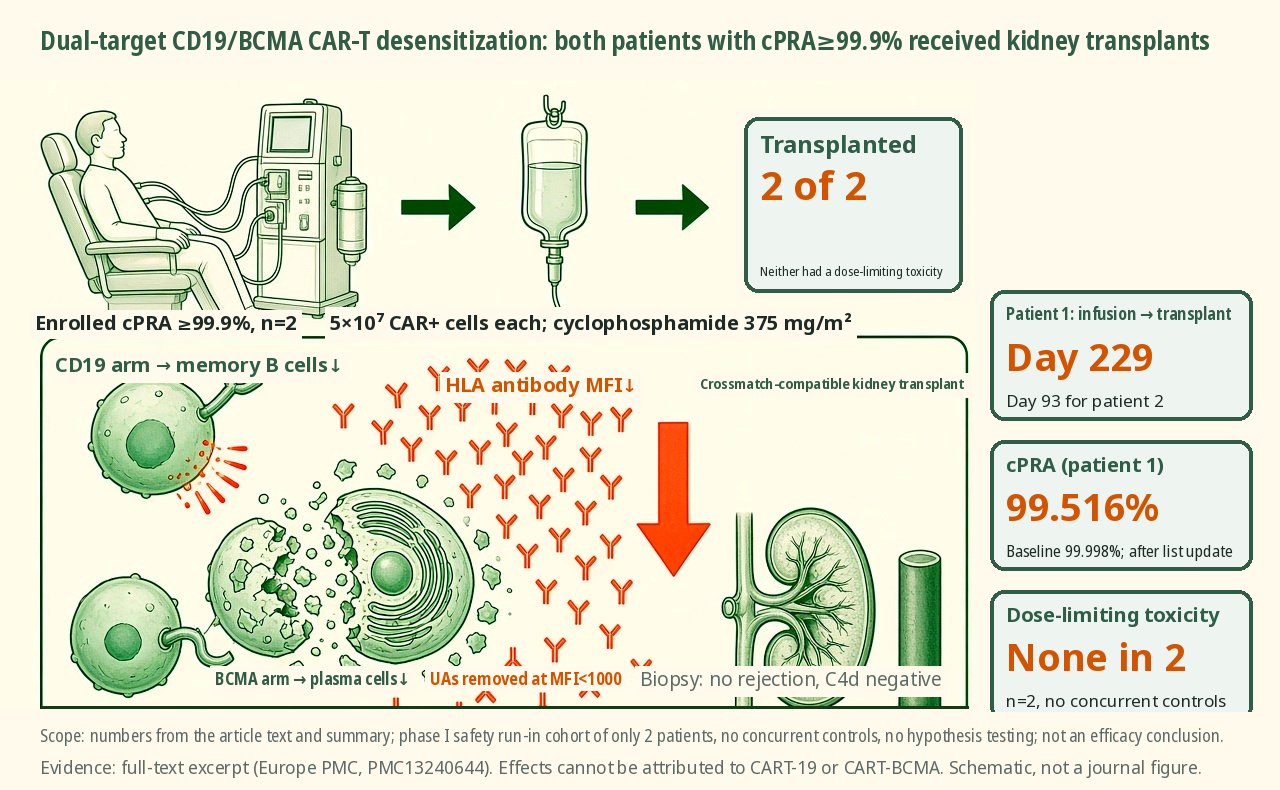
In the phase I safety run-in cohort, 2 extremely highly sensitized kidney transplant candidates with panel reactive antibody of at least 99.9% received dual-target chimeric antigen receptor T cells at 5×10^7 positive cells each, and their sensitization levels fell. Patient 1 was transplanted on day 229 after infusion and patient 2 on day 93. No dose-limiting toxicity was seen during the reporting period, and neither patient had immune effector cell-associated neurotoxicity. Patient 1 had no cytokine release and patient 2 had grade 1.
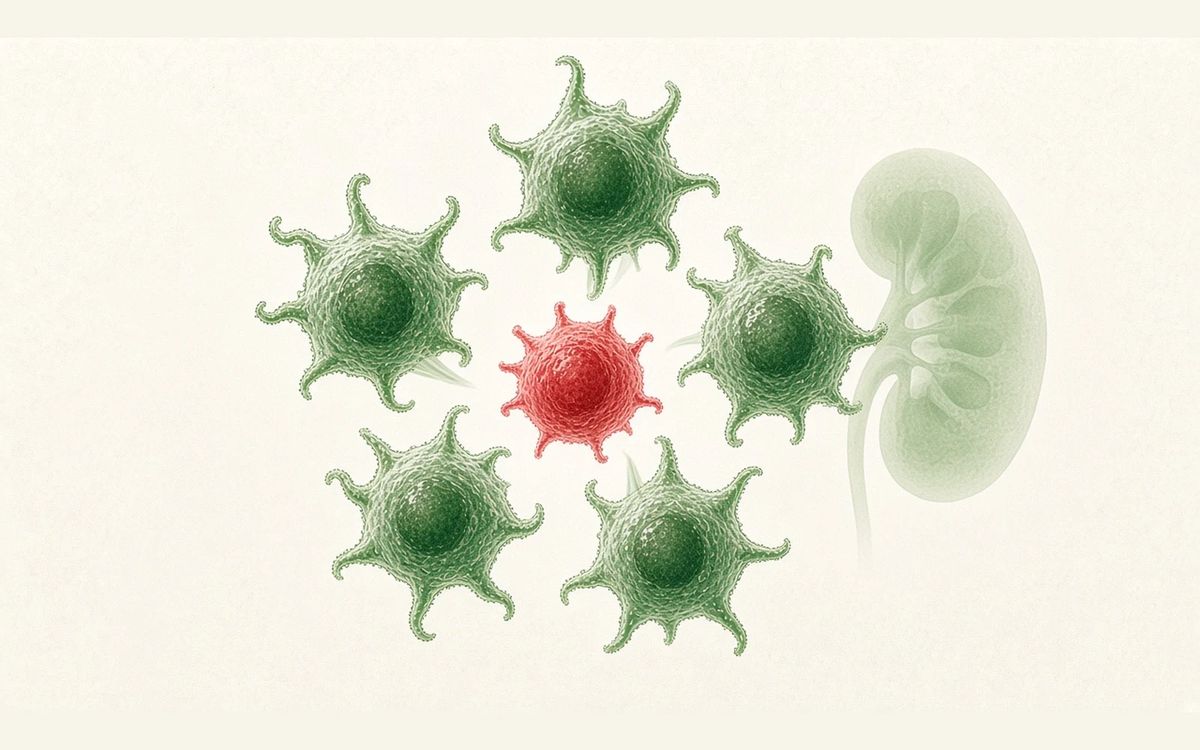
Key data card
- Study type: The safety run-in cohort of a multicentre phase I trial (NCT06056102); a published case report-level readout
- Sample size n: 2 patients in the run-in cohort, with an eligibility threshold of calculated panel reactive antibody (cPRA) ≥99.9% among kidney transplant candidates
- Controls: No concurrent controls. The protocol plans subsequent cohorts of n=3–6 with higher CAR-T doses and intensified lymphodepletion, which are not reported here
- Intervention/dose: huCART-19 and CART-BCMA at 5×10^7 CAR+ cells each (described in the paper as 10-fold lower than previous oncology trials); lymphodepletion with cyclophosphamide 375 mg/m^2 once daily for 3 days; 5 plasma exchanges about 1 month after infusion, each followed by low-dose intravenous immunoglobulin at 100 mg/kg
- Follow-up: 15 months after CAR-T for patient 1 (the paper also states stable creatinine 9 months after kidney transplantation); 8 months after CAR-T and 4 months after transplantation for patient 2, with donor-specific antibodies (DSA) still negative
- Primary endpoint: Phase I safety, with dose-limiting toxicity (DLT) determining whether to proceed to subsequent cohorts; DLT includes protocol-defined high-grade or persistent CRS, ICANS, haematological and other toxicities
- Primary endpoint result: Neither patient had a DLT, and both underwent crossmatch-compatible kidney transplantation after antibodies fell and some unacceptable antigens (UAs) were removed; this is a descriptive readout with n=2
- Statistics: n=2, with no hypothesis testing. HLA antibodies were measured by single-antigen beads, with a mean fluorescence intensity (MFI) of 1000 as the threshold for removing UAs
- Safety: Patient 1 had no CRS/ICANS between infusion and transplantation, with the only grade ≥3 event being transient neutropenia (managed with G-CSF); patient 2 had grade 3 leukopenia and grade 4 neutropenia between apheresis and transplantation, with no fever and therefore no CRS diagnosis
- Evidence level: Full-text excerpt
- Verification record: Europe PMC full-text excerpt (PMC13240644): Abstract, Methods, Results, Discussion, legends for Figures 1–3. The licence is cc by-nc-nd, so the text is paraphrased only; figures are taken solely from those appearing in the excerpt
- Dual-target CAR-T depletes memory B cells and plasma cells
- HLA antibodies fall and some UAs are removed from the waiting list
- A donor kidney is obtained and transplanted after cPRA falls
- Transplant biopsies show no rejection, with no DSA rebound yet
Background and open questions
Patients with end-stage kidney disease who are highly HLA sensitized have very few matching donors while awaiting transplantation. The paper notes that existing desensitization approaches work inconsistently, and that at the cPRA ≥99.9% extreme it is particularly hard to lower anti-HLA antibodies to a sustainable level. Memory B cells continuously generate new antibodies while long-lived plasma cells sustain those already present, so clearing only one compartment is often insufficient.
This trial combines two autologous CAR-T products from oncology, huCART-19 targeting CD19 and CART-BCMA targeting BCMA, in extremely highly sensitized kidney transplant candidates, with the aim of hitting both cell types at once. This report covers only the 2 patients in the safety run-in cohort: lower doses and weaker lymphodepletion, with DLT determining whether doses can be escalated.
Study design
NCT06056102 is a multicentre phase I trial enrolling candidates with cPRA ≥99.9%. The run-in cohort had n=2, with each CAR-T given at 5×10^7 CAR+ cells and lymphodepletion of cyclophosphamide 375 mg/m^2 once daily for 3 days only; the paper states that the cell dose is 10-fold lower than in previous oncology trials and that lymphodepletion is also gentler. Subsequent cohorts are planned at n=3–6 with higher cell doses and intensified lymphodepletion, with progression determined by DLT.
About 1 month after infusion, 5 plasma exchanges were scheduled, each followed by intravenous immunoglobulin at 100 mg/kg to speed clearance of antibodies already in circulation. After a stable decline, previously unacceptable antigens were removed from the UNOS/UNET listing at MFI<1000; antigens corresponding to DSA against previous transplant donors were not removed. Antibody testing used single-antigen beads. The authors regard these 2 patients as matching the demographic profile of extremely highly sensitized waitlisted candidates in the United States.
Key results
Patient 1: falling antibodies, an updated waiting list and transplantation
Patient 1 was a 54-year-old African American man with two previous kidney transplants, relisted at multiple centres, with cPRA of 99.998%. Based on roughly 11,000 deceased donor kidneys per year and accounting for ABO compatibility, the authors estimated his annual equivalent of compatible organs at about 0.1; in 3 years listed before CAR-T he received no kidney offers.
He had no CRS and no ICANS after infusion. The only grade ≥3 adverse event before transplantation was transient neutropenia treated with G-CSF; other cytopenias were low grade and transient. Before plasma exchange and within 1 month of infusion, 12 HLA specificities with baseline MFI>1000 (3 HLA-A, 3 HLA-B, 6 HLA-DR) fell below 1000. In month 2, a further 6 (4 HLA-B, 2 HLA-DR) crossed the threshold, and after the listing was updated cPRA was 99.746%. An organ was allocated 40 days later, but the kidney was prioritized to a multi-organ recipient. In month 7, 6 more UAs that had crossed the threshold were removed, giving a cPRA of 99.516%. Three further allocations followed within 30 days, and on day 229 after CAR-T he received a crossmatch-compatible kidney the authors describe as high quality.
Induction was anti-thymocyte globulin to a total of 6 mg/kg, with maintenance on tacrolimus, mycophenolate and prednisone. The figure legends add tacrolimus trough levels of 8–12 ng/ml, mycophenolate 500/500 mg and a prednisone taper. The paper reports stable serum creatinine 9 months after transplantation with no DSA rebound; a biopsy 2 months after transplantation showed no immune-mediated rejection and was C4d negative. All post-transplant adverse events were grade ≤2. There was no DLT through 15 months after CAR-T. The figure legend timeline: relisting in 2021 at day −1278, 500 days before CAR-T; the first UNET update at day 76 and the second at day 186; transplantation at day 215; observation to day 445; plasma exchange and IVIG on days 32–46.
Pharmacokinetics and target cells in patient 1
By qPCR, CART-19 peaked at 4×10^4 copies/μg gDNA (day 14) and CART-BCMA at 2.7×10^3 (day 7); CART-19 was undetectable by day 53 and CART-BCMA by day 172. Despite no clinical CRS, IL-6, IL-10, MCP-1 and C-reactive protein rose mildly with expansion. Peripheral B cell aplasia ran from day 13 to day 53; fine-needle aspiration of an axillary lymph node in month 2 found no B cells. In month 3, naive/transitional phenotypes made up 98.6% of all regenerating B cells. Bone marrow plasma cells were nearly absent in month 2 and recovered by month 6 while remaining below baseline; most baseline CD38+CD138+ plasma cells were CD19 positive, whereas those remaining in month 2 were CD19 negative. On this basis the authors infer that the higher CART-19 peak in this patient may have contributed more to the fall in plasma cells and HLA antibodies. Serum IgM, IgG and IgA fell until about day 50 and then rose. Protective antibodies were largely preserved; tetanus antibodies were elevated before infusion because of recent vaccination and subsequently fell while remaining at protective levels.
Patient 2: a faster path to transplantation
Patient 2 was a 47-year-old African American man whose primary disease was focal segmental glomerulosclerosis and whose two deceased donor transplants had both failed from refractory antibody-mediated rejection. cPRA was 97.883% at relisting and 99.995% at enrolment. Between apheresis and transplantation, the grade ≥3 events were grade 3 leukopenia and grade 4 neutropenia, managed with G-CSF and without transfusion. He had no fever and so by definition no CRS diagnosis, but during the same period he had low-grade myalgia, anorexia and difficulty concentrating, with elevated C-reactive protein and CRS-associated cytokines, most notably IL-10. There was no DLT through 8 months after CAR-T.
Before plasma exchange, 6 HLA specificities (1 HLA-A, 5 HLA-DP) were already below MFI 1000 in month 1; a further 15 (3 HLA-A, 12 HLA-DP) followed in month 2, and after the listing update cPRA was 99.567%. On day 93 he received a crossmatch-compatible kidney. The donor was brain dead with a KDPI of 64%, and the graft recovered slowly without post-transplant dialysis. A biopsy on day 23 after transplantation showed only mild interstitial fibrosis, with no antibody-mediated or cellular rejection and C4d negative. Low-level BK viraemia was detected at week 4, and after titres rose a repeat biopsy at week 12 showed no BK nephropathy and no rejection; mycophenolate mofetil was halved to 250 mg twice daily. Viral copies subsequently fell and immunosuppression returned to baseline. DSA remained negative 4 months after transplantation. Both CAR-T products peaked at day 10 and then contracted; B cell aplasia ran from day 15 to day 50; plasma cells were cleared by month 2. Figure legends: relisting in 2017 at day −3017, a 300-day window before CAR-T, plasma exchange at day 28 before transplantation, the UNET update at day 77 before transplantation, transplantation at day 92, and observation to day 190 after CAR-T.
Mechanistic interpretation
Demonstrated in the paper: Both patients showed deep but transient B cell depletion, with HLA antibody MFI falling broadly and some specificities crossing the 1000 threshold, lowering cPRA and translating into actual organ allocation. The lymph node aspirate in patient 1 supports depletion of tissue B cells as well; regenerating B cells were predominantly naive/transitional. Bone marrow plasma cells in patient 1 were not eliminated and the residual cells were CD19 negative, with protective antibodies largely retained, indicating incomplete plasma cell clearance. In patient 2, plasma cells are described as cleared by month 2. Neither transplant biopsy showed antibody-mediated or cellular rejection, and there was no DSA rebound during the reporting period. The effects cannot be apportioned between CART-19, CART-BCMA or both.
Author hypotheses: They attribute the absence of marked high-grade toxicity to a lower antigen burden than in haematological malignancy. Retention of protective antibodies is explained by only partial plasma cell clearance, which was nonetheless enough to lower many alloantibodies, a number of them to undetectable levels. Because CART-19 expanded more strongly in patient 1, the authors lean toward CART-19 contributing more to the fall in plasma cells and antibodies in that case. They also note that plasma cell CD19 phenotypes differed markedly between the two patients, suggesting that CART-19 alone may suffice for some patients while others still need a separate approach against plasma cells; the excerpt does not give the baseline plasma cell CD19 proportion for patient 2, and it is not supplied here. Post-transplant induction and maintenance immunosuppression may also have contributed to the absence of DSA rebound.
Limitations and uncertainties
- Only 2 patients in the safety run-in cohort, at doses below those planned subsequently, so these results cannot represent the escalation cohorts or support estimates of population success rate, long-term graft survival or net infection risk.
- The effects cannot be attributed to either CAR-T product; plasma exchange, IVIG, anti-thymocyte globulin and maintenance immunosuppression all overlap with CAR-T, so the CAR-T contribution to the absence of post-transplant DSA rebound cannot be quantified separately.
- The "9 months after transplantation" for patient 1 sits alongside the figure legend's observation to day 445 after CAR-T, and the excerpt does not reconcile the two, so no conversion is made here. The 8 months and 4 months for patient 2 are likewise reported separately from the figure legend's day 190, per the original.
- The excerpt provides no additional point estimates beyond the per-event grading of adverse events in the supplementary tables; absolute laboratory values and MFI trajectory points not listed there are omitted entirely.
- The authors call for larger trials and comparison with other B cell/plasma cell approaches such as bispecific antibodies. The licence is cc by-nc-nd, so this article is a paraphrase and does not substitute for the original.
Clinical and industry implications
If escalation cohorts can still lower cPRA from >99.9% to a level sufficient to obtain a crossmatch-compatible kidney without DLT, dual-target CAR-T could become a path for patients in whom existing desensitization has failed. For now the claim is only this: in a run-in design with lower doses and weaker lymphodepletion, both patients were transplanted, with negative short-term biopsies and no DSA rebound so far. The questions industry must answer are how to escalate dose, whether CD19 and BCMA must be combined, and how to deplete plasma cells deeply enough while preserving protective antibodies. All of these lie beyond this run-in cohort.
Authors, source and verification
Bhoj VG, Kaminski M, Zhao H, et al. Kidney transplant in two highly-sensitized candidates post-CAR T cell therapy. N Engl J Med. 2026. doi: https://doi.org/10.1056/NEJMoa2513428
Evidence level: Full-text excerpt; verification record: The Abstract, Methods, Results, Discussion and legends for Figures 1–3 in the PMC13240644 excerpt. Licence cc by-nc-nd, so the text is paraphrased only; figures are taken solely from those appearing in the excerpt
Bhoj VG, Garfall AL, Naji A, et al. Kidney Transplantation in Two Highly Sensitized Candidates after CAR T-Cell Therapy. N Engl J Med. 2026 Jun 1. https://doi.org/10.1056/nejmoa2513428
Primary field: Autoimmunity & transplant · Related: Dual-target CAR-T, Kidney transplant desensitization, CD19, BCMA, High sensitization, cPRA
Summary of a published paper or preprint, written from the original text; numbers are as reported by the authors. Not medical or investment advice. Corrections: contact@
Related science
Anti-CD19 CAR-T in refractory MG: 3 patients in treatment-free remission for at least 19 months
The neuromuscular junction at left, CAR-T cells clearing red B cells at right
GPR15 guides regulatory CD8 T cells to the colon, with a 42% reduction in sporadic UC
Green regulatory T cells homing to the intestinal epithelium, with red dots marking homing receptors
Hashimoto's thyroiditis: 135 distinct TNFRSF14 mutations in a single donor
Thyroid follicles at left, B cell clones at right, with red dots marking mutations
One email, with links to every paper. Reports and custom landscapes: contact@inlightbio.com.