251 samples across 11 monogenic ASD mouse models: a transient delay in the radial glia lineage and 715 DEGs in P4 layer II/IV neurons
Single-nucleus multi-omic sequencing of 251 samples from 11 monogenic ASD mouse models shows that mutations converge on a transient developmental delay in the radial glia lineage, with shared transcriptional differences greatest in P4 layer II/IV neurons (715 DEGs).
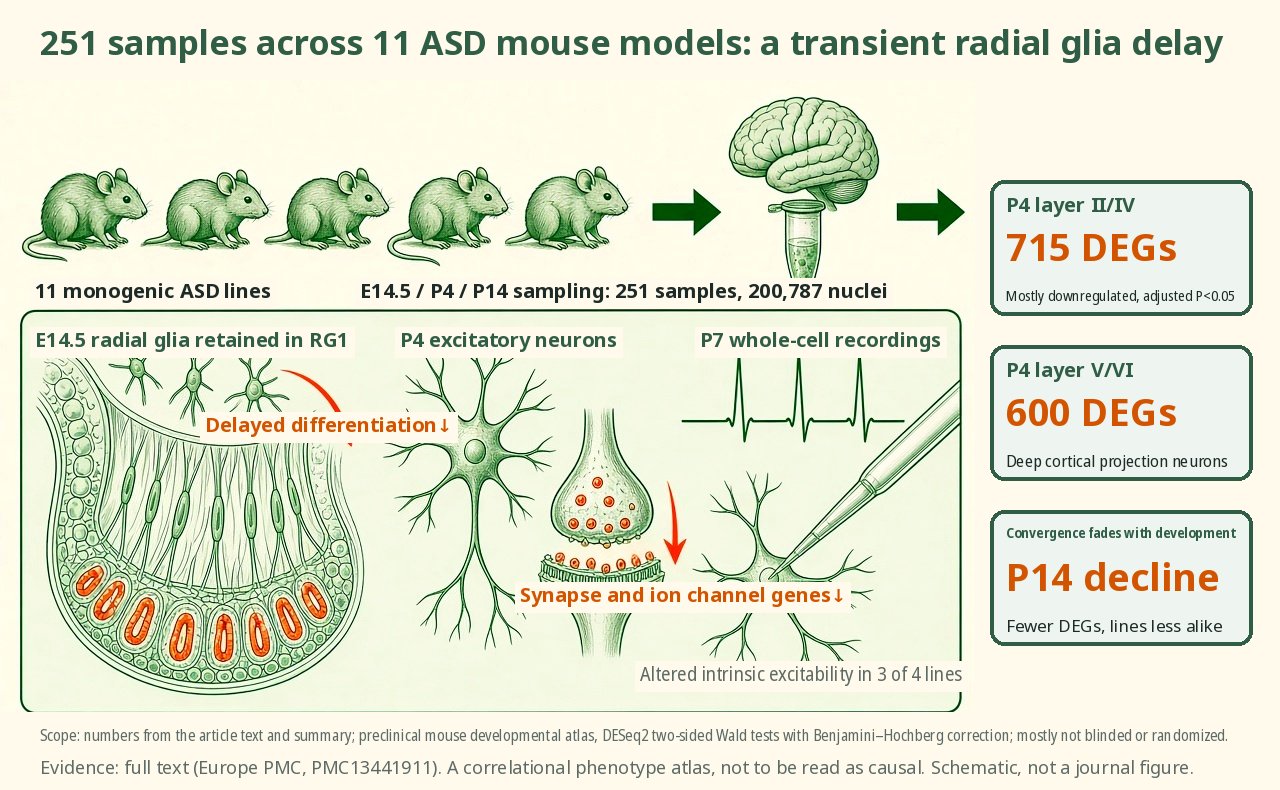
Single-nucleus RNA+ATAC sequencing was performed on 251 samples and 200,787 nuclei from 11 monogenic ASD mouse models. Mutations converged on a transient developmental delay in the radial glia lineage, manifesting as retention in proliferative RG1. Shared transcriptional differences were greatest in P4 layer II/IV neurons (715 DEGs), with 600 DEGs in layer V/VI deep projection neurons, most of them downregulated. Downregulated modules at P4 were enriched for synapses and ion channels. Arid1b and Shank3 shared 236 DEGs in E14.5 radial glia. Electrophysiology in four lines showed altered intrinsic excitability in three, correlated with deviations in ion channel expression.
Key data card
- Study type: Preclinical animal study (single-nucleus RNA+ATAC multi-omics across 11 monogenic ASD mouse models, with electrophysiology and gait analysis)
- Sample size n: 251 samples, 45 conditions and 200,787 nuclei; forebrain at E14.5 mostly 6–7 animals per genotype (3 for Ptchd1), P4 mostly 6 (4 for Kmt5b, 3 for Ptchd1), P14 mostly 6–8; the Methods specify n=3 per genotype per sex at E14.5 and n=3 per genotype per sex per time point at P4/P14; cerebellum at P4 n=3 per genotype; electrophysiology with 5 for Bckdk, 4 for HnrnpU, 7 for Usp7, 7 for Trip12 and 18 pooled controls
- Controls: Colony-matched wild-type animals from the same central C57BL/6J colony; electrophysiology additionally included littermate controls (11 colony-matched, 7 littermate, 18 pooled)
- Intervention/dose: Constitutive heterozygous mutations, or homozygous Bckdk and Ptchd1−/y mutations, with no drug intervention; electrophysiology used whole-cell recordings from layer II/III pyramidal neurons in P7 somatosensory cortex
- Follow-up: Developmental windows at E14.5, P4 and P14; electrophysiology at P7; gait at P13–15
- Primary endpoint: Core readouts are pseudobulk differential expression per cell type (adjusted P<0.05) and pseudotime of the E14.5 radial glia lineage
- Primary endpoint result: Pooling all mutations against controls, layer II/IV had 715 DEGs and layer V/VI deep cortical projection neurons 600 DEGs at P4, most of them downregulated; mutant radial glia tended to be retained in proliferative RG1, indicating a transient developmental delay
- Statistics: DESeq2 two-sided Wald tests with Benjamini–Hochberg correction; edgeR two-sided quasi-likelihood F tests (nominal P); electrophysiology by unpaired two-sided t tests or Mann–Whitney; GSEA at FDR<0.05; no general blinding or randomization
- Safety: Not applicable (a developmental phenotype atlas with no treatment safety readouts)
- Evidence level: Full text
- Verification record: Read the Europe PMC full-text XML (PMC13441911): Abstract, Main, Results sections, Discussion, Methods, legends for Figs. 1–6 and Extended Data legends
- 11 mutant lines sampled at E14.5, P4 and P14
- Radial glia retained in the proliferative RG1 state
- P4 neurons downregulate synapse and ion channel genes
- Electrophysiology correlates with transcriptional deviation, with convergence weaker at P14
Background and open questions
More than 100 causal genes with diverse functions have been mapped in autism spectrum disorder (ASD). The open question is not to list more genes but whether these scattered mutations converge on the same cellular programmes during development, and how long such convergence lasts.
In Nature, Schwarz, Bock, Novarino and colleagues report using scalable single-nucleus multi-omics to place 11 high-risk monogenic mouse models on a shared timeline, covering both sexes and both forebrain and cerebellum. Their approach is to ask first whether the radial glia lineage shares a transient delay, then whether postnatal neuronal transcription and electrophysiology still point to the same synapse and ion channel modules.
Study design
All 11 lines were on a C57BL/6J background: Ash1l+/−, Bckdk−/−, Cul3+/−, HnrnpU+/−, Kdm6b+/−, Kmt5b+/−, Ptchd1−/y, Setd5+/−, Trip12+/−, Usp7+/− and Wac+/−. Controls were wild-type offspring from the same central C57BL/6J colony; apart from homozygous Bckdk, sequenced mutant mice came from crosses of C57BL/6J females with mutant males. The Methods specify at least three litters, with n=3 per genotype per sex at E14.5 and n=3 per genotype per sex per time point at P4 and P14. Unless stated otherwise, experiments were neither blinded nor randomized.
Sequencing used cholesterol-modified oligonucleotides (CMOs) to multiplex single-nucleus RNA and ATAC libraries across 45 conditions and 251 samples. After quality control, 200,787 nuclei remained: 66,969 forebrain nuclei at E14.5, 56,260 at P4 and 59,974 at P14, plus 17,584 cerebellar nuclei at P4; median sequencing depth was about 25,000 reads per cell. Cell types numbered 12 at E14.5, 22 at P4, 26 in P14 cortex and 16 in P4 cerebellum. Electrophysiology covered four lines, Bckdk, HnrnpU, Trip12 and Usp7, with whole-cell recordings from layer II/III pyramidal neurons at P7.
Key results
A transient delay in the radial glia lineage
Pooling all mutations against wild type, overall cell proportions were similar, but cortical plate cells at E14.5 and oligodendrocyte precursor cells (OPCs) at P4 were significantly reduced; stratified by genotype, the trend was stronger for Cul3, HnrnpU, Kdm6b and Ptchd1. The reduction in cortical plate at E14.5 coincided with a higher proportion of radial glia. By P4, neuron numbers were close to wild type while immature astrocytes and OPCs remained reduced; at P14, OPCs were still low while other cell types had normalized.
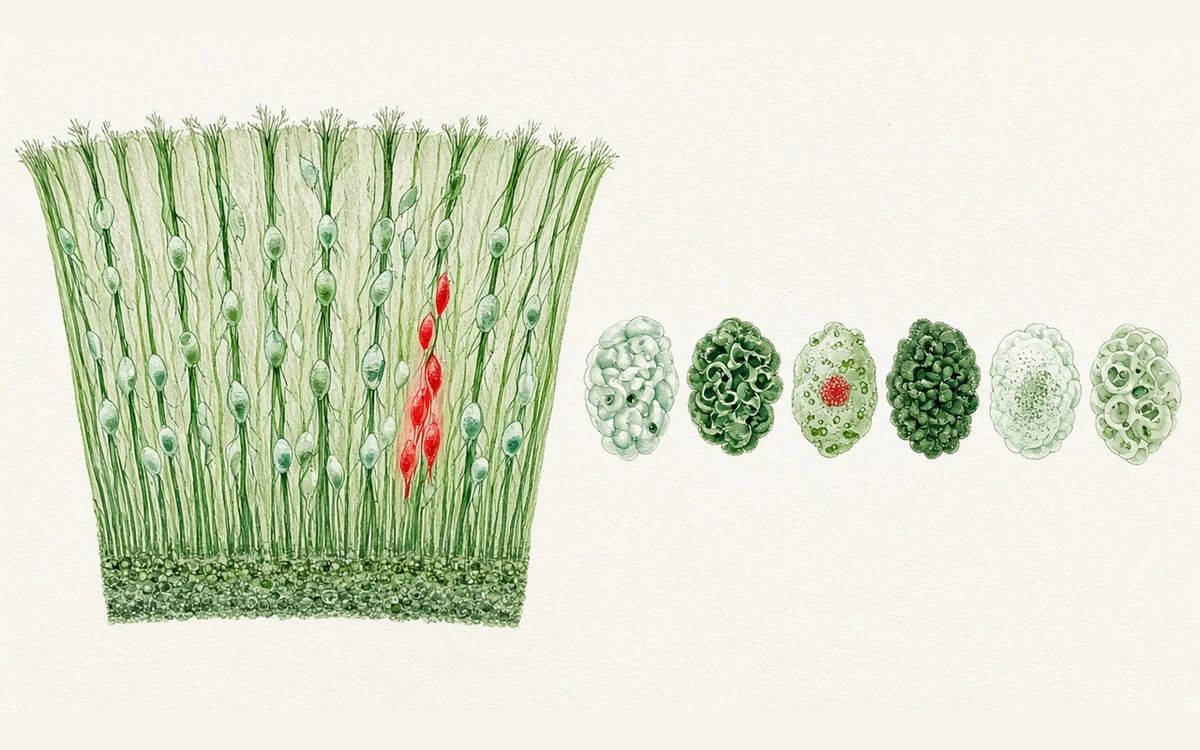
Pseudotime at E14.5 divided radial glia into proliferative RG1 (G1/S, including MKi67) and RG2 (G2). Mutant cells tended to be retained in RG1 with delayed differentiation. EdU labelling showed more EdU-positive cells in both HnrnpU+/− (n=6 wild type, 5 heterozygous) and Kdm6b+/− (flow cytometry: n=15 wild type, 18 heterozygous). Pooling all mutations, only Rsrp1 and Galnt17 were significantly downregulated in RG1; by line, HnrnpU had the most RG1 DEGs (over 150 at FDR<0.1). On this basis the authors conclude that this is a transient delay in lineage progression rather than persistent lineage misspecification.
The largest shared transcriptional differences appear in P4 excitatory neurons
In pseudobulk analysis of all mutations against wild type, shared DEGs were concentrated almost entirely at P4: 715 in layer II/IV and 600 in layer V/VI deep cortical projection neurons (adjusted P<0.05), most of them downregulated; other cell types and time points had few or no shared DEGs. After grouping cells into subclasses, P4 excitatory neurons remained the strongest shared signal. Most genotypes exceeded 700 DEGs in total across subclasses and time points (counting duplicates once); at E14.5 only HnrnpU+/− and Kdm6b+/− changed broadly, and DEG counts fell again by P14.
Among P4 excitatory neurons, about 10% of DEGs were shared by at least four mutations, while overlap between neurons and non-neurons within the same mutation was small. Among the most frequently recurring DEGs, 34% were ASD-associated genes, enriched for synaptic proteins (q=1.03×10⁻¹⁵). At the same time, at least 50% of DEGs in each cell type appeared in only one genotype. The trends persisted after downsampling sequencing depth: excitatory and inhibitory neurons were similarly affected and glia less so, with Cul3 the exception in which glia exceeded neurons.
Network convergence weakens with development, with genotype-specific changes layered on top
GSEA and protein interaction networks pin the common themes to stages: cell cycle, chromosome segregation and neurite outgrowth at E14.5; synapses and ion channels at P4; and synapse-related changes still present at P14 but less alike across genotypes. Within a developmental stage, mutations resembled one another more than expected by chance; by P14, similarity fell, especially in excitatory neurons. Scn1a was among the most frequently affected channels, and most mutations perturbed presynaptic and postsynaptic processes alike. Comparing each mutation with the other ten reveals Cul3 skewing toward migration, Bckdk toward amino acid metabolism, Trip12 toward respiration and energy, HnrnpU toward secretion and cilia, and Kdm6b toward WNT.
Electrophysiology correlates with deviations in ion channel transcription
Three of the four lines showed altered intrinsic excitability or frequency–current relationships; Trip12 was the exception, consistent with its weaker channel transcriptional changes in P4 layer II/IV. Euclidean distances in ion channel expression correlated with distances in electrophysiological features by Spearman correlation. A minimal conductance model, with channels adjusted in the direction and magnitude of the transcriptional changes, reproduced the experimentally observed diversity in action potentials and frequency–current relationships. mEPSC and mIPSC frequencies fell in Bckdk, Usp7 and Trip12, consistent with downregulation of release machinery such as Rims1/2, Syn2 and Dnm1l; Bckdk also showed reduced mEPSC amplitude alongside Gria1 downregulation. HnrnpU showed mild miniature synaptic phenotypes despite broad transcriptional changes, and the authors point to upregulated compensatory candidates such as Akap12.
Chromatin accessibility, sex and cerebellum
Differentially accessible regions (DARs, P<0.001) were most numerous at E14.5, most prominently in radial glia; pooling all mutations, overall accessibility decreased. HnrnpU+/− and Kdm6b+/− radial glia had 801 and 335 DARs at E14.5. Apart from sex chromosome genes, there were almost no DEGs between male and female controls. At P4, Ash1l, Bckdk, HnrnpU, Trip12, Usp7 and Wac had more DEGs in females than males; in the pooled analysis about 61% of DEGs lost significance after splitting by sex (merged DEGs), with similar effect sizes in both sexes, while female-only significant, same-direction fbDEGs had larger effect sizes in females. Female-specific DEGs were enriched for synapses (q=6.5×10⁻⁷), ion channels (q=4.8×10⁻⁶) and cell adhesion (q=7.9×10⁻³).
P4 cerebellum (males, n=3 per genotype) had almost no DEGs shared across mutations; Bckdk was the exception, with 1,023 genes shared between cortex and cerebellum. In gait at P13–15, Bckdk−/− (n=4, controls n=3) showed reduced stride length, step length and speed, while Kmt5b (n=7 each) showed no motor abnormality.
Mechanistic interpretation
Demonstrated in the paper: Pseudotime, EdU and cell composition together show mutant radial glia retained in a proliferative state; P4 neurons share downregulation of synapse and ion channel modules; channel expression deviations correlate with deviations in membrane properties, and adjusting a minimal conductance model in the transcriptional direction suffices to reproduce a variety of firing curves. The common theme is stage-bound transcriptional–physiological coupling rather than a single driver gene.
Author hypotheses: Genotype-specific signatures strengthen with maturation, and whether the early shared changes suffice to reshape later trajectories remains an open question. They argue that intervention windows should be considered by stage and sex, but perform no rescue experiments here.
Limitations and uncertainties
- Experiments were not generally blinded or randomized; Ptchd1 was male-only with n=3, and Setd5 females at P14 had n=2, so some comparisons have limited power.
- DARs used an uncorrected P<0.001; electrophysiology covered only four lines, a single cortical layer and P7; the cerebellum was studied only in males at P4; and gait sample sizes were very small (3 controls and 4 mutants for Bckdk).
- OPCs remained low at P14, so "the delay resolves postnatally" refers mainly to normalization of neuronal composition and does not mean every glial endpoint recovers.
- About half of DEGs were private to one genotype, and convergence weakened at P14; transcriptional–electrophysiological coupling in mice cannot be extrapolated directly to patient cortex.
Clinical and industry implications
If the early radial glia delay and the P4 downregulation of synaptic modules hold up in more models and in human tissue, the intervention window may fall in the perinatal period rather than after school-age phenotypes emerge. The sex stratification suggests that pooling the sexes may underestimate effect sizes in females. This is a mouse atlas, not a therapeutic trial, and "convergence" should not be read to mean that all ASD subtypes can share a single target.
Authors, source and verification
Evidence level: Full text; verification record: Read the Europe PMC full-text XML (PMC13441911): Abstract, Main, Results sections, Discussion, Methods, legends for Figs. 1–6 and Extended Data legends
Schwarz LA, Dotter CP, Isaev S, Lisi M, Malzl D, Büschl C, et al. Cortical development dynamics across autism spectrum disorder mouse models. Nature. 2026 Jun 17. doi: https://doi.org/10.1038/s41586-026-10679-1
Primary field: Disease models · Related: Autism spectrum disorder, Single-nucleus multi-omics, Radial glia, Synapses and ion channels, Sex differences
Summary of a published paper or preprint, written from the original text; numbers are as reported by the authors. Not medical or investment advice. Corrections: contact@
Related science
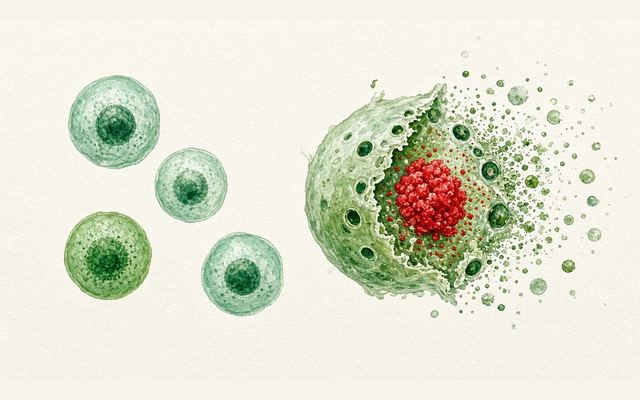
Human DPP9 loss causes HSPC depletion through CARD8 pyroptosis
A normal haematopoietic stem cell at left and a pyroptotic, ruptured cell at right
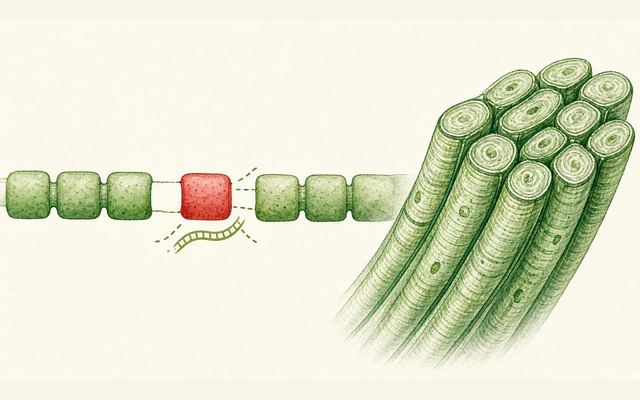
Four humanized DMD lines: deletions of exon 44, 45, 51 or 53
The red exon in the row is the one being skipped, with muscle fibres at right
A pIgR bispecific raises cynomolgus BAL exposure 5.5-fold
A bispecific crossing airway epithelial cells and released at the airway surface
One email, with links to every paper. Reports and custom landscapes: contact@inlightbio.com.