Four humanized DMD mouse models carrying deletions of exon 44, 45, 51 or 53, with flanking exon skipping restoring dystrophin
Four mouse models with deletions of human DMD exon 44, 45, 51 or 53 were generated on the mdx background; gastrocnemius muscle in 8-week-old males lacked dystrophin or had only trace amounts, and intramuscular injection of vivo-morpholinos to skip flanking exons restored the protein.
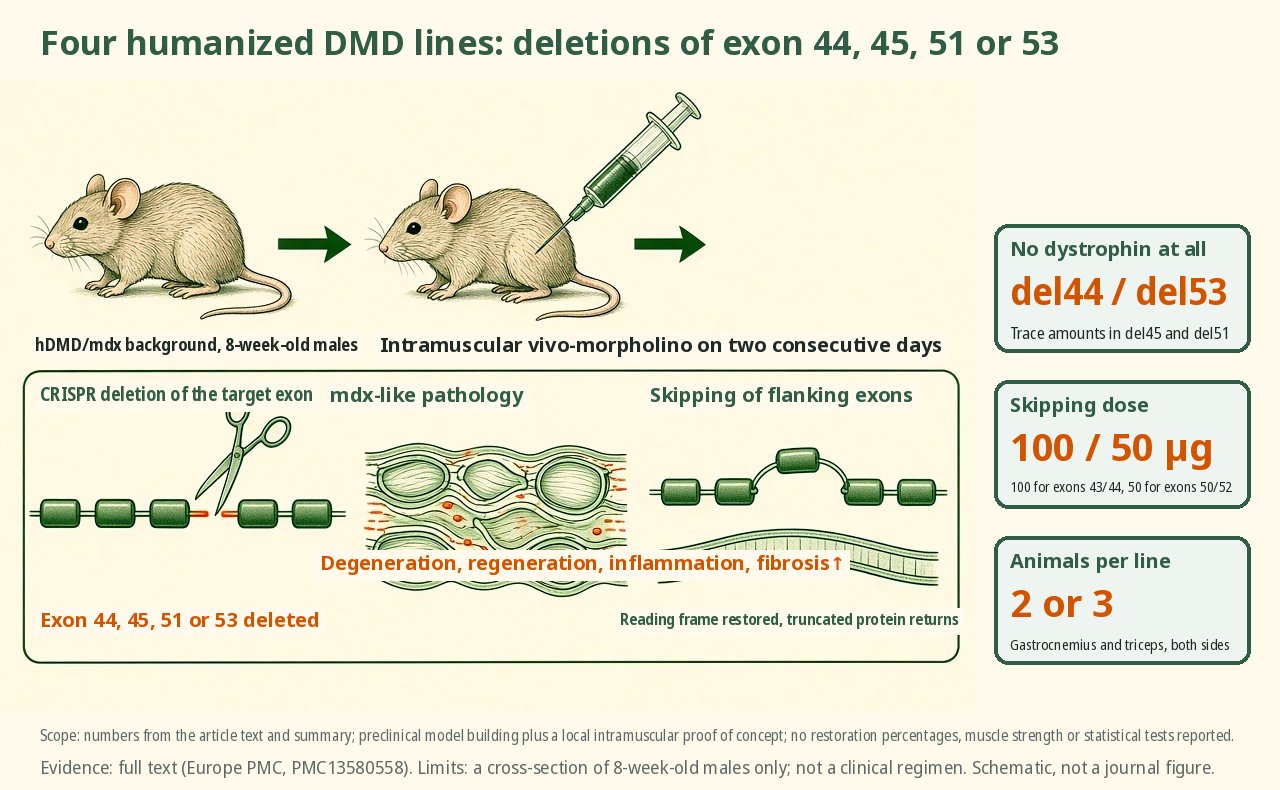
Four mouse models with deletions of human DMD exon 44, 45, 51 or 53 were generated on the mdx background. hDMDdel44/mdx and hDMDdel53/mdx completely lacked dystrophin, while hDMDdel45/mdx and hDMDdel51/mdx had trace amounts. Intramuscular injection of vivo-morpholinos into gastrocnemius and triceps on two consecutive days in 8-week-old males (100 µg per muscle for exons 43/44 and 50 µg per muscle for exons 50/52) produced detectable skipping of the target exon and restored truncated protein on Western blot. All four models showed degeneration, regeneration, inflammation and fibrosis in the gastrocnemius.
Key data card
- Study type: Preclinical animal study (generation of humanized DMD mouse models and intramuscular antisense oligonucleotide proof of concept)
- Sample size n: Pathology and protein in 8-week-old males; Western blots used 2 individuals per line, with left and right limbs of the same mouse for hDMDdel53/mdx; exon skipping used left and right gastrocnemius and triceps from 2 or 3 male mice per line; the del53 allele was sequenced from 12 TOPO clones
- Controls: hDMD/mdx (human dystrophin at wild-type levels), C57BL/6J, mdx; the skipping experiments included saline, no-reverse-transcriptase and water controls
- Intervention/dose: Intramuscular vivo-morpholinos on two consecutive days in 8-week-old males: 100 μg per muscle for exons 43/44 and 50 μg per muscle for exons 50/52; 50 μL in gastrocnemius and 40 μL in triceps; 50 μg produced insufficient 43/44 skipping to restore protein, hence the higher dose
- Follow-up: Pathology and protein in untreated mice at 8 weeks of age; tissue collected 2 weeks after the last injection in the skipping experiments
- Primary endpoint: Core readouts: whether human dystrophin is absent or present only in trace amounts, whether muscles show mdx-like pathology, and whether skipping a flanking exon restores the reading frame and protein
- Primary endpoint result: hDMDdel44/mdx and hDMDdel53/mdx completely lacked dystrophin while hDMDdel45/mdx and hDMDdel51/mdx had trace amounts; all four models showed degeneration, regeneration, inflammation and fibrosis in the gastrocnemius; target exon skipping and truncated dystrophin were detectable in all four models
- Statistics: This is a model generation and qualitative validation study, with no between-group P values or quantitative percentages of protein restoration reported
- Safety: No ASO-related adverse events reported; the experiments used local intramuscular injection and were not a systemic toxicity assessment
- Evidence level: Full text
- Verification record: Read the Europe PMC full-text XML (PMC13580558): Abstract, Introduction, Results sections, Discussion, Materials and Methods and legends for Figs. 1–6
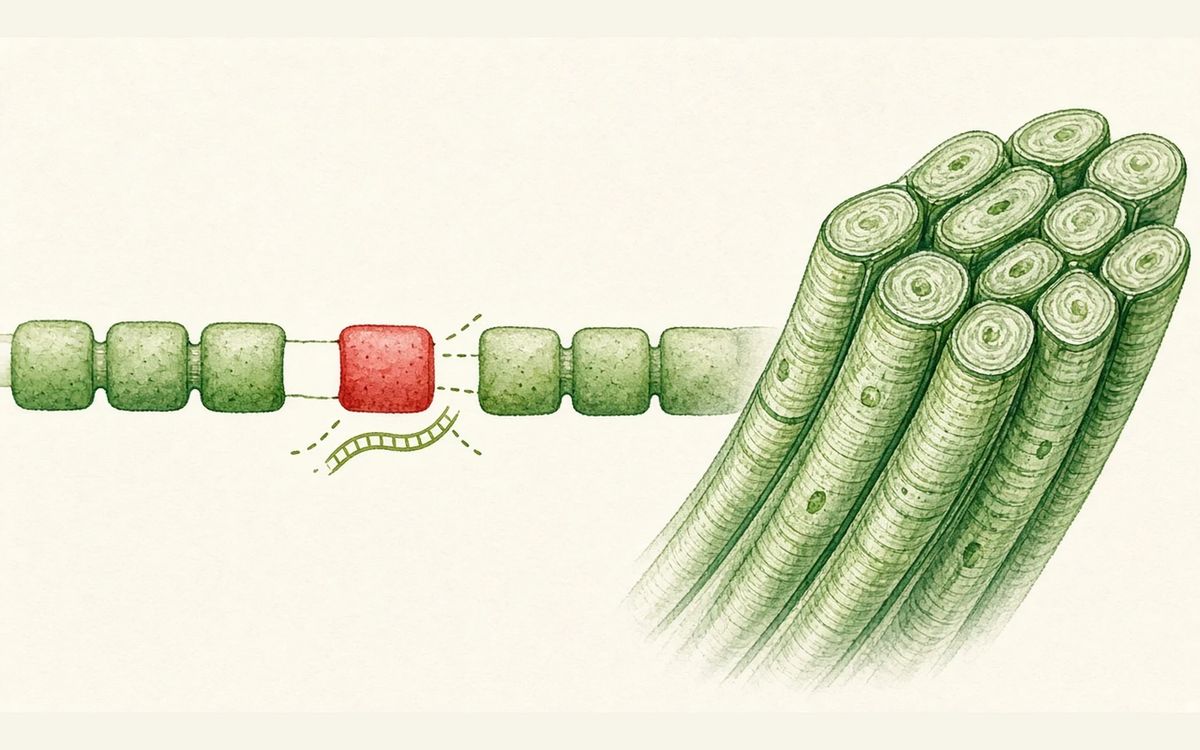
- CRISPR deletion of target exons on the duplicated human DMD YAC
- Dystrophin absent or present only in traces on the mdx background
- Degeneration, regeneration, inflammation and fibrosis appear
- Skipping a flanking exon restores the reading frame and protein
Background and open questions
Duchenne muscular dystrophy (DMD) is caused by disruption of the DMD reading frame. With multidisciplinary care, patients mostly lose ambulation in their teens, need assisted ventilation around age 20, and die of respiratory or heart failure in the second to fourth decade of life. Variants in the middle of the gene that preserve the reading frame instead produce the milder Becker form. Exon skipping and gene editing are both variant specific and must act on human sequence.
The most widely used mdx mouse carries a nonsense mutation in mouse Dmd exon 23, so it validates mouse sequence. The humanized hDMD yeast artificial chromosome (YAC) carries the complete 2.3 Mb human gene and can rescue the mdx phenotype, but is integrated on mouse chromosome 5 as a tail-to-tail duplication. The previously described hDMDdel52/mdx has already proved useful as a preclinical tool, but knocking out other exons risks excising the 3′ end of both copies at once. The problem van Putten, Aartsma-Rus, Hohenstein and colleagues set out to solve is how to make the single-exon deletions most common in patients cleanly on this duplicated YAC, and to show that human-targeted ASOs can still bring the protein back.
Study design
hDMD/mdx carries two tail-to-tail copies of human DMD. Prescreening used two PCR assays: one spanning the expected deletion to confirm that the target exon had been removed while the 3′ flank remained, and one inside the deletion to exclude clones or animals in which only one copy had been deleted. del44 was generated in previously isolated hDMD/mdx embryonic stem cells using Cas9 RNPs targeting introns 43 and 44, with lines established by blastocyst injection. del45, del51 and del53 were produced by direct zygote electroporation: wherever possible, homozygous hDMD/mdx males were crossed with C57BL/6J females so that each embryo carried only one tail-to-tail insertion. Lines were then backcrossed to mdx on C57BL/6J, reducing the number of generations needed to bring in the mdx mutation.
Skipping was validated in 8-week-old males: exon 43 for del44, exon 44 for del45, exon 50 for del51 and exon 52 for del53. Gastrocnemius and triceps were injected bilaterally on two consecutive days; tissue was collected 2 weeks after the last injection, with cryosections from the same muscle used for both RNA and protein.
Key results
Prescreening for both copies enabled all four deletions
Among del44 embryonic stem cell clones, 14% of candidates passed the two-step prescreen; Sanger sequencing revealed only one deletion, indicating that both YAC copies had received the same deletion. del45 likewise showed only one deletion. For del51, the first round usually lost only one copy, and a second guide targeting a sequence inside the already-deleted segment was needed to obtain founders lacking exon 51 on both copies. del53 initially gave mixed sequencing peaks, and TOPO cloning of 12 clones resolved two different deletions on the two copies. ddPCR showed that, apart from the target exon deletion, the other exons sampled across the gene remained at two copies.
Dystrophin loss and mdx-like pathology by 8 weeks of age
Human dystrophin in healthy hDMD/mdx gastrocnemius reached wild-type levels. hDMDdel44/mdx and hDMDdel53/mdx lacked it entirely; hDMDdel45/mdx and hDMDdel51/mdx had trace amounts, with del51 showing almost no positive signal by immunofluorescence. All four deletion models showed muscle fibre degeneration and regeneration, inflammation and fibrosis, which the authors consider comparable to mdx/BL6. Western blots loaded two individuals per line, with left and right limbs of the same mouse used for del53.
Skipping flanking exons restores truncated protein
In left and right gastrocnemius and triceps from 2 or 3 male mice per line, RT-PCR showed skipping of the target exon in every case. Western blots detected truncated dystrophin in both gastrocnemius and triceps. In the Discussion the authors note that protein restoration after skipping exon 43 in hDMDdel44/mdx was relatively low, possibly because protein lacking 43–44 is less stable, or simply because the ASO design was not optimized; the main text gives no restoration percentages. Skipping of 43/44 at 50 μg was insufficient to restore protein, so 100 μg was used for those two.
Mechanistic interpretation
Demonstrated in the paper: After deleting exon 44, 45, 51 or 53 on the duplicated human DMD YAC, human dystrophin on the mdx background disappeared or remained only in traces, and gastrocnemius at 8 weeks of age showed mdx-like histopathology. Human-targeted vivo-morpholinos against flanking exons induced skipping, restored the reading frame and brought truncated protein back in both gastrocnemius and triceps. ddPCR showed the target exon deleted while other sampled exons remained at two copies, indicating that the phenotype is not the loss of a whole YAC segment.
Author hypotheses: They suggest that the trace protein in del45 and del51 comes from spontaneous skipping in some muscle fibres, consistent with trace protein seen clinically in patients eligible for exon 44 skipping; this explanation was not demonstrated directly here with single fibres or sequencing. They also note that the duplicated YAC brings human protein expression closer to healthy controls but may underestimate targeting efficiency for gene editing therapies.
Limitations and uncertainties
- The authors state that natural history work (changes in motor function, histology and molecular readouts with age) is still ongoing; this paper provides only a cross-section in 8-week-old males, focused mainly on gastrocnemius.
- The skipping experiments used only 2 or 3 mice per line with local intramuscular injection, with no quantitative protein percentages, no muscle force or systemic dosing data, and no statistical testing reported.
- The tail-to-tail duplicated integration may cause gene editing efficiency to be underestimated; the two copies in del53 do not carry identical deletions.
- The mdx background is itself milder than the patient condition, and the spontaneous skipping hypothesis for trace protein remains open. A local proof of concept should not be read as a clinically effective exon skipping regimen.
Clinical and industry implications
Together with the existing hDMDdel52/mdx, these four lines cover the most common single-exon deletions in patients: exon 45 (4%), 51 (3%), 44 (3%) and 52 (3%). The authors cite literature stating that single-exon skipping of these exons could in total address more than 50% of mutations, though the exact proportion depends on whether a given deletion can be skipped in the forward or reverse direction. For human-targeted ASOs and guide RNAs, these models offer sequence matching rather than completed pharmacodynamic quantification. Using them in preclinical gene editing studies may first require conversion to a single-copy YAC following published strategies.
Authors, source and verification
Evidence level: Full text; verification record: Read the Europe PMC full-text XML (PMC13580558): Abstract, Introduction, Results sections, Discussion, Materials and Methods and legends for Figs. 1–6
van Putten M, Linssen M, Tanganyika-de Winter C, Brouwers CM, Claassens JWC, Verwey N, et al. Four new mouse models of Duchenne muscular dystrophy with clinically relevant exon deletions in the human DMD gene. Dis Model Mech. 2026 Aug 28. https://doi.org/10.1242/dmm.052875
Primary field: Disease models · Related: Nucleic acid and gene therapy, DMD, Exon skipping, Humanized mice, Vivo-morpholinos
Summary of a published paper or preprint, written from the original text; numbers are as reported by the authors. Not medical or investment advice. Corrections: contact@
Related science
Human DPP9 loss causes HSPC depletion through CARD8 pyroptosis
A normal haematopoietic stem cell at left and a pyroptotic, ruptured cell at right
251 samples across 11 ASD mouse models: a transient radial glia delay
Red marks the delay among radial glial fibres, with multiple models in the right column

A pIgR bispecific raises cynomolgus BAL exposure 5.5-fold
A bispecific crossing airway epithelial cells and released at the airway surface
One email, with links to every paper. Reports and custom landscapes: contact@inlightbio.com.