Knocking out DPP9 in humanized mice causes CARD8-driven pyroptosis, haematopoietic stem cell depletion and pancytopenia
CRISPR knockout of DPP9 in human CD34+ HSPCs in MISTRG6 mice reproduced peripheral and bone marrow cytopenias; the loss is driven by CARD8-mediated pyroptosis, rescued by knocking out CARD8 or CASP1 but not NLRP1.
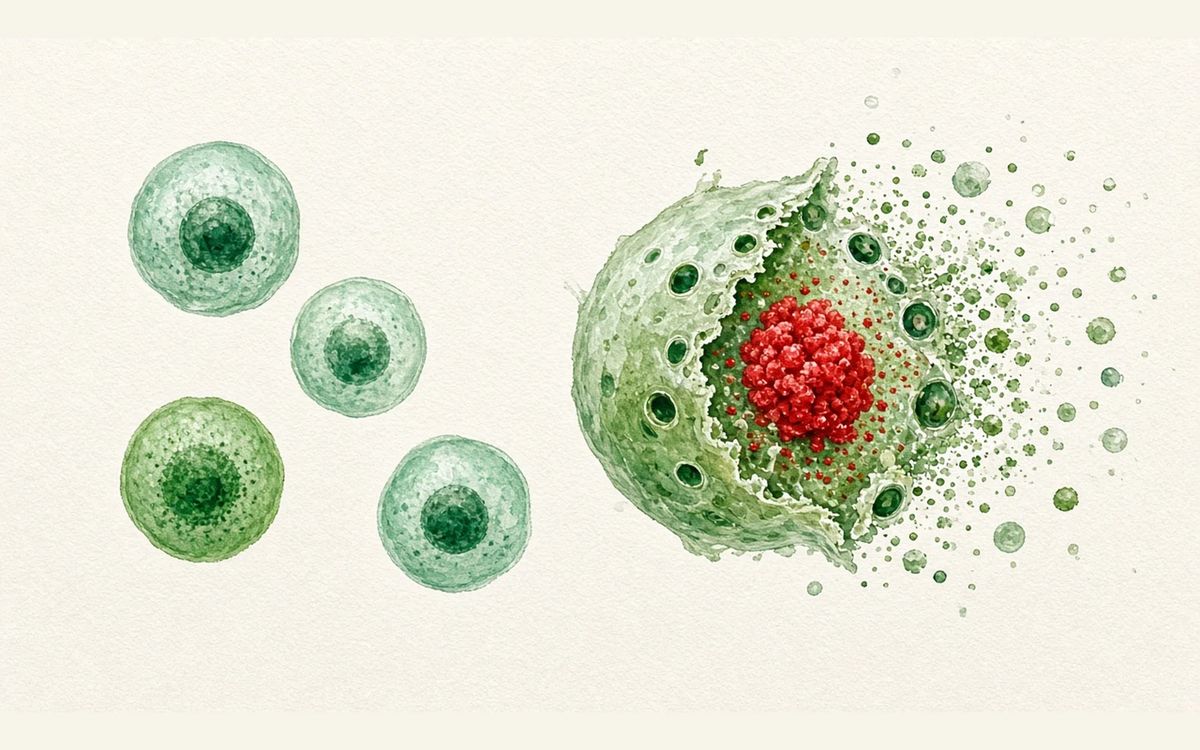
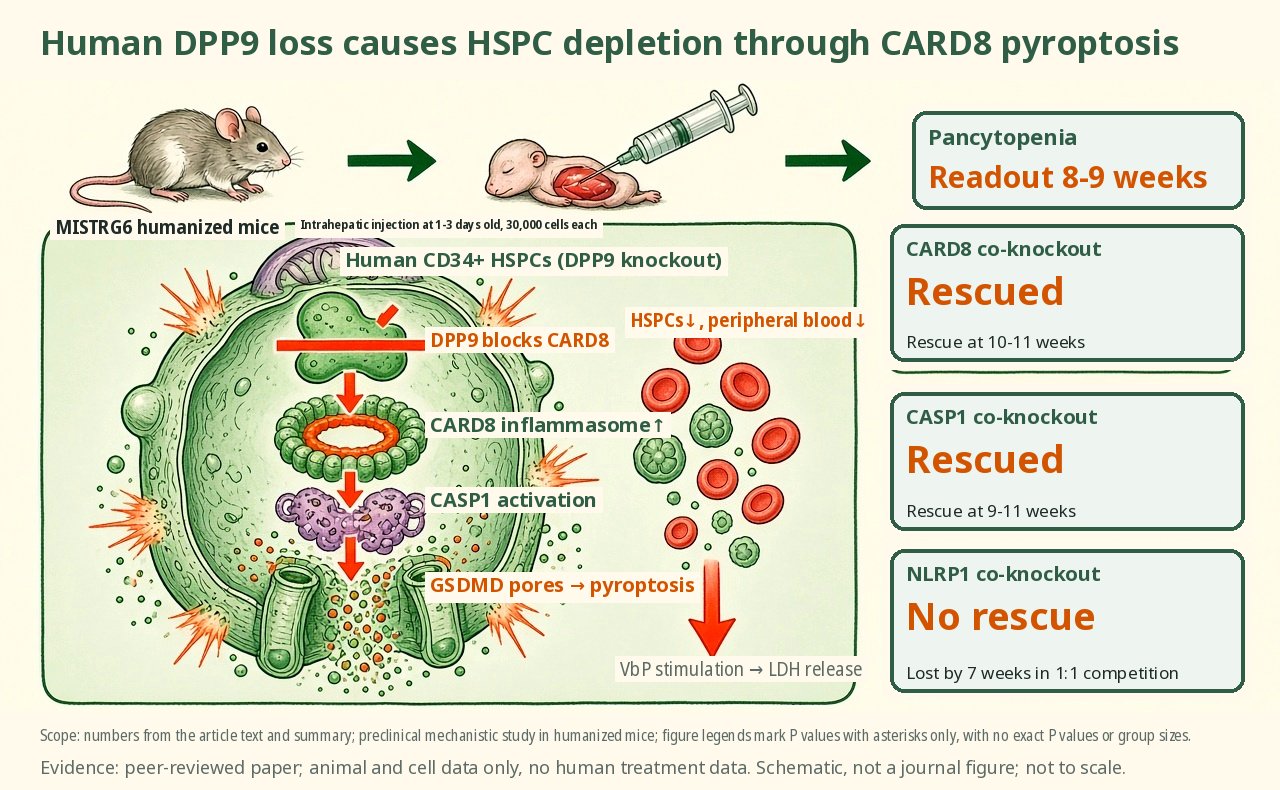
CRISPR knockout of DPP9 in human CD34+ HSPCs in MISTRG6 humanized mice reproduced peripheral and bone marrow cytopenias and loss of HSPCs. Knocking out CARD8 or CASP1 rescued the phenotype while knocking out NLRP1 did not, indicating that the loss is driven by CARD8-mediated pyroptosis rather than the NLRP1 pathway. Newborn mice aged 1–3 days received intrahepatic injection of 30,000 cells, with the main phenotypic readouts at 8–9 weeks. scRNA-seq sampled at 4 weeks after transplantation covered more than 5,000 cells at an average of 5,000 genes per cell across 13 clusters, showing broad CARD8 expression across CD34+ subpopulations.
Key data card
- Study type: Preclinical animal study (CRISPR-edited human CD34+ HSPCs transplanted into MISTRG6 humanized mice)
- Sample size n: The main text gives donors and time points but no total mouse count for the study; platform validation used 2 donors with data from 2 experiments (TRAC) or 2 donors (CSF1R); the DPP9 phenotype was consistent across human donors; scRNA-seq used 2 donors and more than 5,000 cells after quality control; competitive transplants mixed control and knockout cells 1:1
- Controls: HSPCs from the same human donor edited with control sgRNAs (including TRAC or AAVS1); littermate MISTRG6 recipients; double-knockout experiments used control, DPP9−/−, DPP9−/−CARD8−/− and DPP9−/−NLRP1−/− cells from the same donor
- Intervention/dose: Newborn MIS^h/mTRG6 mice aged 1–3 days received intrahepatic injection of 30,000 CD34+ HSPCs (20 μL) without preconditioning; intrafemoral transplants used the same 30,000 cells in adults after 1.5 Gy sublethal irradiation; RNPs used 40 pmol Cas9 plus 100 pmol total sgRNA (2 or 3 guides per gene)
- Follow-up: TRAC was followed to 16 weeks after transplantation; CSF1R to 9 weeks; the main DPP9 phenotype to 8–9 weeks; competitive transplants to 7 weeks; scRNA-seq at 4 weeks; CARD8/NLRP1 double knockouts at 10–11 weeks and CASP1 double knockouts at 9–11 weeks
- Primary endpoint: Core readout: whether human CD45+ peripheral blood cells and bone marrow Lin−CD34+ HSPCs (including HSC, MPP and other subsets) are maintained
- Primary endpoint result: DPP9−/− significantly reduced human CD45+ cells (including monocytes and B cells) and bone marrow Lin−CD34+ HSPCs, with declines in HSC, MPP, CLP, CMP and MEP; simultaneous knockout of CARD8 or CASP1 rescued the phenotype while NLRP1 knockout did not
- Statistics: Mean ± standard deviation; two-sided Student's t tests or two-way ANOVA; P<0.05 considered significant; figure legends mark significance from P≤0.05 to P≤0.0001 without exact P values; some readouts use relative cell numbers (each animal as a fold of the mean of same-donor controls)
- Safety: Not applicable (a disease mechanism model; the phenotype itself is HSPC pyroptosis and pancytopenia)
- Evidence level: Full text
- Verification record: Read the Europe PMC full-text XML (PMC13574144): Abstract, Introduction, Results sections, Discussion, Methods and legends for Figs. 1–5
- CRISPR knockout of DPP9 in human HSPCs followed by transplantation
- Loss of bone marrow HSPCs and peripheral blood cells
- CARD8 inflammasome activation and CASP1-dependent pyroptosis
- Knocking out CARD8 or CASP1 rescues; NLRP1 does not
Background and open questions
Loss of DPP9 function causes Hatipoglu syndrome: recurrent fever and infection, pancytopenia and anaemia, often requiring bone marrow transplantation; one patient has been reported with elevated serum inflammatory cytokines. Conventional Dpp9 mutant mice have normal immune cell numbers and their HSCs still reconstitute on serial transplantation, suggesting that pancytopenia may involve a human-specific mechanism.
DPP9 is the endogenous inhibitor of the human NLRP1 and CARD8 inflammasomes. CARD8 is absent in most rodents including Mus musculus, yet is broadly expressed in human haematopoietic cells. Using reverse genetics in MISTRG6 humanized mice, Xiao, Krause, Flavell and colleagues ask which sensor, NLRP1 or CARD8, burns out the stem cells when human HSPCs lose DPP9.
Study design
MISTRG6 carries human CSF1, IL3/CSF2, SIRPA, THPO and IL6 knocked into the corresponding mouse loci on a Rag2−/−IL2rg−/− background. The recipients here were MIS^h/mTRG6: human–mouse heterozygous for SIRPα and some factors, and homozygous human for M-CSF, IL-3/GM-CSF, thrombopoietin and IL-6. Newborns aged 1–3 days received intrahepatic injection of 30,000 cord blood- or fetal liver-derived CD34+ cells without preconditioning. iPSC-derived CD34+ cells expressed CD34, CD90 and CD49f but could not exceed 1% engraftment, so primary HSPCs were used instead. Editing used 40 pmol Cas9 plus 100 pmol total sgRNA. Both male and female donors and recipients were used, and the authors report similar results in both sexes. Relative cell number is defined as each animal's fold change against the mean of same-cohort controls.
Key results
Editing persists in vivo, and DPP9 loss reproduces the cytopenias
After TRAC knockout, transplanted mice generated almost no human T cells in spleen, liver or lung through 16 weeks, while B cells and myeloid cells were preserved. Nine weeks after CSF1R knockout, CSF1R fell on blood monocytes, with fewer CD16+ monocytes and liver macrophages and similar total human CD45+ cells. For DPP9, 3 sgRNAs targeted the catalytic exon, and at 8–9 weeks peripheral human CD45+ cells, monocytes and B cells were significantly reduced while T cell numbers matched controls — which the authors attribute partly to the resistance of activated T cells to CARD8-driven death and to compensatory T cell expansion when engraftment is poor in humanized models. Bone marrow Lin−CD34+ HSPCs were not maintained, with significant reductions in CLP, CMP, MEP, HSC and MPP. Direct intrafemoral injection in adults also failed to maintain them, showing that this is not merely a homing failure.
The loss is cell intrinsic and weaker in vitro than in vivo
DPP9−/− HSPCs expanded normally in liquid culture. CFU colonies were reduced, but far less than the in vivo loss and without lineage bias. Single-cell-sorted CD34+CD38−CD90+ HSCs yielded fewer cells after 7 days of expansion and a lower proportion of highly expanded clones (>100 cells), with similar myeloid and erythroid differentiation proportions. When control and DPP9−/− cells were transplanted as a 1:1 mixture, ddPCR at 7 weeks showed that knockout cells had almost disappeared from HSCs, progenitors and Lin+ differentiated cells.
Few transcriptional changes, but the inflammasome components are all present
scRNA-seq of Lin−CD34+ cells at 4 weeks after transplantation, while knockout cells had not yet fully disappeared, covered more than 5,000 cells at an average of 5,000 genes per cell across 13 clusters. HSC–MPP showed only 77 differentially expressed genes, with 29 in myeloid progenitors, 14 in CLP and 16 in pro-B cells; downregulated pathway signals came mainly from FOS and JUN. CARD8 was broadly expressed across CD34+ subpopulations, NLRP1 was detectable but lower, and CASP1 and GSDMD were likewise present.
CARD8, not NLRP1, mediates pyroptosis
After 3 days of culture following editing and 20 hours of stimulation with the DPP8/DPP9 inhibitor Val-boropro (VbP), LDH indicated pyroptosis, and DPP9−/− cells were more sensitive to VbP. Knocking out CARD8 or CASP1 abolished pyroptosis entirely. Ten to 11 weeks after transplanting cells from the same donor, loss of DPP9−/− HSPCs was rescued by co-knockout of CARD8, including HSC and MPP, while co-knockout of NLRP1 was not rescuing. Peripheral human CD45+ cells, monocytes and B cells likewise recovered with CARD8 but not NLRP1. Knocking out CASP1 (9–11 weeks) also rescued the loss of bone marrow HSPCs.
Mechanistic interpretation
Demonstrated in the paper: Knocking out the DPP9 catalytic exon causes cell-autonomous loss of human HSPCs in MISTRG6 bone marrow, driving multilineage peripheral reductions. HSPCs possess the CARD8–CASP1–GSDMD machinery; VbP-induced LDH release depends entirely on CARD8 and CASP1; and in vivo co-knockout of CARD8 or CASP1 rescues the stem cell and leukocyte loss, while co-knockout of NLRP1 does not. The transcriptome barely moves, pointing to a protein-level inflammasome threshold rather than transcriptional reprogramming.
Author hypotheses: Human DPP8 may still restrain NLRP1 but not CARD8; alternatively, the expression advantage of CARD8 in HSPCs may determine the selectivity. Unidentified stresses in the bone marrow niche (protein folding, reductive stress, competition for limited human THPO) may ignite CARD8 after transplantation. The in vivo effect (beyond 7 weeks) is far more severe than in vitro (under 2 weeks), suggesting that niche signals accelerate the loss. Most patient mutations reduce enzyme activity or protein levels, whereas this work models the condition by knocking out the catalytic exon, which is not equivalent to the clinical alleles.
Limitations and uncertainties
- Figure legends mostly give significance as asterisks from P≤0.05 to P≤0.0001, and the main text reports neither exact P values nor the number of mice per group; relative cell numbers are normalized across donors and cannot be read directly as absolute reconstitution levels.
- scRNA-seq was sampled at 4 weeks while knockout cells were still present, introducing survivorship bias; the 77 differentially expressed genes in HSC–MPP also show that "almost no transcriptional change" is not zero change.
- T cells were not reduced, so the model does not account for the full lymphocyte picture in patient pancytopenia; the humanized niche is still mouse stroma plus a few human cytokines.
- The in vivo stress that ignites CARD8 was not identified, and why NLRP1 is dispensable remains three parallel hypotheses rather than a settled answer.
Clinical and industry implications
If the CARD8 threshold applies equally in patient HSPCs, the bone marrow failure of Hatipoglu syndrome is not a "mouse model failure" but a consequence of human stem cells carrying an extra sentinel in CARD8. The therapeutic logic would narrow from pan-inflammasome inhibition to the CARD8 or CASP1 axis, and it also explains why Dpp9 mice are normal while patients need transplantation. DPP9 SNPs have also been associated with idiopathic pulmonary fibrosis and SARS-CoV-2 outcomes, but those tissue sites were not tested directly here. This is mechanistic evidence from humanized mice, not a clinical intervention trial.
Authors, source and verification
Evidence level: Full text; verification record: Read the Europe PMC full-text XML (PMC13574144): Abstract, Introduction, Results sections, Discussion, Methods and legends for Figs. 1–5
Xiao T, Brewer JR, Carlino M, Han A, Takabe YJ, Lee CY, et al. Reverse genetics in humanized mice reveals CARD8-mediated pyroptosis causing pancytopenia in human DPP9 deficiency. J Clin Invest. 2026 Sep 15. https://doi.org/10.1172/jci207530
Primary field: Disease models · Related: Autoimmunity and transplant immunology, DPP9 deficiency, CARD8 inflammasome, Humanized mice, Haematopoietic stem cell pyroptosis
Summary of a published paper or preprint, written from the original text; numbers are as reported by the authors. Not medical or investment advice. Corrections: contact@
Related science
Four humanized DMD lines: deletions of exon 44, 45, 51 or 53
The red exon in the row is the one being skipped, with muscle fibres at right
251 samples across 11 ASD mouse models: a transient radial glia delay
Red marks the delay among radial glial fibres, with multiple models in the right column
A pIgR bispecific raises cynomolgus BAL exposure 5.5-fold
A bispecific crossing airway epithelial cells and released at the airway surface
One email, with links to every paper. Reports and custom landscapes: contact@inlightbio.com.