A 160-member bispecific library shows surface properties can be predicted from parental arms with ρ up to 0.95
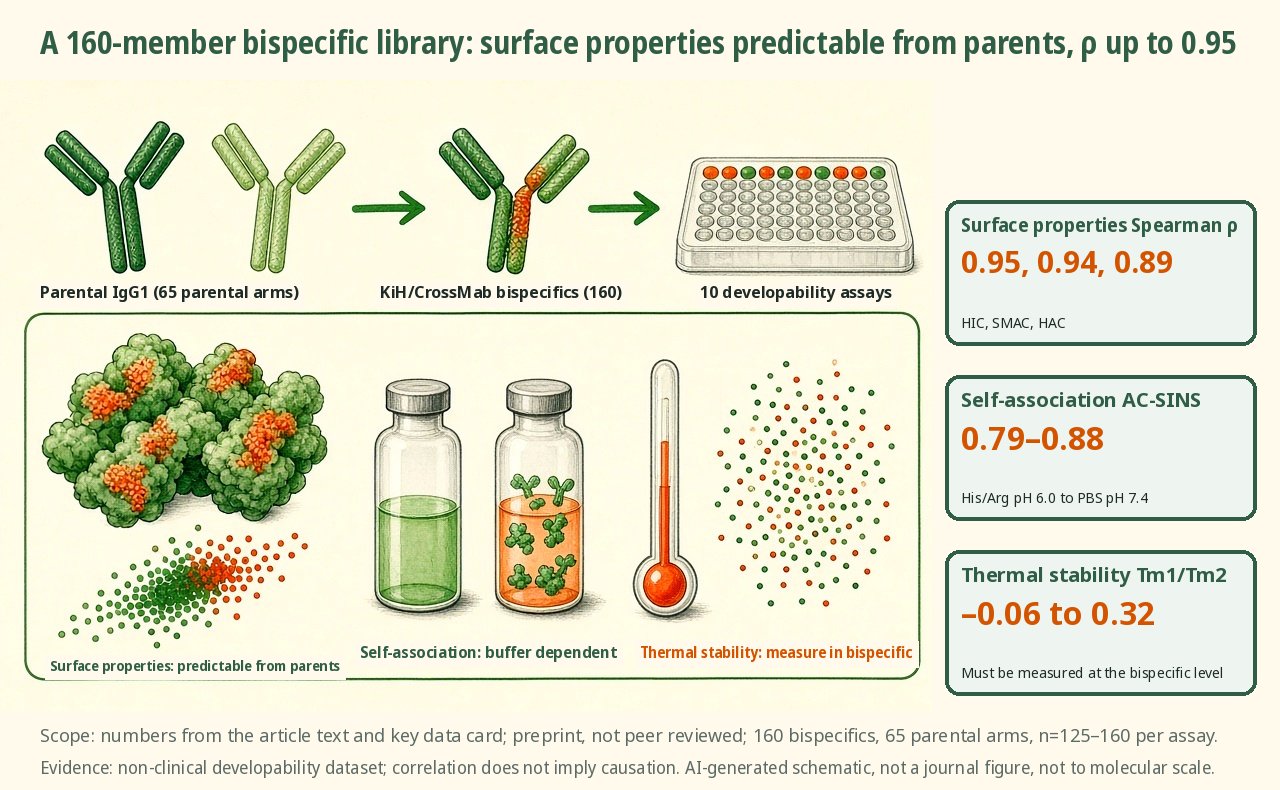
In a non-peer-reviewed study of a 160-member bispecific library, Ritter et al. predicted measured values from parental combinations, reaching Spearman ρ of 0.95, 0.94 and 0.89 for HIC/SMAC/HAC.
Preprint. This study has not yet been peer reviewed; findings may change.
In this non-peer-reviewed study, 160 bispecifics and 65 parental arms were assessed on 10 developability assays in a uniform cross-shaped immunoglobulin scaffold. The abstract reports that hydrophobicity and surface charge are inherited cleanly from the parents (rank correlations of roughly 0.85 to 0.95); self-association and polyreactivity are inherited partly (roughly 0.60 to 0.88); and thermal stability is poorly predicted (below 0.4) and must be measured at the bispecific level. The paper is a biology preprint and has not been peer reviewed.
Key data card
- Study type: Preprint (not peer reviewed) library-wide antibody developability characterization and predictive modelling study
- Sample size n: 160 bispecific antibodies and 65 parental arms; 21 pairs for orientation controls
- Controls: Parental combination baselines, orientation-swapped bispecifics, complex supervised models
- Intervention/dose: A uniform knobs-into-holes CrossMab IgG1 scaffold; 10 developability assays on PROPHET-Ab
- Primary endpoint: Spearman ρ between measured bispecific developability values and values predicted from parents by mean/min/max combination; n=125–160 per assay
- Primary endpoint result: 0.95, 0.94 and 0.89 for HIC, SMAC and HAC; 0.79–0.88 for AC-SINS; –0.06 to 0.32 for Tm1/Tm2
- Statistics: Spearman ρ; Mann-Whitney U for charge distributions; supervised models used parent-disjoint leave-one-out
- Evidence level: Full text
- Verification record: bioRxiv JATS XML full text; checked the Abstract, Results, Methods, Discussion and figure legends
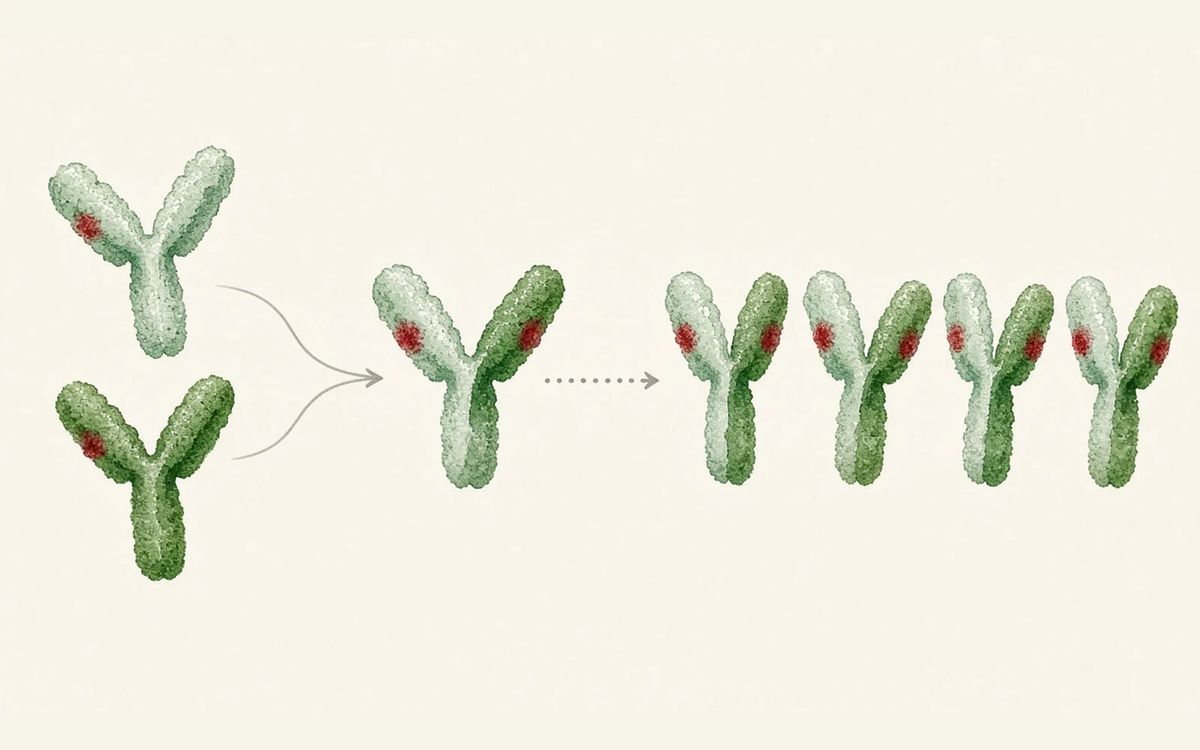
- Parents reformatted as standard IgG1
- Bispecifics assembled as KiH/CrossMab
- Bispecific readouts predicted by parental operators
- Stratification identifies inheritance and risk
- Thermal stability returns to bispecific measurement
Background and open questions
Bispecific antibodies place different binding arms in one molecule, enabling dual-target or bridging functions that monoclonals cannot achieve; developability, however, does not simply add up. Even when parental monoclonals have favourable developability profiles, combining them into a bispecific can still produce self-association, polyreactivity, aggregation and impaired thermal stability, emergent properties that have mostly been described case by case.
The approach of this bioRxiv preprint (not peer reviewed) is to measure "parent determined" and "format emergent" behaviour separately. Rather than explaining one failed molecule as a case study, Ritter et al. compare how parental properties transfer into the bispecific format under uniform production, purification and PROPHET-Ab assay conditions, and distil screenable design rules from the result.
Study design
Ritter et al. built 160 bispecific antibodies and 65 parental arms, all in a uniform knobs-into-holes CrossMab IgG1 scaffold, and ran 10 developability assays on PROPHET-Ab. Parental antibodies were built as standard IgG1. All antibodies were transiently expressed in CHO cells and purified by Protein A capture and polishing; 21 bispecific pairs were also made in swapped orientation as controls for scaffold directionality.
This is a non-clinical developability dataset, not powered for between-group comparison of therapeutic effect. The core inheritance readout is the Spearman ρ between measured bispecific values and values predicted from parental combination; the authors applied three simple operators, mean, min and max, per assay across n=125–160, and used complex supervised models as a negative control for whether they can beat the simple baseline.
Key results
Surface properties are the most predictable
The main readout shows that Class I surface properties most resemble the parents. Spearman ρ between parental combination predictions and measured bispecific values was 0.95, 0.94 and 0.89 for HIC, SMAC and HAC; HAC was better predicted by the parental maximum, with ρ of 0.89 versus 0.67 for the mean operator, suggesting that a strongly positive surface patch can dominate the heparin binding readout and can serve as an early screening criterion.
Self-association depends on buffer
Class II self-association retains the parental signal but is environment dependent. AC-SINS gave ρ of 0.88 in PBS at pH 7.4, falling to 0.79 in His/Arg at pH 6.0. Enhancers and suppressors defined by the noise envelope also correlated with charge metrics: the sum of absolute charges tracked enhancers best, p=0.01, while the signed geometric mean tracked suppressors best, p=0.02.
Orientation and buffer controls
Buffer switching provided a key control: three examples, brazikumab/gantenerumab, abrilumab/landogrozumab and ligelizumab/romosozumab, were suppressors in PBS at pH 7.4 and all became strong enhancers in His/NaCl at pH 6. In the orientation swap controls, most non-thermal-stability readouts across the 21 bispecific pairs gave ρ of 0.78–0.95, while Tm1/Tm2 correlated weakly.
Polyreactivity is partly inherited
Polyreactivity sits between predictable and emergent. PR-BVP reached ρ of 0.80, while the other two polyreactivity assays reached only 0.67 and 0.60. The authors further used distance to the frontier in the parental HIC×HAC plane to identify the top 20% for polyreactivity, with AUC of 0.69–0.80; when a high-HIC arm is paired with a high-HAC partner, surface burden can add up in the bispecific. HIC×HAC is therefore more a risk marker than a determinant of fate.
Thermal stability must be measured
Class III thermal stability does not follow parental inheritance. With the minimum operator, ρ for Tm1 and Tm2 was only –0.06 to 0.32. Complex supervised models brought no predictive gain either: the best ρ for SMAC, HIC and HAC was 0.94, 0.94 and 0.87, at or below the simple baselines of 0.95, 0.94 and 0.89. These three tiers point respectively to parental screening, buffer re-checking and bispecific-level measurement, forming the design rules.
Mechanistic interpretation
Demonstrated in the paper: The results directly establish a tiered framework: HIC, SMAC and HAC correlate highly with parental combination values, AC-SINS and polyreactivity retain moderate correlation with outliers, and Tm1/Tm2 correlate least. The orientation swap experiments confine scaffold directionality effects to a narrow range for most non-thermal-stability readouts while highlighting that thermal stability is format dependent.
Charge analysis directly supports the link between self-association outliers and Fv charge distribution; enhancers are distinguished by the sum of absolute charges and suppressors by the signed geometric mean. Switching from PBS at pH 7.4 to His/NaCl at pH 6 turns several suppressors into enhancers, showing that this relationship depends on the formulation environment.
Author hypotheses: The authors suggest that like-signed Fv charges reinforce an overall charge monopole and promote intermolecular approach, while opposite charges may cancel intramolecularly and reduce self-association; the difficulty of predicting thermal stability may stem from CrossMab domain swapping, the heterodimeric Fc interface and altered Fv neighbourhoods changing unfolding transitions. These explanations are supported by correlations and controls but are not molecule-by-molecule causal proof.
Limitations and uncertainties
- Generalizability is limited first by sampling: the 160 bispecifics are a non-random 8% sample of the 2,080 possible pairings among 65 parents, and the authors state that the conclusions apply to the sampled subset; all molecules also use a single heavily engineered IgG1 scaffold and cannot be extrapolated directly to DVD-Ig, BiTE or common light chain platforms.
- Modelling limits come from features and the pairing graph. The paper notes that computational features derive from monoclonal parental sequences, with no attempt at structure prediction of the bispecific heterodimer; format effect decomposition is likewise limited to additive per-Fv terms, because the current pairing graph is not dense enough to identify pairwise epistasis.
- Methodologically, apart from the 21 orientation-swapped molecules, only a single arrangement was chosen for each parental pairing; all parents were reformatted as IgG1, removing isotype confounding but sacrificing the original isotype context. The current pairing graph is also not dense enough to identify pairwise epistasis reliably.
Clinical and industry implications
Applied within the paper's own assay system, these rules let bispecific discovery screen hydrophobicity and charge at the parental level first, avoiding pairings of two mAbs that are both high HIC and high HAC; self-association should be re-checked in the formulation buffer, and thermal stability measured at the bispecific level.
For computational workflows, this preprint suggests that simple parental combination baselines are a necessary reference and that complex supervised models brought no clear improvement. The authors propose a cascade: convert monoclonal sequences into arm-level empirical values first, then combine them with format-aware features to predict bispecific developability, and they mention data initiatives such as FAITE, Lilly TuneLab and Ginkgo-Apheris.
Authors, source and verification
Evidence level: Full text; verification record: bioRxiv JATS XML full text; checked the Abstract, Results, Methods, Discussion and figure legends
Ritter S, Rand L, Karthick S, Bloomingdale T, Smith A, Ao X, et al. Decoding Bispecific Antibody Developability: Design Rules and Predictive Models from a 160-Member Library. bioRxiv. 2026 Jun 15. doi: https://doi.org/10.64898/2026.06.15.732449
Primary field: Antibody engineering · Related: AI drug design, Bispecific antibodies, Developability prediction, AC-SINS, HIC-HAC, CrossMab
Summary of a published paper or preprint, written from the original text; numbers are as reported by the authors. Not medical or investment advice. Corrections: contact@
Related science
A pIgR bispecific raises cynomolgus BAL exposure 5.5-fold
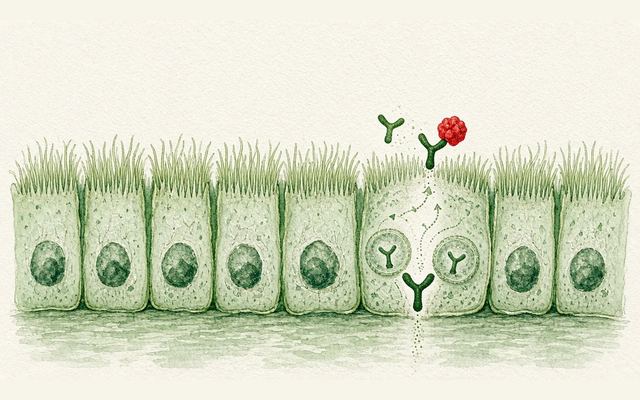
A bispecific crossing airway epithelial cells and released at the airway surface
A 156-member bispecific screen selects a low-affinity SIRPα×CD38
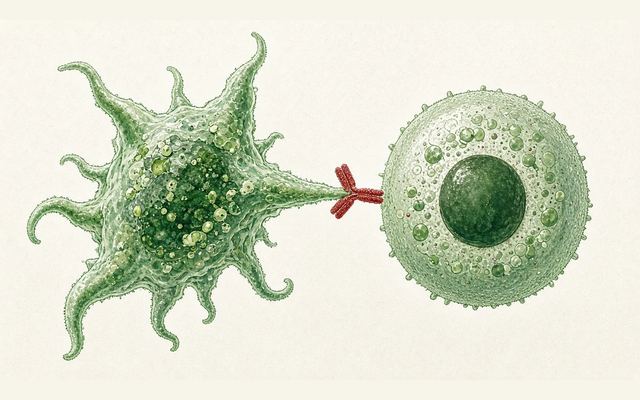
A macrophage phagocytosing the tumour cell at right via a red bispecific
A trispecific IL-2R antibody reaches an EC50 of 0.015 nM with Treg bias
A green trispecific antibody binding a dark green regulatory T cell, with the rest quiescent
One email, with links to every paper. Reports and custom landscapes: contact@inlightbio.com.