The trispecific IL-2R antibody αβγVHH-48 reaches an EC50 of 0.015 nM
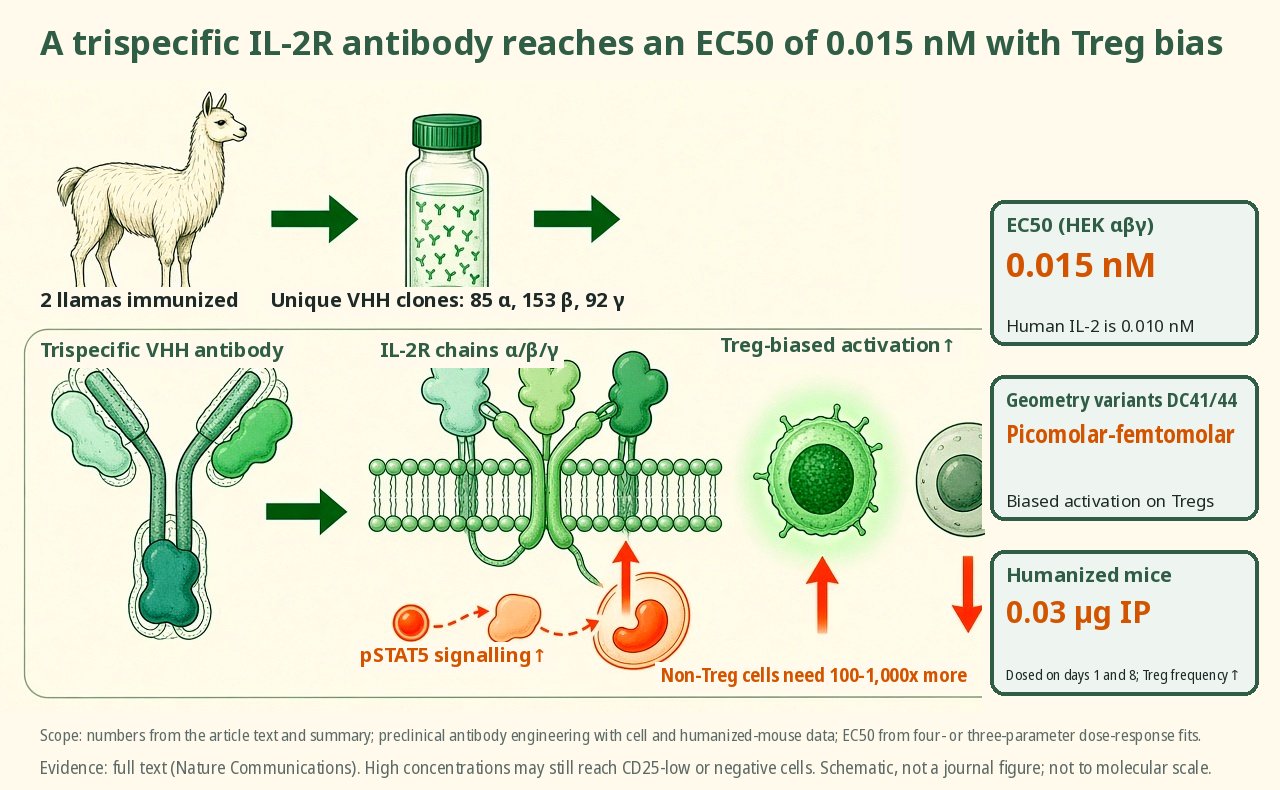
Lykhopiy et al. assembled VHHs against CD25/CD122/CD132 into trispecific agonist antibodies; the lead αβγVHH-48 had a pSTAT5 EC50 of 0.015 nM in HEKαβγ cells, close to the 0.010 nM of human IL-2, and after making CD25 bivalent and altering the geometry it could activate Tregs selectively at picomolar and even femtomolar concentrations.
Heavy-chain antibody fragments against the three chains of the human interleukin-2 receptor were assembled into trispecific agonist antibodies, with immunization yielding 85 unique α chain clones, 153 β chain clones and 92 γ chain clones. The lead molecule had a half-maximal effective concentration for phosphorylation signalling in human embryonic kidney reporter cells of 0.015 nanomolar, close to the 0.010 nanomolar of human interleukin-2. After altering the geometry, it could activate regulatory T cells selectively at picomolar and even femtomolar concentrations, with effector cells requiring 100- to 1,000-fold more. In humanized mice, 0.03 micrograms given intraperitoneally raised the frequency of regulatory T cells.
Key data card
- Study type: Preclinical multispecific antibody engineering and Treg-biased IL-2R agonism study (Nature Communications)
- Sample size n: 2 llamas; unique VHH clones of 85 for CD25, 153 for CD122 and 92 for CD132; 16 βγ bispecifics; up to 12 human PBMC donors; n=4–5 per group in vivo
- Controls: Parental βγ bispecifics, recombinant human IL-2, the Fc-fused IL-2 mutein V91K, low-dose IL-2, PBS; NK/Tconv/CD8 cells as non-Treg controls
- Intervention/dose: LALAPG IgG1 Fc with trispecific VHHs assembled by cFAE; in vivo, 0.03 µg intraperitoneally in the NSG human PBMC model on days 1 and 8
- Primary endpoint: pSTAT5 potency/efficacy; ΔAUC for Tregs relative to non-Tregs; Treg frequency and ratios in vivo
- Primary endpoint result: αβγVHH-48 gave EC50=0.015 nM in HEKαβγ cells (0.010 nM for human IL-2); the geometry variants DC41/DC44 reached single-digit picomolar or femtomolar activity on Tregs, with non-Tregs requiring 100–1,000-fold more
- Statistics: Four- or three-parameter dose-response fits for EC50; one- and two-way ANOVA (Tukey); Kaplan-Meier with two-sided log-rank
- Safety: Low-dose IL-2 also expanded effector T cells and accelerated GvHD; at high concentrations the antibodies may still reach CD25-low or CD25-negative cells
- Evidence level: Full text
- Verification record: Europe PMC full-text XML (PMC13482293): Abstract, Results, Methods, Discussion and legends for Figs. 1–5
- VHHs cover all three IL-2R subunits
- βγ crosslinking triggers pSTAT5
- The CD25 arm biases potency toward Tregs
- Bivalent CD25 and further geometry optimization
Background and open questions
Regulatory T cells (Tregs) depend on IL-2 to maintain tolerance. The intermediate-affinity IL-2R comprises CD122 and CD132 (the paper gives a Kd of about 1 nM) and is widespread on memory CD8 and NK cells; adding CD25 forms the high-affinity trimer (the paper gives a Kd of about 10 pM), and Tregs express CD25 constitutively at high levels. Low-dose IL-2 can expand Tregs but has a short half-life and readily hits non-Tregs. Existing IL-2 muteins, PEGylation and antibody complexes all trade selectivity against signal strength.
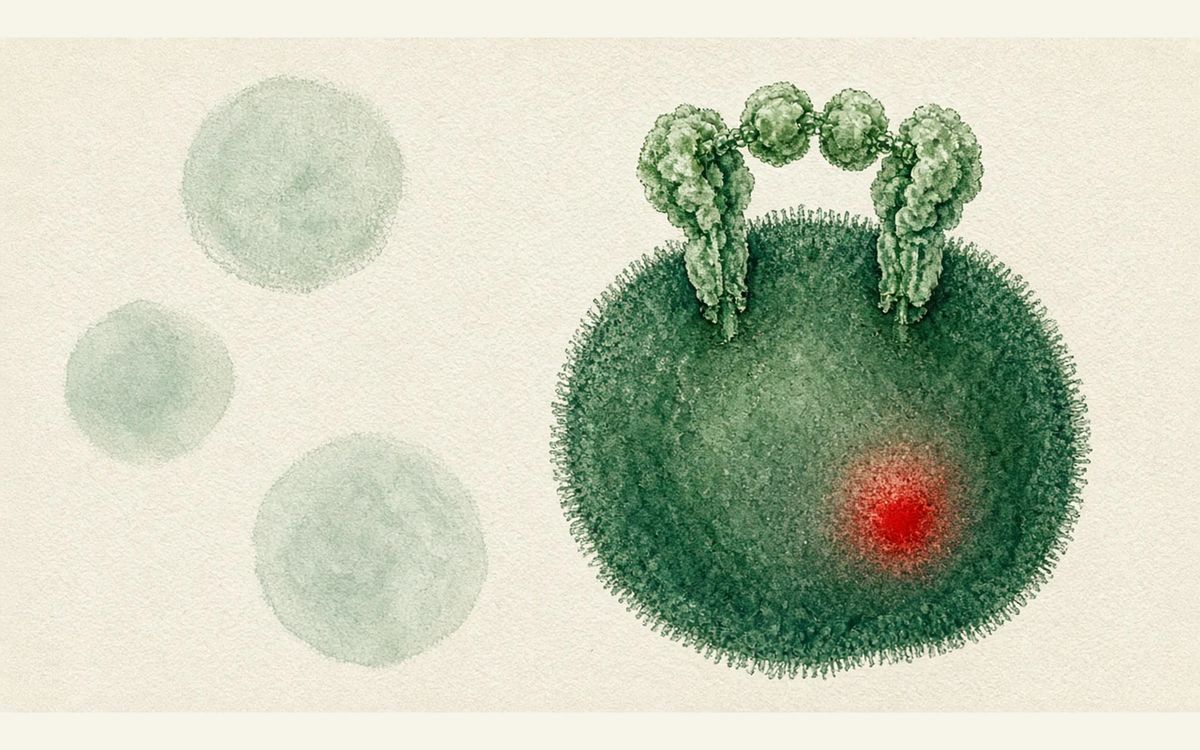
The hypothesis of Lykhopiy (also corresponding) with the Van Rompaey and Schlenner groups is that rather than modifying the cytokine, one can use an antibody to grab all three receptor subunits at once, creating an agonist that only works when crosslinked, so that CD25 locks the activity onto Tregs.
Study design
Two llamas were immunized with plasmid DNA encoding human IL-2Rα/β/γ, 6 injections 2 weeks apart. After three rounds of phage selection, unique VHHs numbered 85 against CD25 (15 CDR3 families), 153 against CD122 (38 families) and 92 against CD132 (7 families); SPR epitope binning gave 3, 4 and 5 bins respectively. Ten to 13 clones per subunit were made as VHH-Fc, and epitope representatives of β and γ were combined into 16 βγ bispecifics. The Fc carried LALAPG to abolish effector function, with F405L/K409R enabling controlled Fab arm exchange to recombine αVHHs with βγVHHs into trispecifics.
Function was first assessed by binding and pSTAT5 in HEKαβγ cells overexpressing all three subunits, then in resting human PBMCs, comparing Tregs (CD25 high) with NK, Tconv, CD8 and NKT cells. In vivo, human PBMCs (20×10^6 per mouse) were infused into NSG mice, with 0.03 µg or PBS given intraperitoneally on days 1 and 8. Keeping specificity and valency constant and rearranging only the spatial positions of the VHHs, 5 geometry variants with bivalent CD25 were then made (DC41, DC43, DC44, DC45, DC60).
Key results
Signalling requires grabbing both β and γ
Neither single antibodies nor α-plus-β or α-plus-γ combinations induced pSTAT5; most molecules containing both β and γ VHHs did, and some βγ bispecifics approached the maximal signal of recombinant IL-2. The non-functional γVHH-35 was an exception. βγ clones with weak binding but strong signalling show that potency is not simply affinity. Cell binding of the trispecifics was determined mainly by the αVHH, while maximal pSTAT5 followed the parental βγ: CD25 governs which cells are hit and dose sensitivity, while βγ governs whether the signal assembles and how strong it is.
αVHH-2 shifts potency toward CD25-positive cells across the board
After adding anti-CD25, fold improvements in EC50 relative to the parental βγ were greatest among trispecifics containing βγVHH-11; αVHH-2 gave the largest fold improvement across all βγ backbones. On this basis αβγVHH-48 was selected (αVHH-2, βVHH-19, γVHH-27), with an EC50 of 0.015 nM in HEKαβγ cells versus 0.010 nM for human IL-2. In PBMCs, high-affinity CD25 VHHs targeting the IL-2 binding site (αVHH-2, 8, 10) were the most potent on Tregs, while low-affinity or non-IL-2 epitopes were weaker. Using ΔAUC, which integrates potency and maximal response, αβγVHH-48 and αβγVHH-61 gave the highest Treg/non-Treg ratios, above other trispecifics and IL-2. The Discussion summarizes that trispecifics carrying anti-CD25 are more than 100-fold more potent on Tregs in vitro than IL-2, with little activation of CD25-negative cells. In purified Treg cultures over 7 days, αβγVHH-48 expanded cells less than IL-2 but more than βγVHH-11; in whole PBMCs, Treg proliferation with both trispecifics approached IL-2, while the βγ bispecifics barely expanded Tregs. The Treg proliferation index exceeded that of βγVHH-11 (Kruskal-Wallis, adjusted P=0.0339).
0.03 µg widens Treg ratios in the NSG model
Dose titration set the optimal day-1 dose at 0.03 µg. αβγVHH-48 raised Treg frequency without changing Tconv or CD8 frequencies, significantly increasing Treg/CD4 and Treg/CD8 ratios; Ki-67+ Tregs increased, while Ki-67 in non-Tregs was higher in the βγVHH-11 group. FOXP3 remained stable. Compared with low-dose IL-2, the latter expanded Tregs by day 7 but also expanded effector T cells and accelerated disease; the IL-2 mutein, αβγVHH-48 and the later DC41 were comparable on Treg specificity and disease outcome. The authors note that this CD25 VHH competes with IL-2 for binding, which may weaken the ability of Tregs to suppress by sequestering IL-2.
Geometry matters more than sequence for the window
All five geometry variants were more potent than the original αβγVHH-48, consistent with bivalent CD25. Maximal pSTAT5 varied with the relative positions of the β and γ VHHs. DC41 and DC44 reached maximal phosphorylation on Tregs at single-digit picomolar or even femtomolar concentrations, with non-Tregs requiring 100- to 1,000-fold more; DC43, DC45 and DC60 behaved more like partial agonists, with the largest difference between Tregs and non-Tregs. Because some curves did not yield reliable EC50 fits, the authors compared ΔAUC within the experimental concentration range (without extrapolation, which therefore underestimates the differences), and DC41 and DC44 still showed the widest Treg–non-Treg windows. In purified Treg expansion, DC41 matched αβγVHH-48; although the V91K mutein gave selective phosphorylation, single-cell MFI was too low to drive proliferation. SPR on individual subunits showed no binding differences between geometries, so the functional differences arise from assembly at the cell surface rather than steric hindrance at a single receptor.
Mechanistic interpretation
Demonstrated in the paper: pSTAT5 requires engaging β and γ simultaneously, with αβ or αγ alone insufficient, consistent with classical IL-2R assembly. The CD25 domain changes EC50 rather than maximal signal, while βγ determines Emax. The PBMC and NSG experiments translate this potency difference into a numerical advantage for Tregs over non-Tregs. Geometry variants with identical composition, linkers and valency still diverge functionally, with no difference by single-subunit SPR, directly supporting the idea that spatial configuration determines signalling.
Author hypotheses: A CD25 VHH that competes with IL-2 may pull the receptor into a conformation closer to that occupied by native IL-2 and thus work better; the cost is that Tregs lose IL-2 sequestration as a suppressive route. The decline in proliferation at high concentrations is explained as non-productive occupancy in an overcrowded system rather than weaker intrinsic agonism. The Discussion also proposes adding a Treg-enriched surface molecule to make a tetraspecific and narrow the cellular spectrum further. These are design inferences, not demonstrations of efficacy in disease models.
Limitations and uncertainties
- Most VHHs do not cross-react with mouse IL-2R, so disease models require humanized IL-2/IL-2R systems; the in vivo work here extends only to expansion and GvHD scoring in human PBMC-NSG/NOG mice, with no autoimmune disease model.
- Receptor density in HEK reporter cells is non-physiological, so the authors focus their conclusions on PBMCs. Activation of effector cells at high exposure cannot be fully excluded, a window problem shared by all Treg-biased IL-2-type drugs.
- The main readout is STAT5; contributions of PI3K-AKT, MAPK and mTOR to Treg metabolism and stability were not measured. The suppressive function and lineage stability of Tregs expanded in vivo were likewise not examined in depth. Because the CD25 arm of αβγVHH-48 competes with IL-2, it may weaken IL-2-deprivation-based suppression.
Clinical and industry implications
Compared with IL-2 muteins that reduce CD122 binding, this route aims through CD25 affinity and geometry rather than crippling the cytokine itself. Antibody half-life also differs from that of wild-type IL-2. If humanized models and early clinical work hold up, such molecules suit autoimmunity and transplant rejection where Treg expansion is needed, though the therapeutic window still depends on dose: too low is insufficient and too high reaches CD25-low cells. The platform is modular and could in principle swap in a non-competing CD25 VHH or add a fourth Treg marker.
Authors, source and verification
First and co-corresponding author: Valentina Lykhopiy; last authors: Luc Van Rompaey and Susan M Schlenner (corresponding). Pollenus, Rangan, Van Rompaey and Schlenner contributed equally. Evidence level: Full text; verification record: Europe PMC full-text XML (PMC13482293): Abstract, Results, Methods, Discussion and legends for Figs. 1–5. The licence is CC BY-NC-ND, so the text is a paraphrase and not a sentence-by-sentence reproduction.
Lykhopiy V, Pollenus E, Rangan L, Stakenborg M, Tezil T, Varheust M, et al. Engineering trispecific IL-2 receptor agonistic antibodies through geometry optimization for enhanced Treg targeting. Nat Commun. 2026 Jul 10;17:8534. doi: https://doi.org/10.1038/s41467-026-75024-6
Primary field: Antibody engineering · Related: Autoimmunity and transplant immunology
Summary of a published paper or preprint, written from the original text; numbers are as reported by the authors. Not medical or investment advice. Corrections: contact@
Related science
A pIgR bispecific raises cynomolgus BAL exposure 5.5-fold
A bispecific crossing airway epithelial cells and released at the airway surface
A 156-member bispecific screen selects a low-affinity SIRPα×CD38
A macrophage phagocytosing the tumour cell at right via a red bispecific
A 160-member bispecific library: surface properties predictable from parents, ρ up to 0.95
Two parental antibodies combining into a bispecific, with red dots marking surface properties
One email, with links to every paper. Reports and custom landscapes: contact@inlightbio.com.