A screen of 156 macrophage-activating bispecifics selects WTa2d1xCD38, with IC50 values as low as 18.0 pM
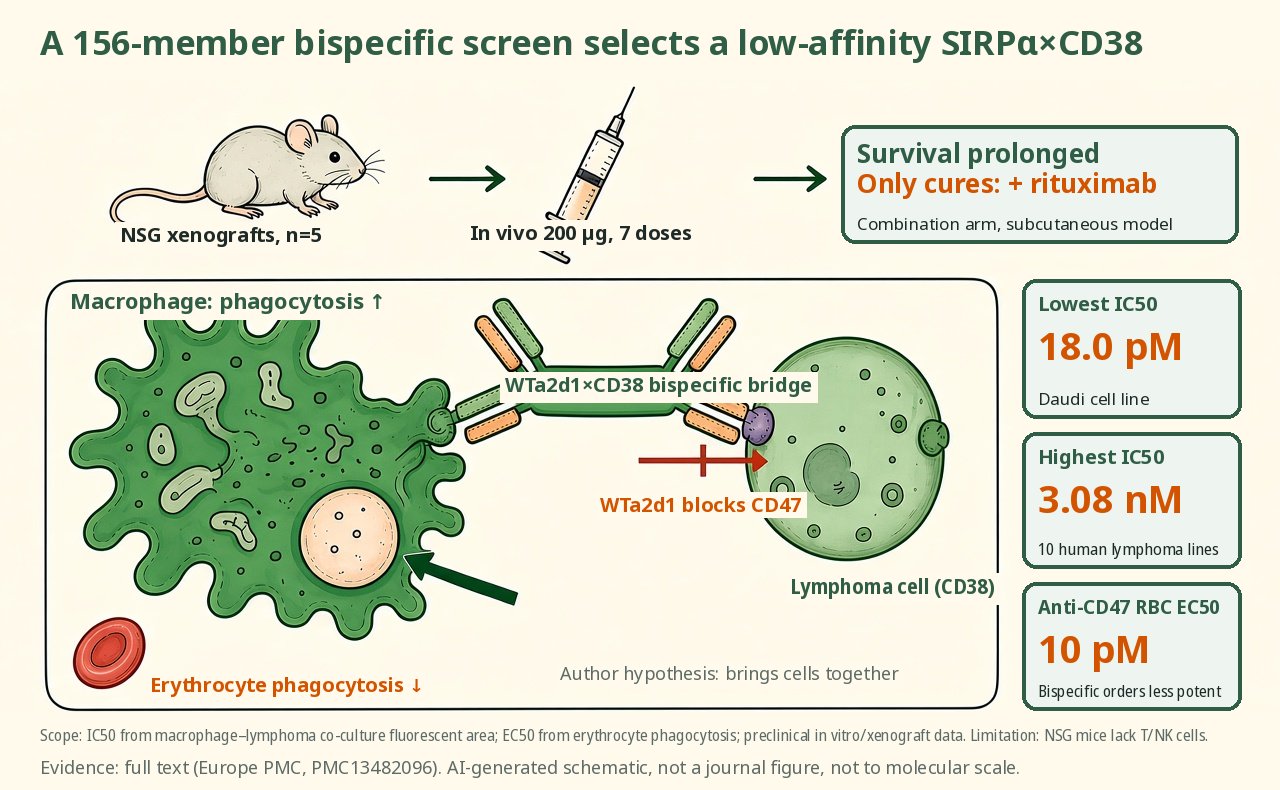
Using function-first surfaceome screening plus 156 heterodimeric scFv-Fc bispecifics, Pagès-Geli et al. selected the low-affinity SIRPα decoy × CD38 molecule WTa2d1xCD38; IC50 values across 10 lymphoma cell lines ranged from 18.0 pM to 3.08 nM, and in vivo it prolonged survival and produced complete cures when combined with rituximab.
Function-first surfaceome screening plus 156 heterodimeric scFv-Fc bispecifics drew on antibody libraries of 173 mouse and 241 human monoclonals (92 shared antigens). The low-affinity SIRPα decoy × CD38 molecule WTa2d1xCD38 was selected; IC50 values across 10 human lymphoma cell lines ranged from 18.0 pM (Daudi) to 3.08 nM (U-2932), and knocking out CD47 in Raji cells barely affected killing. After engraftment of human Raji cells in NSG-SGM3 mice, WTa2d1xCD38 alone or combined with rituximab prolonged survival, with the combination the only cohort achieving complete cures (n=10 per group). Anti-CD47 induced erythrocyte phagocytosis with an EC50 of 10 pM, while WTa2d1xCD38 was several orders of magnitude less potent in this respect.
Key data card
- Study type: Preclinical high-throughput antibody screening and bispecific antibody engineering study (Nature Communications)
- Sample size n: Mouse monoclonal library of 173 and human library of 241 (92 shared antigens); 64 mouse and 11 human combinations; a 156-member bispecific library; n=5 per group in xenografts
- Controls: Monoclonals, anti-CD47, anti-CD20/rituximab, daratumumab, conventional four-plasmid bispecifics, vehicle; erythrocyte and leukocyte phagocytosis as off-target controls
- Intervention/dose: Heterodimeric scFv-Fc (human IgG1 knob-into-hole); in vivo 200 µg, given intraperitoneally for 7 doses in subcutaneous tumours and intravenously for 6 doses in intracranial tumours
- Primary endpoint: Lymphoma fluorescent area in macrophage co-culture; tumour volume and survival in vivo
- Primary endpoint result: WTa2d1xCD38 had IC50 values of 18.0 pM (Daudi) to 3.08 nM (U-2932) across 10 human lymphoma lines; the combination arm was the only cohort with complete cures in the subcutaneous model
- Statistics: One-tailed t tests and the 95th percentile for screening; two-way ANOVA, Kruskal-Wallis (Dunn correction) and log-rank for between-group comparisons
- Safety: Anti-CD47 induced erythrocyte phagocytosis with an EC50 of 10 pM, while WTa2d1xCD38 was several orders of magnitude less potent; no appreciable depletion of CD3+ T cells or NK cells
- Evidence level: Full text
- Verification record: Europe PMC full-text XML (PMC13482096): Abstract, Results, Methods, Discussion and legends for Figs. 1–5
- Function-first surfaceome screening defines targets
- Heterodimeric scFv-Fc assembles 156 bispecifics
- Grouping by killing and erythrocyte binding
- WTa2d1xCD38 is active against lymphoma in vivo
Background and open questions
B cell non-Hodgkin lymphoma is the most common haematological malignancy, with diffuse large B cell lymphoma accounting for about 35% of cases. A substantial proportion still relapse or become refractory after first-line rituximab plus chemotherapy; subsequent strategies mostly turn to T cells, but the literature cited in the paper reports that more than half of B cell lymphomas have defects in MHC antigen presentation or overexpress checkpoints, limiting T cell approaches. Macrophage-mediated antibody-dependent cellular phagocytosis (ADCP) is one in vivo mechanism of rituximab, yet it is often blocked by the CD47/SIRPα "don't eat me" signal. Clinical exploration of CD47 blockade with rituximab already exists, but systematic searches for additional surface targets that can mobilize macrophages have been rare.
The approach taken by Pagès-Geli and Ribeiro (co-first authors) with the Crespo and Weiskopf groups is to measure "how much binding" and "whether macrophages can kill the lymphoma" separately, then turn effective combinations into bispecifics that can be manufactured at scale.
Study design
On the mouse side, M-CSF-derived bone marrow macrophages were co-cultured with StayGold+ MHC-I knockout A20 cells across 173 purified monoclonals, each tested alone, with anti-CD47 and with anti-CD20, reading growth or clearance by fluorescent area over 7 days. On the human side, primary monocyte-derived macrophages were co-cultured with GFP+ Raji cells across 241 monoclonals, 92 of whose antigens were shared with the mouse library. Sixty-four antibody combinations were then tested in the mouse system and 11 in human wild-type/MHC-I knockout Raji and Toledo cells.
To turn combinations into single molecules, the authors compared conventional four-plasmid bispecifics with heterodimeric scFv-Fc (one plasmid per arm, IgG1 knob/hole). After confirming that scFv-Fc expressed better, bound more strongly and killed better at low concentrations (n=6 transfections), they crossed arms against CD47, CD24, CD79b, CXCR4, CD40, CD95, CD38, CD71, LILRB1, CD20 and PD-1, with both the high-affinity decoy CV1 and the low-affinity decoy WTa2d1 used on the CD47 side, yielding 156 unique bispecifics tested for function, binding, ELISA expression and human erythrocyte binding in Raji, Toledo and SUD-HL-8 cells. In vivo work used NSG mice: 1×10⁶ GFP+ Raji cells subcutaneously, or 1×10⁵ luciferase Raji cells intracranially to model primary central nervous system lymphoma, with n=5 per group.
Key results
Cross-species screening identifies macrophage-addressable targets
In the mouse library, anti-CD24, CD95 (FAS), CD40, CXCR4 and CD79b all drove macrophage clearance of A20 cells under all three conditions. The human library highlighted MHC-I/II components along with CXCR4, CD38, CD147, CD71, CD98 and CD45RA. Binding strength and killing showed only a moderate trend: CD24 bound most strongly and killed most strongly, but with many outliers, showing that strong binding alone does not predict function. Anti-LILRB1 was nearly inactive as a single agent but most antitumour in combination with anti-CD47, consistent with its role as a macrophage checkpoint. Targets reproducible across species included CXCR4, CD47, CD147, CD98 and MHC-II. Among the 64 mouse combinations, most containing anti-CD24 or anti-CD95 nearly eliminated lymphoma in co-culture, outperforming anti-CD20 plus anti-CD47; the most effective human combinations included anti-CD47 paired with anti-B2M, LILRB1, CD71 or CD38. MHC-I knockout lines were generally more susceptible to macrophage killing.
Heterodimeric scFv-Fc supports a 156-member bispecific library
Compared with a conventional CD20xCD38 bispecific, the scFv-Fc gave higher titres in the same transfection system, bound Raji and Toledo cells more strongly, and killed at lower concentrations (two-way ANOVA, ****p<0.0001). Unsupervised clustering divided the 156 molecules into four classes: high activity with low erythrocyte binding, high activity with high erythrocyte binding, binding with limited activity, and poor expression or folding. The CV1 arm killed extremely well but also bound erythrocytes strongly; WTa2d1, CD20 or CD38 arms often balanced killing with low erythrocyte binding. Across the three cell lines, WTa2d1xCD38, WTa2d1xLILRB1 and CD38xCXCR4 sat consistently in the group with high potency and low or absent erythrocyte binding.
WTa2d1xCD38 outperforms rituximab and daratumumab in vitro
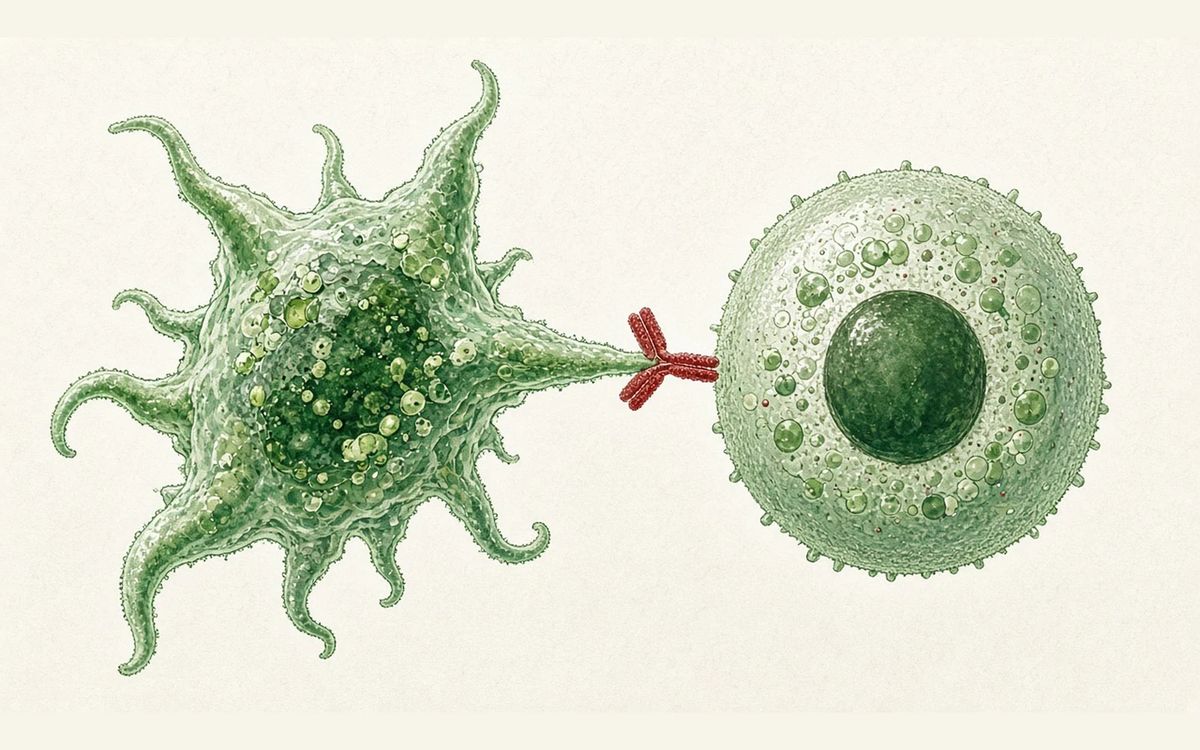
All three purified bispecifics were potent against Raji and Toledo, but only the first two were effective against HBL-1. Because the LILRB1 arm does not cross-react with the mouse orthologue, the work focused on WTa2d1xCD38. At 10 µg/mL over 144 h of co-culture it outperformed rituximab and daratumumab and matched monospecific anti-CD47; against three rituximab-resistant lines it still significantly enhanced macrophage killing while the latter two were nearly inactive. IC50 values across ten human lymphoma lines ranged from as low as 18.0 pM (Daudi) to as high as 3.08 nM (U-2932); MHC-I deficiency improved IC50 by about 2–3-fold in SUD-HL-8 and HBL-1. Knocking out CD47 in Raji cells barely affected killing by this bispecific, while knocking out CD38 preserved efficacy with a slight loss of potency, indicating that engaging either target monovalently suffices and that co-expression of both is more potent. Mass spectrometry and structural modelling support correct knob-into-hole assembly. Immunofluorescence showed the bispecific binding macrophage and lymphoma simultaneously, with macrophages extending radial microvilli and the strongest staining at the phagocytic interface.
Erythrocyte toxicity window and in vivo efficacy
Phagocytosis of unfractionated leukocytes increased only slightly, while WTa2d1xCD38 drove stronger phagocytosis of Toledo cells than anti-CD47. In 24 h PBMC depletion experiments, WTa2d1xCD38 and CXCR4xCD38 depleted B cells comparably to rituximab, with no significant depletion of CD3+ T cells or NK cells. Anti-CD47 induced erythrocyte phagocytosis with an EC50 of 10 pM, while WTa2d1xCD38 was several orders of magnitude less potent. In the subcutaneous model, 200 µg of WTa2d1xCD38 or rituximab each inhibited growth and prolonged survival, with the combination falling further below rituximab alone and being the only cohort with complete cures. In the intracranial model, the bispecific inhibited tumour growth and prolonged survival relative to vehicle and rituximab.
Mechanistic interpretation
Demonstrated in the paper: Functional screening separates "can bind" from "can mobilize macrophage killing", showing that surface abundance alone does not predict ADCP. Heterodimeric scFv-Fc eliminates light chain mispairing, allowing combinatorial libraries to be screened directly from supernatants. Clustering separates the erythrocyte binding of the high-affinity CV1 from the low erythrocyte binding of the low-affinity WTa2d1 while preserving anti-lymphoma activity. Knockout experiments show that the bispecific can work through the CD38 arm alone and that CD47 loss is equivalent to blockade; immunofluorescence supports bridging of the molecule at the macrophage–lymphoma interface. In vivo NSG models show that the molecule reaches both subcutaneous and intracranial lesions and confers a survival benefit.
Author hypotheses: WTa2d1xCD38 may simultaneously (i) opsonize tumour cells, (ii) block CD47/SIRPα, (iii) inhibit CD38-mediated immunosuppression and (iv) bring macrophages and tumour cells into proximity. The radial microvilli are interpreted as favouring an immune synapse. The authors consider a low-affinity CD47 binding arm the better geometry for reducing haematological toxicity while preserving macrophage effector function. These are mechanistic models rather than item-by-item causal dissection in vivo.
Limitations and uncertainties
- The surfaceome does not cover every antigen or every antibody; hits are true positives, but false negatives are unknown. Screening started on an MHC-I knockout background, which favours highlighting innate pathways but does not represent all clinical subtypes.
- NSG mice lack T, B and NK cells while retaining myeloid cells, which may overestimate CD47 blockade effects; the bispecific also binds human macrophages more strongly than NSG mouse macrophages, which may conversely underestimate in vivo potency. The authors state explicitly that non-human primate toxicology or early clinical trials are the more appropriate next step.
- The LILRB1 arm was not tested in vivo because of species cross-reactivity limits; the explanation that daratumumab has limited single-agent activity in B-NHL invokes the CD47 checkpoint post hoc and is not a direct comparison of clinical cohorts in this study.
Clinical and industry implications
If translation holds, this pipeline yields two actionable outputs: a list of lymphoma surface targets that macrophages can act on, together with a bispecific matrix that need not rely on the old CD20/CD47 combination; and a way of delivering CD47 blockade as a low-affinity decoy × tumour antigen bispecific rather than a high-affinity monoclonal, trading for therapeutic index. WTa2d1xCD38 remains effective against rituximab-resistant lines and may extrapolate to other CD38-positive haematological malignancies, though all of this requires primate safety and human data. Heterodimeric scFv-Fc itself reduces light chain mispairing, which the authors believe can scale to larger combinatorial libraries and even to other cancers or other effector cells.
Authors, source and verification
Co-first authors: Carlota Pagès-Geli and Juliano Ribeiro; last authors: Marta Crespo and Kipp Weiskopf (corresponding). Evidence level: Full text; verification record: Europe PMC full-text XML (PMC13482096): Abstract, Results, Methods, Discussion and legends for Figs. 1–5.
Pagès-Geli C, Ribeiro J, Wienclaw T, Meglan AM, Sloat L, Silva M, et al. High-throughput engineering of bispecific antibodies to enhance macrophage-mediated cytotoxicity of B-cell lymphoma. Nat Commun. 2026 Aug 1;17:8491. doi: https://doi.org/10.1038/s41467-026-76180-5
Primary field: Antibody engineering · Related: Tumor immunology and cell therapy
Summary of a published paper or preprint, written from the original text; numbers are as reported by the authors. Not medical or investment advice. Corrections: contact@
Related science
A pIgR bispecific raises cynomolgus BAL exposure 5.5-fold
A bispecific crossing airway epithelial cells and released at the airway surface
A trispecific IL-2R antibody reaches an EC50 of 0.015 nM with Treg bias
A green trispecific antibody binding a dark green regulatory T cell, with the rest quiescent
A 160-member bispecific library: surface properties predictable from parents, ρ up to 0.95
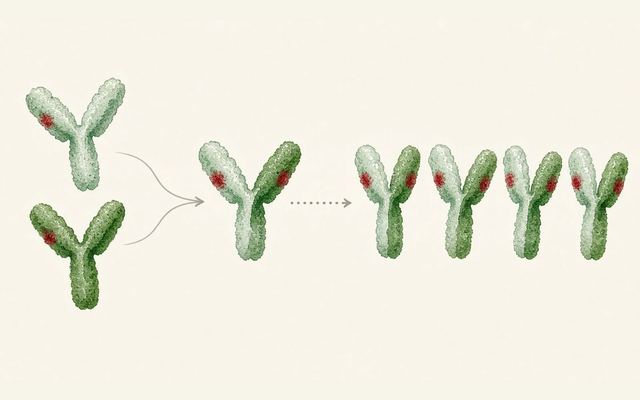
Two parental antibodies combining into a bispecific, with red dots marking surface properties
One email, with links to every paper. Reports and custom landscapes: contact@inlightbio.com.