Shotgun genetic engineering rebuilds essential amino acid synthesis in mammalian cells
Shotgun genetic engineering delivered a 40-member barcoded TU library at high MOI into CHO and Jurkat cells; CHO clones doubled in 1.05–1.14 days without valine, a six-gene set enabled isoleucine prototrophy, and Jurkat clones grew without valine at about 1.9–2.0 days per doubling.
A 40-member barcoded transcription-unit library (ten Escherichia coli coding sequences, EF1a or PGK promoters, with or without mitochondrial targeting) was delivered at high multiplicity. In CHO cells (MOI 8.8; 2.42 million cells), Monte Carlo sampling predicted about 1.56 million pathway combinations; CHO-Val-D1 and CHO-Val-D3 doubled in 1.14 and 1.05 days in valine-free medium with 96.5% and 96.6% 13C-labelled valine. CHO-Ile-10-H1 doubled in 1.69 days with 78.5% labelled isoleucine. In Jurkat cells (MOI 3.4; 3 million cells), 85 of 119 clones met the valine prototrophy threshold. Functional pathways favoured mitochondrial localization and integrated tens of kilobases of synthetic DNA.
Background and open questions
Mammalian metabolic engineering is limited less by DNA synthesis than by how slowly large multi-gene constructs can be built, delivered and iterated. Coding-sequence choice, promoter strength, stoichiometry and organellar placement expand a combinatorial space that construct-by-construct delivery cannot sample.
In Nature Biotechnology, Trolle et al. introduce shotgun genetic engineering (SGE): high-multiplicity infection with barcoded small transcription units (TUs) lets each cell sample a different pathway; survivors of essential-amino-acid dropout are sequenced to recover working barcodes. The test case is reconstituting valine and isoleucine biosynthesis in CHO cells and, for valine, in Jurkat human T cells.
Study design
Ten Escherichia coli coding sequences (ilvN, ilvB, ilvC, ilvD, ilvA and feedback variants ilvA L481F and ilvA L447F, plus AHAS II subunits ilvG and ilvM, and GFP) were paired with EF1a or PGK promoters and with or without a mitochondrial targeting sequence (40 TUs). Barcodes for promoter–localization and coding sequence sat within about 100 bp in the 3′ UTR. After Golden Gate assembly and lentiviral packaging, 2.42 million CHO cells were infected at estimated MOI 8.8 and 3 million Jurkat cells at MOI 3.4.
Selection used amino-acid-dropout RPMI with dialyzed serum. Prototrophy was scored by PrestoBlue as metabolic activity in amino-acid-free versus replete medium (twofold over parental = threshold; strong >0.75). Genotypes came from amplicon sequencing with z-score filtering, with long-read, RNA-seq and 13C metabolomics checks on selected clones.
Key results
Valine prototrophy near wild-type growth in CHO
After 15 days on 4.25 µM valine, clonal outgrowths appeared in the SGE population but not in CHO-GFP controls. All 16 picked clones met the Val-score threshold. CHO-Val-D1 and CHO-Val-D3 grew for 10 days in valine-free medium at 1.14 and 1.05 days per doubling (83% and 80% of replete), while parental cells died by day 7—versus 3.77 days per doubling (26% of replete) for earlier rational pMTIV. Heavy-isotope labelling reached 96.5% and 96.6% 13C2–5 valine, versus 32.2% for pMTIV. Strongly prototrophic fingerprints pointed to mitochondrially localized, PGK-driven ilvN, ilvB, ilvC and ilvD (48-fold enrichment at MOI 8). A single Flp-In construct with that architecture gave 1.25 days per doubling in valine-free RPMI (74% of replete).
Isoleucine prototrophy from a six-gene solution
Rational design had not produced isoleucine independence despite shared pathway steps. After selection at 1.5–6 µM isoleucine, 19 of 46 clones (41%) improved Ile score. CHO-Ile-10-H1 doubled in 1.69 days (48% of replete) and CHO-Ile-10-H2 in 3.04 days (33%), with 78.5% and 39.5% 13C2–6 isoleucine. Every strongly prototrophic clone carried ilvB, ilvC, ilvD, ilvG, ilvM and partially feedback-resistant ilvA L481F, predominantly mitochondrially localized (217-fold over expectation; none had all six cytoplasmic). The two highlighted clones carried about 13 and 10 TUs (~52 kb and ~41 kb integrated DNA).
Jurkat valine prototrophy and a predictive classifier
In Jurkat cells the same library yielded Jurkat-Val recovery by day 21 across 0–4.25 µM valine, while GFP controls did not rebound. Of 119 expanded clones, 85 (71%) met Val score >0.23; Jurkat-Val-31 and Jurkat-Val-32 doubled in 2.02 and 1.87 days (50% and 52% of replete). After removing clonal siblings, the composite solution centred on mitochondrially localized PGK-driven ilvN, ilvB, ilvC and ilvD (31-fold and 283-fold enrichments). A random-forest model on relative TU abundances classified prototrophy with mean accuracy 0.942±0.005 and ROC AUC 0.993±0.006. Isoleucine selection in Jurkat did not outcompete GFP controls over 32 days, consistent with rarity of the six-gene solution at MOI ~3.4.
Mechanistic interpretation
Demonstrated in the paper: High-MOI delivery of barcoded TUs turns each cell into an independent pathway experiment; nutrient dropout selects combinations that restore biosynthesis. Across CHO valine, CHO isoleucine and Jurkat valine screens, working solutions favoured mitochondrial localization of E. coli-derived enzymes and often integrated tens of kilobases of synthetic DNA. Barcode calls largely agreed with long-read/RNA-seq checks; 13C labelling confirmed endogenous synthesis.
Author hypotheses: Mitochondrial preference may reflect higher local pyruvate, cofactor availability or enzyme concentration in a smaller compartment. SGE datasets are proposed as training data for generative pathway models; the Jurkat classifier is a pilot, not a finished design rule.
Limitations and uncertainties
- The work is in vitro engineering in CHO and Jurkat lines; there are no in vivo, primary-cell or therapeutic efficacy readouts.
- Lentiviral packaging skewed the library (EF1a constructs underrepresented; ilvG at 1.2% of reads), and the authors flag possible barcode swapping.
- SGE as implemented needs a selectable phenotype. Isoleucine prototrophy was not recovered in Jurkat at the MOI and library depth used. Compact single-vector reconstitution in the main text is shown for the optimized valine pathway, not for the six-gene isoleucine solution.
Clinical and industry implications
If similar screens extend to other nutrients or stress traits, SGE could help discover multi-gene metabolic solutions for biomanufacturing chassis and, Near-term uses the authors emphasize are simpler media and pathway-scale datasets for learning—not a clinical product from this paper. The immediate result is that mammalian cells can be screened, rather than only hand-designed, for pathway-scale essential amino acid biosynthesis, with mitochondrial localization as a recurring design variable.
Authors and source
Julie Trolle (Institute for Systems Genetics, NYU Langone Health; Department of Genome Sciences, University of Washington; Seattle Hub for Synthetic Biology); Sofia Sessa, Aleksandra Wudzinska, Mark Grivainis and David Fenyö (Institute for Systems Genetics, NYU Langone Health); Katerina Rincones (Graduate Program in Molecular Engineering, University of Washington); Tori Rodrick and Drew R. Jones (Department of Biochemistry and Molecular Pharmacology, NYU Langone Health); Sudarshan Pinglay (Institute for Systems Genetics, NYU Langone Health; University of Washington; Seattle Hub for Synthetic Biology; Brotman Baty Institute); Jef D. Boeke (Institute for Systems Genetics, NYU Langone Health; Department of Biomedical Engineering, NYU Tandon School of Engineering).
Full text (open access): https://doi.org/10.1038/s41587-026-03318-7 ; https://www.nature.com/articles/s41587-026-03318-7 ; licence CC BY-NC-ND 4.0. Not indexed in Europe PMC when this brief was written.
Numbers are as reported by the authors. Corrections: contact@
Related science
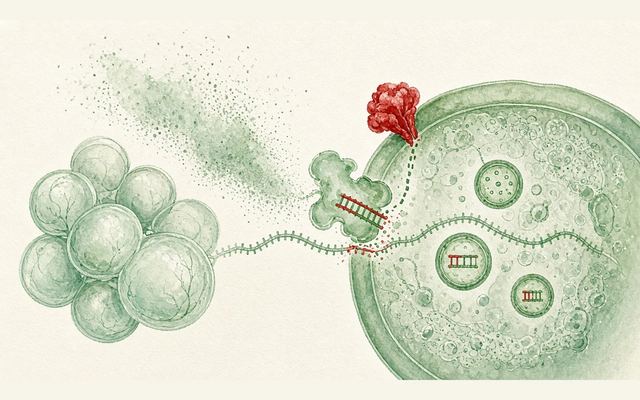
A single inhaled dose of ARO-RAGE lowered BALF sRAGE by 90.2%
Alveoli and droplets at left, with the siRNA cleaving messenger RNA at right
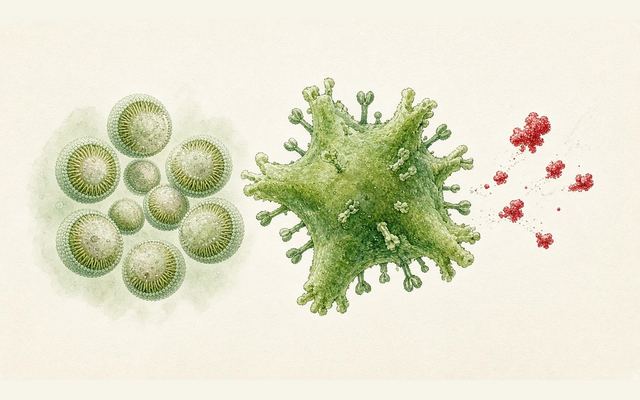
Charge-switchable LNPs did not raise IL-6 and other inflammatory cytokines in LPS-pretreated mice
Lipid particles and a macrophage, with sparse red inflammatory cytokines at right
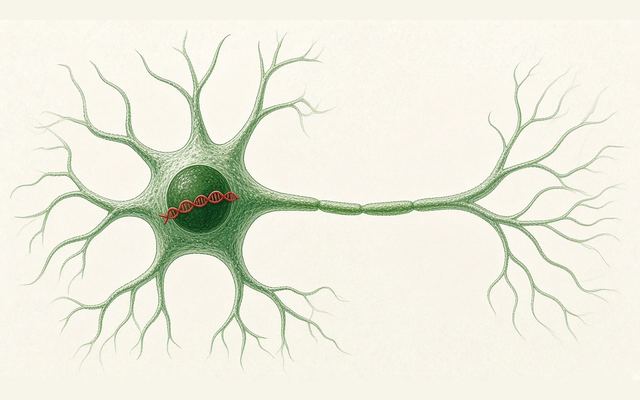
RAG-17 phase 1 in 6 patients: cerebrospinal fluid SOD1 down 69% and 56%
A red strand inside a motor neuron cell body representing the silenced messenger RNA
One email, with links to every paper. Reports and custom landscapes: contact@inlightbio.com.
Opens your email app with a pre-filled request; we add you by hand. Free, unsubscribe any time.