Inhaled ARO-RAGE was tolerable in healthy volunteers and patients with asthma, with a single 184 mg dose lowering BALF sRAGE by 90.2%
In a randomized double-blind trial, an inhaled siRNA targeting RAGE in the lung epithelium achieved tolerable safety; in healthy volunteers, soluble RAGE in bronchoalveolar lavage fell by a mean of up to 90.2% after a single 184 mg dose.
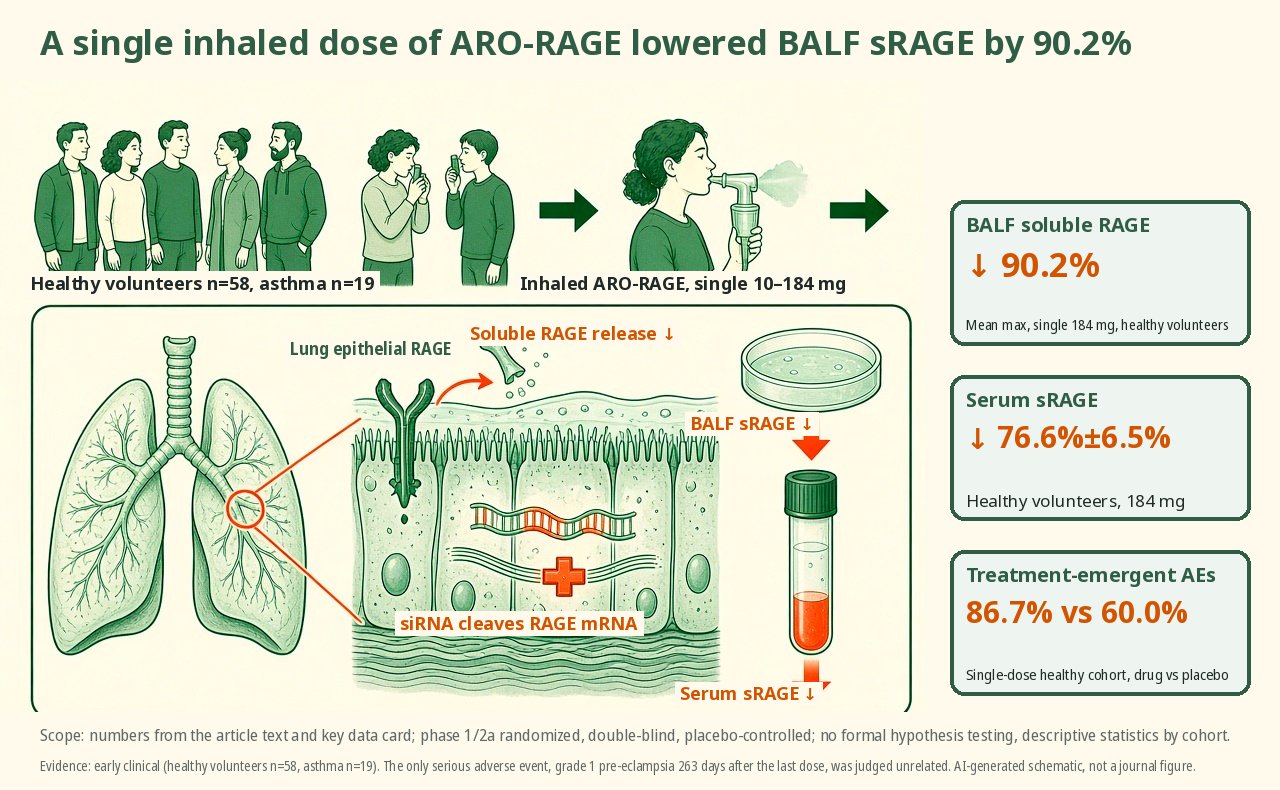
In a phase 1/2a randomized, double-blind, placebo-controlled trial of ARO-RAGE, an inhaled siRNA targeting RAGE in the lung epithelium, 58 healthy volunteers and 19 patients with asthma received single doses of 10–184 mg. In healthy volunteers, soluble RAGE in bronchoalveolar lavage fluid fell by a mean of up to 90.2% after 184 mg and serum sRAGE by 76.6%±6.5%. There were no adverse events leading to discontinuation. Treatment-emergent adverse events occurred in 86.7% of the single-dose healthy volunteer cohort versus 60.0% on placebo. The only serious adverse event was grade 1 pre-eclampsia with onset 263 days after the last dose, judged unrelated to the drug.
Key data card
- Study type: Phase 1/2a, multicentre, randomized, double-blind, placebo-controlled first-in-human trial, accompanied by preclinical rat, mouse and cynomolgus monkey data
- Sample size n: ARO-RAGE in 58 healthy volunteers (14 male) and 19 patients with asthma (6 male). Placebo: 10 in the single-dose healthy volunteer cohort, 13 in the multiple-dose cohort and 6 in asthma. Actual enrolment in Table 1: 40 single-dose healthy, 41 multiple-dose healthy and 25 asthma
- Controls: Volume-matched saline. Preclinical work additionally used saline/vehicle, non-sensitized animals, and heterozygous and homozygous RAGE knockout mice
- Intervention/dose: Nebulized inhalation with the PARI eFlow. Healthy volunteers, single dose: 10, 20, 44, 92, 120 and 184 mg; multiple dose: days 1 and 29 at 10–184 mg. Asthma multiple dose: 44, 92 and 184 mg. Preclinically, a lung-deposited dose of 0.5 mg/kg in rats and single lung-deposited doses of 0.13–1.2 mg/kg in monkeys
- Follow-up: Primary safety observation to the end of the trial; chest radiographs compared between screening and day 113. Pharmacodynamics: serum sRAGE over time, with bronchoscopy in healthy volunteers at about day 31 (single dose) and on days 57 and 85 in the multiple-dose cohort
- Primary endpoint: Occurrence and frequency of treatment-emergent adverse events (safety and tolerability)
- Primary endpoint result: No adverse events led to discontinuation or withdrawal. At least 1 treatment-emergent adverse event occurred in 60.0% on placebo versus 86.7% on drug in the single-dose healthy volunteer cohort, and 69.2% versus 78.6% in the multiple-dose cohort; in asthma, 83.3% versus 84.2%. One serious adverse event (grade 1 pre-eclampsia) occurred 263 days after the last dose and was judged unrelated to the drug
- Statistics: No formal hypothesis testing in the clinical part, with descriptive statistics by cohort and by pooled placebo/drug groups. Preclinical: one-way ANOVA with Tukey HSD for parametric data and Kruskal–Wallis with Dunn for non-parametric data, with P<0.01 considered significant
- Safety: No clinically meaningful changes on chest radiographs. No clear sustained declines in FEV1, FVC or DLCO; at the two highest asthma doses, DLCO fell transiently by about 10% at day 57 and returned to baseline by day 113. Anti-drug antibodies 0/77. No consistent rise in circulating hsCRP or IL-6
- Evidence level: Full text
- Verification record: Europe PMC full-text XML (PMC13577916): abstract, Main, all Results sections, Discussion, Methods, legends for Figs. 1–4 and Extended Data Figs. 1–9, and Tables 1–2
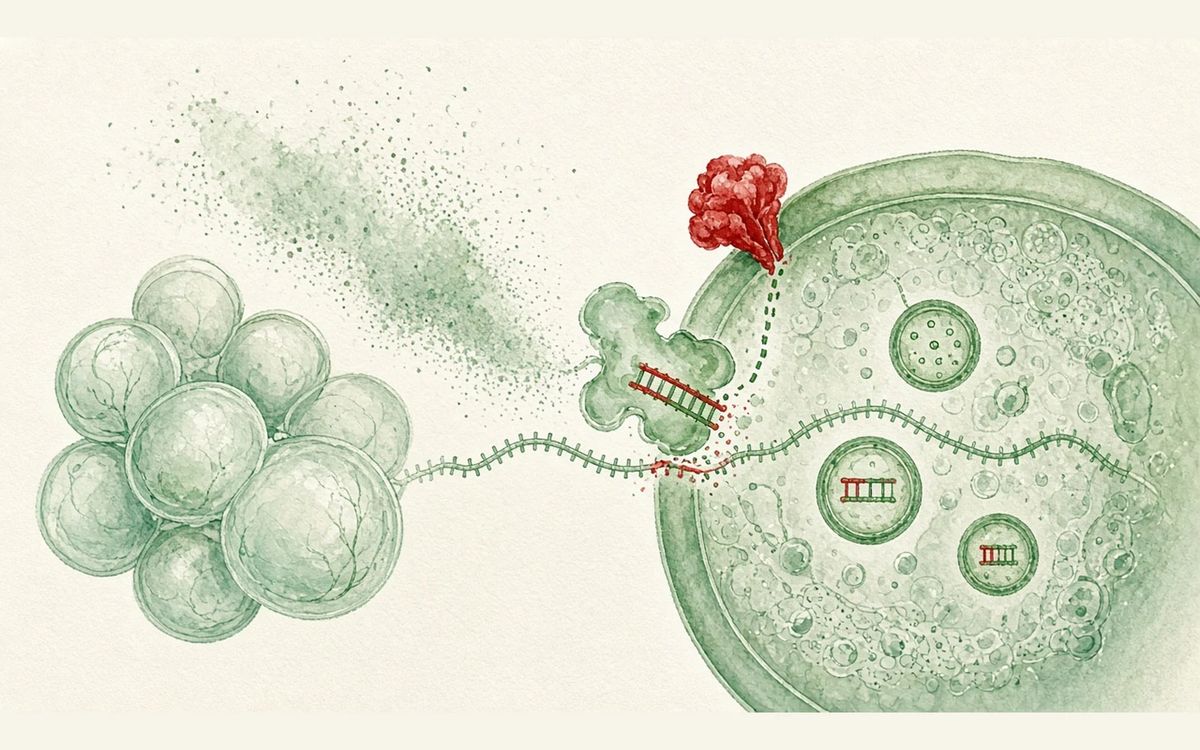
- An αvβ6 ligand-conjugated siRNA reaches the alveolar epithelium by inhalation
- RNA interference silences RAGE mRNA, lowering membrane-bound and soluble RAGE
- Eosinophilic and neutrophilic inflammation are limited in rat models
- The human trial shows tolerability and pulmonary target engagement
Background and open questions
Some patients with asthma and chronic obstructive pulmonary disease still respond inadequately to inhaled corticosteroids and existing type 2 inflammation biologics, particularly those with neutrophilic or mixed inflammatory phenotypes. The receptor for advanced glycation end products (RAGE) is highly expressed on type I alveolar epithelium and amplifies innate immunity after binding a range of damage-associated molecules; knockout mice are protected in eosinophilic and neutrophilic airway models and in emphysema-like injury. Clinical attempts to block RAGE with small molecules have had limited success, and antibodies or recombinant soluble RAGE have largely remained preclinical.
In Nature Medicine, O'Carroll et al. report ARO-RAGE: a double-stranded siRNA targeting human RAGE mRNA, fully homologous with the cynomolgus sequence and conjugated to an αvβ6 integrin ligand to promote uptake by lung epithelium, given by nebulized inhalation. The question has two layers: whether RAGE can be suppressed in the lung enough to reproduce the knockout phenotype; and whether inhaled siRNA is tolerable with demonstrable target engagement in healthy volunteers and in mild to moderate type 2 asthma.
Study design
The phase 1/2a trial (NCT05276570, EudraCT 2022-003466-20) was conducted at multiple centres in Australia, New Zealand, Thailand and South Korea, randomized, double-blind and placebo-controlled. The primary objective was safety and tolerability, with pharmacokinetics secondary and pharmacodynamics exploratory. The trial was not powered for FEV1 or exacerbations. Healthy volunteers were 18–55, non-smoking with normal FEV1; asthma participants were 18–60 with mild to moderate disease, pre-bronchodilator predicted FEV1 ≥70% and blood eosinophils ≥200/µl.
Single-dose cohorts were planned at 8 participants each (6 drug, 2 placebo) with sentinel dosing, and the multiple-dose healthy and asthma cohorts escalated by dose. Nebulized volumes were 1–4.6 ml over 3–14 minutes. Healthy volunteers in some cohorts underwent bronchoscopy; asthma cohorts did not. Preclinically, species-specific ligand-conjugated siRNAs were used in rat allergic asthma, elastase-induced emphysema-like injury and LPS acute lung injury, with heterozygous knockout mice used to estimate the protection afforded by partial RAGE reduction.
Key results
Rats: deep silencing that limits several forms of lung inflammation
After inhalation the drug remained mainly in the lung, with tracheal exposure about 6% of lung AUC and very low levels in non-respiratory organs. A single lung-deposited dose of 0.5 mg/kg silenced lung RAGE mRNA by more than 90% within 3 days and maintained this for over 8 weeks; serum soluble RAGE (sRAGE) fell to near undetectable within about 4 weeks. Dosing before Alternaria challenge significantly limited eosinophil and neutrophil recruitment into lavage fluid, lowered MIP-1α and IP-10, and attenuated MUC5AC and CHI3L1 mRNA; IL-17A and IL-13 trended lower without meeting the paper's P<0.01 threshold. In the elastase model, silencing prevented neutrophil and macrophage entry into the airways and lowered lavage protein, IL-6, MMP12 and HMGB1 among others. In the LPS model it had little effect on acute neutrophil recruitment but limited neutrophil elastase, citrullinated histone H3 and a range of mediators and reduced lavage protein. Lung RAGE mRNA in heterozygous knockouts was about 50% of wild type, with protection intermediate between wild type and homozygous knockout.
Cynomolgus monkeys: dose-related declines in tissue membrane-bound RAGE and serum sRAGE
Nine genes have two mismatches to the ARO-RAGE antisense strand, and among the 3 of these known to express protein, STARD7 was unchanged in monkey lung tissue with deep RAGE knockdown. Fourteen days after a single lung-deposited dose of 1 mg/kg, RAGE mRNA silencing exceeded 90% in left and right lung, cranial and caudal lobes and proximal, middle and distal segments (n=3 per group). Single doses of 0.13–0.47 mg/kg produced dose-related declines in lung membrane-bound RAGE and serum sRAGE at day 28, generally deeper in tissue. After 1.2 mg/kg, serum sRAGE reached a nadir at about 4 weeks and then recovered over roughly 3 months; a second dose on day 29 restored the deep reduction for a further 4 weeks or more. Lavage sRAGE approached the lower limit of quantification 4 weeks after the second dose.
Human safety (primary endpoint)
Baseline characteristics were broadly balanced between placebo and drug groups. No adverse events led to discontinuation or withdrawal. The most common events were headache and upper respiratory infection. COVID-19 was more frequent in the drug group (14/58 versus 2/23 on placebo). The only serious adverse event was grade 1 pre-eclampsia in a healthy volunteer in the 92 mg multiple-dose cohort who conceived about 1 month after her last dose with onset at day 263, judged unrelated and resolving after delivery of a healthy infant. There were no serious adverse events in the asthma cohorts, where adverse event rates were 83.3% versus 84.2%. Chest radiographs at day 113 showed no clinically meaningful changes among those collected. At the two highest asthma doses, DLCO fell transiently by about 10% at day 57 and recovered by day 113, which the authors consider within the normal variability of the measurement. Lavage cell differentials showed no clear increase in eosinophils, lymphocytes, macrophages or neutrophils relative to placebo. The incidence of anti-drug antibodies was 0 (0/77).
Pharmacokinetics and pharmacodynamics (secondary/exploratory)
Median time to peak plasma concentration after inhalation was 1–7 hours with low peak concentrations, consistent with systemic bioavailability of 8.6% in rats and 5.7% in monkeys. Plasma levels declined roughly monoexponentially and cleared within 48 hours; terminal half-life ranged from 6.1 hours (10 mg) to 16 hours (184 mg). Apparent clearance fell with dose, with arithmetic means of 752 L/h (10 mg) to 41 L/h (184 mg), which the authors attribute to an increasing absorbed fraction rather than a change in clearance itself. About 0.51% of the inhalable delivered dose appeared unchanged in urine, with mean renal clearance of 0.414 L/h. Exposure was similar on days 1 and 29, with day 29 trough concentrations below the limit of quantification, indicating no systemic accumulation at intervals of 4 weeks or longer. Plasma AUC24 ranges were similar in asthma and healthy volunteers (256–1,580 and 248–1,680 ng·h/ml). No circulating metabolites at relative abundance >10% were detected in plasma after 184 mg.
Serum sRAGE was stable on placebo in healthy volunteers. After a single dose, serum sRAGE reached a nadir at day 29, with a mean maximum reduction of 76.6%±6.5% at 184 mg, remaining suppressed for a further 4–6 weeks before recovering. Lavage sRAGE at day 31 fell by a mean of up to 90.2%±4.2% at 184 mg, versus 0.1%±32.8% on placebo. After two 184 mg doses, the mean maximum serum reduction was 88.7%±8.4%, with lavage reductions of 93.7%±3.9% at day 57 and 81.9%±11.6% at day 85; serum was still 65.9%±17.4% lower at day 113 and returned to at least 70% of baseline within about 6 months thereafter. In asthma, the nadir after two 184 mg doses was 76.2%±12.0%, falling to 34.6%±13.8% at day 113, a faster recovery than in healthy volunteers.
Mechanistic interpretation
Demonstrated in the paper: Ligand conjugation keeps the inhaled siRNA mainly in the lung and brings it into the epithelium, and as RAGE mRNA and membrane-bound protein fall, the sRAGE generated by proteolytic cleavage falls in the airway and circulation, so serum and lavage sRAGE serve as target engagement markers. In rats this silencing is sufficient to reproduce part of the knockout phenotype in eosinophilic and neutrophilic models. In humans, low systemic exposure after inhalation, absence of anti-drug antibodies and no consistent rise in hsCRP or IL-6 indicate that driving circulating sRAGE very low does not automatically unleash systemic inflammation. STARD7, a potential off-target, was unchanged in monkey lung.
Author hypotheses: Most circulating sRAGE is thought to come from lung epithelium, so silencing alveolar RAGE lowers the serum readout; although the literature treats sRAGE as an anti-inflammatory decoy, this paper saw no systemic inflammation attributable to reduced sRAGE in the markers measured. The authors also suggest the same strategy might cover type 2 and non-type 2 airway disease including COPD and cystic fibrosis, but the human pharmacodynamic cohorts comprised only mild to moderate type 2 asthma, were not stratified by phenotype, and had no confirmatory exacerbation or FEV1 endpoints.
Limitations and uncertainties
- The samples remain small with short follow-up in mild to moderate asthma, and the trial was explicitly not powered to test FEV1 or exacerbations; the findings cannot be extrapolated to severe asthma or COPD.
- The asthma cohorts had no bronchoscopy, so pulmonary cellular and local RAGE changes can only be inferred indirectly from serum sRAGE, which recovered faster in asthma patients than in healthy volunteers.
- Although the authors attribute the transient DLCO decline at the highest asthma doses to assay variability, it still needs re-examination in the planned phase II (NCT07241546 in the text). Transcriptome-wide off-target effects beyond three mismatches were not measured. No sex-stratified analysis was performed in the clinical part.
Clinical and industry implications
If phase II reproduces the safety and reads out clinical endpoints in allergen-induced asthma, inhaled ligand-conjugated siRNA would become a route for delivering RNAi directly to alveolar epithelium without relying on systemic LNPs. RAGE sits downstream of many injury signals and is in principle "broader" than any single type 2 cytokine, but that remains a mechanistic extrapolation.
What can be said now is that nebulized dosing is tolerable in healthy volunteers and mild to moderate asthma, and that doses in the 184 mg range suppress lavage and serum sRAGE deeply for several weeks. Whether this becomes a therapy depends on diffusion capacity over longer follow-up, efficacy stratified by inflammatory phenotype, and whether safety holds in diseases with higher RAGE such as emphysema or cystic fibrosis.
Authors, source and verification
Evidence level: Full text; verification record: Europe PMC full-text XML (PMC13577916): abstract, Main, all Results sections, Discussion, Methods, legends for Figs. 1–4 and Extended Data Figs. 1–9, and Tables 1–2. The licence is CC BY-NC-ND 4.0, so the text is a paraphrase and does not reproduce the original sentence by sentence.
O'Carroll M, Kasahara D, Huetsch J, Reed T, Perkins TN, Zhou R, et al. Inhaled siRNA therapy targeting RAGE for pulmonary inflammation: a first-in-human randomized trial. Nat Med. 2026 Sep 9. https://doi.org/10.1038/s41591-026-04607-z
Primary field: Nucleic acid & gene therapy · Related: ARO-RAGE, Inhaled siRNA, RAGE, αvβ6, Asthma, Soluble RAGE
Summary of a published paper or preprint, written from the original text; numbers are as reported by the authors. Not medical or investment advice. Corrections: contact@
Related science
Charge-switchable LNPs did not raise IL-6 and other inflammatory cytokines in LPS-pretreated mice
Lipid particles and a macrophage, with sparse red inflammatory cytokines at right
RAG-17 phase 1 in 6 patients: cerebrospinal fluid SOD1 down 69% and 56%
A red strand inside a motor neuron cell body representing the silenced messenger RNA
A single dose of PE-LNP achieved 49% precise editing across the mouse liver
A lipid particle carrying red editing components into a hepatocyte
One email, with links to every paper. Reports and custom landscapes: contact@inlightbio.com.