An optimized PE-LNP at a single 2 mg/kg dose achieved 49% average prime editing across the whole mouse liver
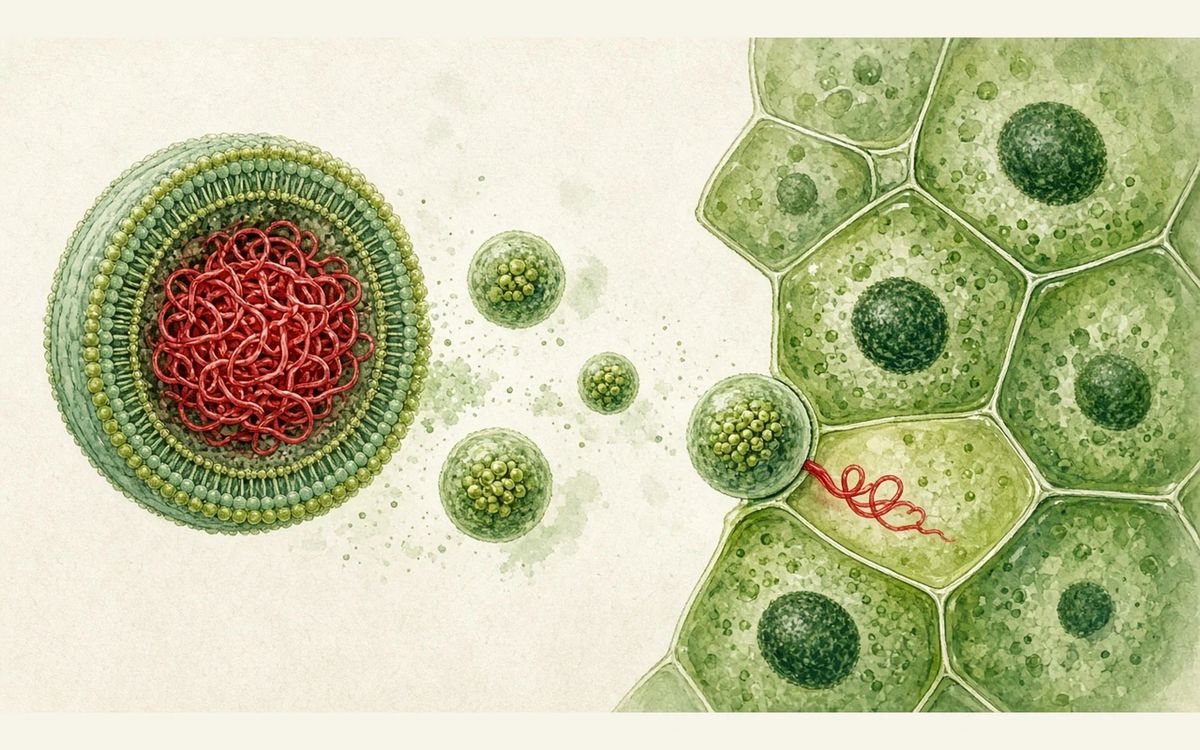
After systematic optimization of lipid nanoparticles for the three-component prime editor, a single dose of 2 mg/kg total RNA achieved an average of 49% indel-free precise editing across the whole mouse liver, a 63-fold improvement over the initial formulation.
After systematic optimization of lipid nanoparticles for the three-component prime editor, a single dose of 2 milligrams per kilogram of total ribonucleic acid achieved an average of 49% indel-free precise editing across the whole mouse liver at 7 days, a 63-fold improvement over the initial formulation and a 13-fold improvement over the intermediate one; at 8 weeks it was 44%, close to the 46% of dual-vector adeno-associated virus. In phenylketonuria mice, serum phenylalanine fell 90% within 3 days and was below 360 micromolar by day 7. At a saturating dose of 4 milligrams per kilogram, whole-liver editing reached 53% and serum proprotein convertase fell by up to 94%.
Key data card
- Study type: Preclinical study (cells, precise editing in mouse liver, humanized phenylketonuria mice)
- Sample size n: Mostly n=3 wells in vitro; mostly n=3 mice for in vivo editing and serum readouts; n=4 per condition (1 male, 3 female) in the phenylketonuria model
- Controls: The initial HM-pegRNA formulation (s0.1), PEmax, tevopreQ1 epegRNA, in-house mRNA, PBS, untreated, dual-vector PE-AAV9 (1×10^12 vg) and plasmid transfection
- Intervention/dose: Separately formulated OF-02 LNPs carrying PE mRNA, epegRNA and ngRNA, mixed just before use; typically 2 mg/kg total RNA by retro-orbital injection; dose response 0.5–4 mg/kg; a single 4 mg/kg dose in the phenylketonuria model; repeat dosing at 1 mg/kg twice 7 days apart
- Follow-up: Liver editing mostly 7 days after dosing; pharmacokinetic sampling at 1, 6, 24 and 48 hours; the AAV comparison at 8 weeks; serum phenylalanine in phenylketonuria before dosing and on days 3 and 7
- Primary endpoint: The paper has no protocol-specified clinical endpoint. Central readout: average precise editing rate at the Pcsk9 locus across the whole mouse liver after a single 2 mg/kg dose of s3 PE-LNP
- Primary endpoint result: s3 PE-LNP carrying commercially produced, HPLC-purified, double-stranded-RNA-depleted PE6c mRNA achieved an average of 49% indel-free precise editing across the whole liver 7 days after dosing, a 63-fold improvement over s0.1 and 13-fold over s0.2. In the 8-week head-to-head comparison, 2 mg/kg s3 gave 44% versus 46% for dual-vector PE-AAV9 (1×10^12 vg)
- Statistics: Mean ± s.e.m.; one-way ANOVA with Tukey unless otherwise noted; some comparisons by unpaired t-test or two-way ANOVA with Bonferroni. Sample sizes were not calculated in advance for power
- Safety: Serum ALT rose mildly and transiently on day 1 after 2 mg/kg and returned close to untreated controls by day 3; in phenylketonuria mice given 4 mg/kg, ALT/AST on day 3 were no higher than on day 0. The authors report no observed long-term toxicity
- Evidence level: Full text
- Verification record: Europe PMC full-text XML (PMC13379318): abstract, Main, all Results sections, Conclusions, Methods, legends for Figs. 1–6 and Extended Data Figs. 1–10
- Separately formulated LNPs carrying mRNA and the two guide RNAs, mixed just before use
- Sequential optimization of PE variants, the epegRNA 3′ motif and mass ratios
- Transient expression in liver with efficient precise editing across the organ
- Correction of PAH R408W and lower phenylalanine in phenylketonuria mice
Background and open questions
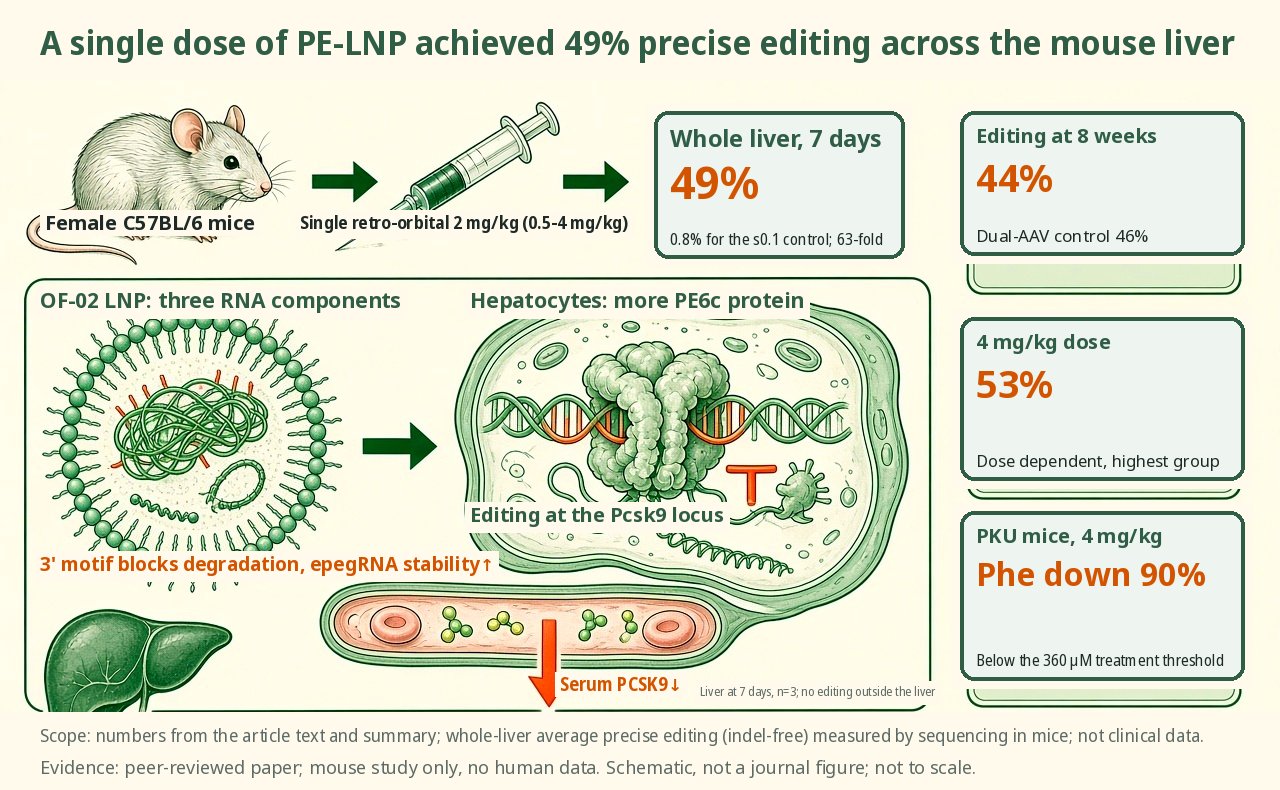
Prime editing can make specified substitutions, short insertions or short deletions in living cells, but most therapeutic efforts so far rely on ex vivo electroporation or adeno-associated virus (AAV). AAV has limited packaging capacity, may hinder repeat dosing, and its sustained expression widens the window for off-target effects and immunogenicity. Lipid nanoparticles (LNPs) have been used to deliver Cas9 and base editors in vivo, but for three-component prime editing, which requires editor mRNA, pegRNA and nicking gRNA together, previous LNPs were inefficient.
In Nature Nanotechnology, Jiang et al. break the limiting steps apart: pegRNA degrades before the editor protein appears, the editor's own activity and translation are insufficient, the three components are mismatched in stoichiometry, and an approximately 6.5 kb large mRNA and 100–150 nt small gRNAs are hard to accommodate in a single particle. Previous LNP routes listed in the text include: heavily chemically modified pegRNA given at 3 mg/kg weekly for three doses reaching only 8% on average across the liver; AAV-expressed epegRNA plus LNP-delivered mRNA at about 16%; and La-fused PE7 at two doses of 4 mg/kg reaching at most about 23%. They apply a generalizable optimization workflow to an all-RNA PE-LNP and test in Pcsk9 and in the PAH R408W mouse model of phenylketonuria (PKU) whether it reaches what the authors call a rescuing level of editing.
Study design
PE mRNA, (e)pegRNA and ngRNA were separately formulated into LNPs of OF-02/DOPE/cholesterol/C14-PEG2000 (35/16/46.5/2.5, N/P 10.1) by microfluidics and mixed by mass ratio before injection or transfection. In vivo work mostly used 6-week-old female C57BL/6 mice dosed retro-orbitally, with high-throughput sequencing of liver after 7 days. The initial mass ratio was 1:0.9:0.1 (mRNA:epegRNA:ngRNA), and Pcsk9 used the established PE3 strategy to install a +1 TTAC frameshift insertion.
Optimization proceeded in stages: s0.1 used heavily chemically modified pegRNA, s0.2 switched to epegRNA, s1 switched to PE6 variants, s2 switched to the new 3′ motif eSBRMV1-A, and s3 adjusted the mRNA:gRNA ratio and switched to commercial double-stranded-RNA-depleted mRNA. The PKU work ran the same workflow in HuH-7 cells carrying an integrated PAH R408W cassette before giving a single 4 mg/kg dose to 7–9-week-old homozygous humanized mice. Off-target comparisons included plasmid transfection and dual-vector PE-AAV9. Most in vivo groups were n=3, with n=4 for PKU, and no prespecified power calculation was given.
Key results
Stepwise optimization pushed whole-liver editing from 0.8% to 49%
At the highest dose in Hepa1-6 cells, HM-pegRNA gave 31% editing and epegRNA 70%. Across the whole mouse liver, s0.1 averaged 0.8% and s0.2 rose to 3.8% (P=0.0003). PE6c raised s0.2 from 2.3% with PEmax to 11% (4.6-fold, P<0.0001); PE6b gave 4.1% and PE6d 6.2%. Relative to tevopreQ1, eSBRMV1-A raised average whole-liver editing from 17% to 26% (P=0.0006). mRNA:gRNA ratios between 2:1 and 1:4 made little difference (about 18–22%), and the authors chose 1:2 for s3. PE6c mRNA with commercial UTRs and HPLC removal of double-stranded RNA brought s3 to 49%, versus 26% with in-house mRNA (1.9-fold, P=0.0016). Total improvements over s0.1 and s0.2 were 63-fold and 13-fold.
Particle properties, dose and repeat dosing
The mRNA-LNP had 63% encapsulation efficiency and a hydrodynamic diameter of 118 nm, below the two gRNA-LNPs (epegRNA 87%/105 nm, ngRNA 92%/98 nm). By cryo-electron microscopy, mRNA particles often showed bleb-like protrusions while the small gRNA particles had lamellar or hexagonal cores. The clinically used MC3 and SM-102 encapsulated better but did not exceed OF-02 for liver editing in vivo. At 2 mg/kg, editing was essentially confined to liver (49%), with none detected in heart, lung, kidney, spleen, bone marrow, liver non-parenchymal cells or whole blood. At the saturating dose of 4 mg/kg, whole-liver editing was 53% and serum PCSK9 fell by up to 94%. A single 1 mg/kg dose gave about 28% (31% with dexamethasone pretreatment) and 43% after a second dose (45% with pretreatment); serum PCSK9 fell 70–72% after one dose and 83–84% after two. Editing was already 27% on day 1 and 47% on day 7; PCSK9 fell 56% on day 1 and 90% on day 7.
Phenylketonuria mice: a single dose reached what the authors call a rescuing level
The best editor at this locus was PE6d (0.4% at the highest dose in HuH-7), eSBRMV1-A raised editing to 3.7% (7.5-fold above tevopreQ1), and the 1:2 ratio gave 11%. In vivo, whole-liver genomic editing with s2 and s3 was 15% and 12%, with cDNA values of 23% and 19%, consistent with preferential transfection of hepatocytes producing Pah transcripts. s2 lowered serum phenylalanine by 90% within 3 days; by day 7 all groups except s0.2 were below the recommended intervention threshold of 360 µM. These results come from a single dose rather than the multi-dose regimens of previous LNP prime editing reports.
Off-target editing lower than with sustained-expression DNA delivery
Across four edits at HEK4 in HuH-7 cells, PE-LNP gave correct editing no lower than plasmid for three; plasmid produced significant off-target editing at OT1 (three of four edits) and OT3 (all four), while for PE-LNP only the +2 TAA insertion was significant at OT3 and still at a lower frequency than plasmid. At 8 weeks, 2 mg/kg s3 and 1×10^12 vg dual-vector PE-AAV9 gave whole-liver editing of 44% versus 46% (P=0.1419) and serum PCSK9 reductions of 91% versus 96%. AAV additionally produced 7.9% editing in the heart, while the LNP produced no extrahepatic editing. Of 14 CIRCLE-seq candidate sites, only OT13 rose above background, and significantly more with AAV than with the LNP.
Mechanistic interpretation
Demonstrated in the paper: epegRNA outperformed chemically modified pegRNA alone, and PE6c gave higher protein levels than PEmax in liver lysates at every sampling point. In the presence of PE, eSBRMV1-A showed slightly higher relative persistence in liver at 24 hours (P=0.0883) and higher editing at 24 and 48 hours (13% versus 7.8%, and 16% versus 11%); when epegRNA-LNP was given alone, the two 3′ motifs decayed similarly, indicating that the stabilizing effect depends on co-presence of the editor. Double-stranded-RNA-depleted mRNA and HPLC-purified epegRNA further improved efficiency in vivo. Editing occurred in liver parenchyma, appeared rapidly, could be built on with a second dose, and raised ALT only transiently.
Author hypotheses: Besides slowing degradation, eSBRMV1-A may also promote ribonucleoprotein assembly or favour pairing of the DNA flap with the primer binding site. The bleb morphology may correspond to one large mRNA per bleb, suggesting that formulations may eventually need separate optimization for large and small RNAs. La-fused PE7 was not better than PE6c with eSBRMV1-A in this workflow (50% versus 39%), and the authors suggest that protection by the 3′ motif and by La may partly overlap or even interfere. These mechanistic explanations largely come from correlations and the literature rather than item-by-item knockout experiments.
Limitations and uncertainties
- Nearly all core in vivo data use n=3 6-week-old female C57BL/6 mice, with n=4 for PKU; sample sizes were not calculated in advance, so there is no basis for extrapolating to other strains, sexes or larger animals.
- Efficient editing is currently confined to liver; after systemic OF-02 dosing, no editing was detected in non-liver tissues or liver non-parenchymal cells. At the PKU locus, s3 was not better than s2 (12% versus 15%), showing that the optimal stage of the workflow need not hold at every locus.
- Off-target analysis covered only known and nominated sites rather than the whole genome. There are no human data. The authors also note that mRNA sequence, cap and tail, epegRNA chemistry and purity, and cargo-specific LNP design all still need improvement.
Clinical and industry implications
If reproduced across more genes and in larger animals, all-RNA PE-LNPs offer a non-viral route for hepatic genetic metabolic diseases that can be given as a single dose, repeated, and with a shorter editing window than AAV. This paper achieves liver editing at Pcsk9 comparable to dual AAV without cardiac editing, and brings phenylalanine below the intervention threshold in PAH c.1222C>T mice.
Whether it reaches the clinic depends on editing depth and distribution in non-human primates, immune and liver enzyme responses to repeat dosing, and epegRNA manufacturing for patient-specific mutations. It fills the transversions and short indels that base-editing LNPs cannot easily cover, rather than replacing base-editing LNPs already used in humans.
Authors, source and verification
Evidence level: Full text; verification record: Europe PMC full-text XML (PMC13379318): abstract, Main, all Results sections, Conclusions, Methods, legends for Figs. 1–6 and Extended Data Figs. 1–10. The licence is CC BY 4.0.
Jiang AY, Cristian A, Brooks DL, Feierman ER, Chen PZ, Whittaker MN, et al. Efficient prime editing in vivo and in vitro using lipid nanoparticles. Nat Nanotechnol. 2026 Jun 15. https://doi.org/10.1038/s41565-026-02200-6
Primary field: Nucleic acid & gene therapy · Related: Disease models, prime editing, PE-LNP, Pcsk9, Phenylketonuria, PAH R408W
Summary of a published paper or preprint, written from the original text; numbers are as reported by the authors. Not medical or investment advice. Corrections: contact@
Related science
A single inhaled dose of ARO-RAGE lowered BALF sRAGE by 90.2%
Alveoli and droplets at left, with the siRNA cleaving messenger RNA at right
Charge-switchable LNPs did not raise IL-6 and other inflammatory cytokines in LPS-pretreated mice
Lipid particles and a macrophage, with sparse red inflammatory cytokines at right
RAG-17 phase 1 in 6 patients: cerebrospinal fluid SOD1 down 69% and 56%
A red strand inside a motor neuron cell body representing the silenced messenger RNA
One email, with links to every paper. Reports and custom landscapes: contact@inlightbio.com.