Multi-objective antibody design and optimization using machine learning (Review)
Antibodies—including conventional immunoglobulins, single-domain antibodies and bispecifics—are often engineered to optimize affinity, specificity, polyreactivity, stability, aggregation and immunogenicity at once. Trade-offs among these attributes frequently hinder variants suitable for clinical use, and identifying leads typically takes multiple rounds of experimental screening, especially for pre-selected epitopes or difficult targets such as GPCRs, ion channels and multipass membrane proteins. In this Nature Reviews Bioengineering article, Kuo, Tessier and colleagues review computational multi-objective optimization of existing antibodies and de novo antibody design, and write that AI and machine-learning methods have the potential to ease current bottlenecks.
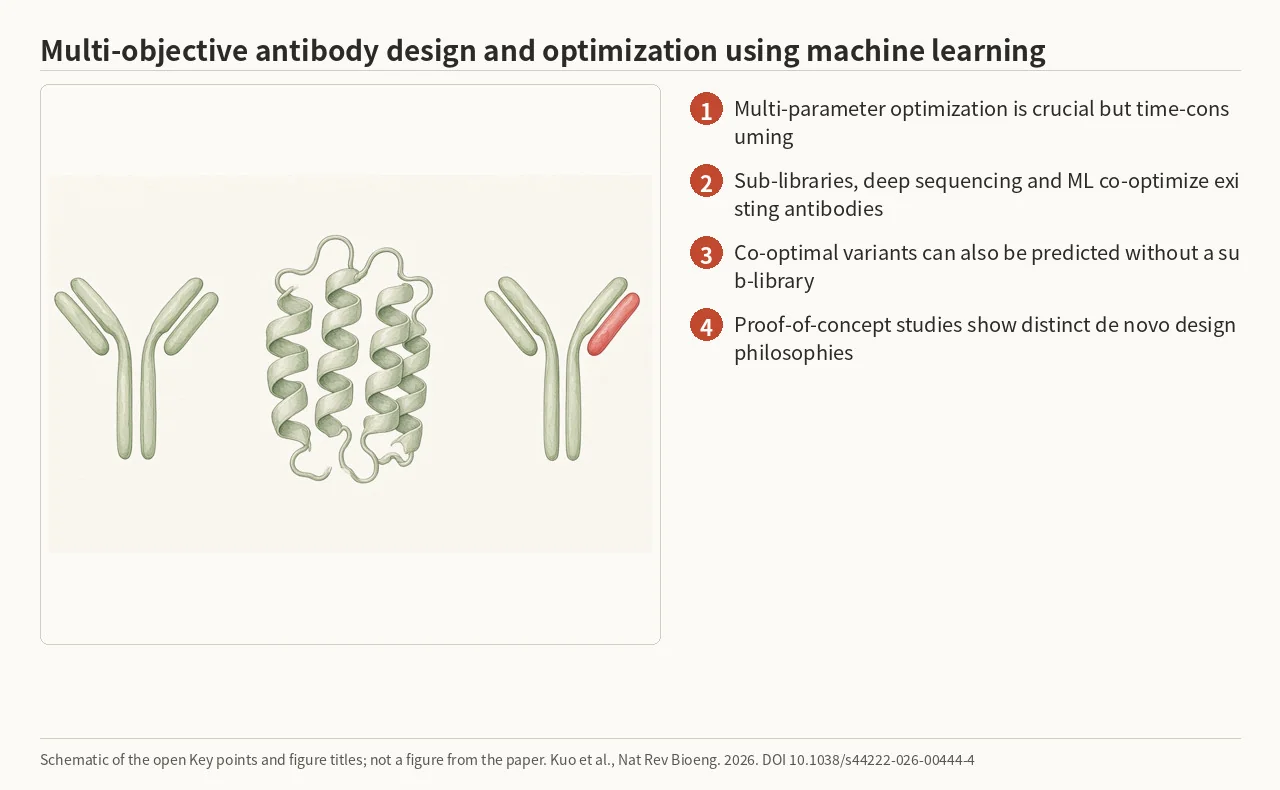
Background and open questions
Antibodies are developed across a wide spectrum of therapeutic and diagnostic uses, from conventional immunoglobulins to single-domain and bispecific formats. Lead antibodies are commonly engineered to improve one or more key properties, including affinity, specificity, polyreactivity, stability, aggregation and immunogenicity. Trade-offs among these attributes frequently get in the way of variants that are suitable for clinical use.
Identifying leads with desirable properties typically requires multiple rounds of experimental screening and evaluation. That burden is especially clear when the target is a pre-selected epitope or a challenging, high-value protein such as a GPCR, an ion channel or a multipass membrane protein. The authors write that artificial intelligence and machine-learning methods can streamline experimental screening and antibody generation. In this Review they discuss both computational multi-objective optimization of existing antibodies and de novo antibody design.
Study design
This is a review, not a report of a new cohort or trial. The open materials describe two threads: multi-objective optimization of existing antibodies, and de novo design. Four figure titles on the publisher page line up with the Key points: overall multi-objective optimization with AI and machine learning (Fig. 1); sub-library generation, deep sequencing and machine learning (Fig. 2); methods for direct prediction of co-optimal variants (Fig. 3); and methods that involve elements of de novo design of co-optimal antibodies (Fig. 4). This brief uses only those open titles to describe the structure and does not recount figure panels that are not visible. The article was accepted on 13 April 2026 and published on 9 June 2026 in volume 4, pages 778–792, of the August 2026 issue.
Key results
The five open Key points are the authors’ own outline of the review.
First, multi-parameter optimization is a crucial yet difficult and time-consuming task in antibody drug development. That statement matches the abstract’s emphasis on trade-offs among affinity, specificity, polyreactivity, stability, aggregation and immunogenicity.
Second, computational methods, including artificial intelligence and machine learning, are being explored for antibody optimization in order to improve efficiency and quality and to expand current optimization capabilities. The abstract likewise says that AI and ML methods can streamline experimental screening and antibody generation. This is a description of an active methods effort, not a claim that any one algorithm has replaced experiment.
Third, antibody sub-library generation, deep sequencing, and AI- and machine-learning-guided predictions are improving the multi-objective optimization of existing antibodies by enabling the co-optimization of multiple properties and the exploration of broader sequence spaces. The title of Fig. 2 matches this path.
Fourth, other strategies use computation to predict co-optimal variants of existing antibodies directly, without sub-library generation. The authors’ range of examples runs from energy-based models for antibody humanization and stabilization to interpretable machine-learning models for co-optimizing self-association and polyreactivity. Fig. 3 is titled “Methods for direct prediction of co-optimal antibody variants.”
Fifth, several proof-of-concept studies showcase distinct de novo antibody design philosophies and, in the authors’ wording, open the door to AI- and machine-learning-guided design of de novo, multi-parameter-optimized antibodies. Fig. 4 is titled “Methods involving elements of de novo design of co-optimal antibodies.” In the abstract, the authors conclude that applying AI and ML methods has the potential to overcome current bottlenecks in antibody development and to accelerate the generation of improved therapeutics. That is a prospective statement by the reviewers, not a new clinical result.
Mechanistic interpretation
Read from the open outline, the computational work splits into two approaches to existing antibodies, plus a third de novo thread. One path still starts from an existing molecule: generate a sub-library, then use deep sequencing and machine learning to co-optimize several properties across a broader sequence space. The other path tries to skip the sub-library and predict co-optimal variants directly, with energy-based models called out for humanization and stabilization and interpretable machine-learning models called out for self-association and polyreactivity. De novo design is presented separately as proof-of-concept work that illustrates different design philosophies, not as a mature process that has already displaced experimental screening. This brief does not add algorithm names or benchmark numbers that are not in the open text.
Limitations and uncertainties
The article is a review of computational and AI/ML methods and does not present new human efficacy or safety data. The authors themselves flag trade-offs among developability attributes; whether a given prediction improves all of the intended properties in a real program has to be judged from the primary studies they cite. De novo design is framed as proof of concept in the Key points and should not be read as already routine in the clinic. The information boundary is also important: this brief is based only on the PubMed abstract and the open parts of the publisher page. The main text is subscription content, so methods details, case studies or numbers that appear only behind the paywall are not used here. Readers who need to check a specific algorithm or example should consult the full paper.
Clinical and industry implications
For antibody development, this 2026 review places developability-related attributes in a single multi-objective optimization problem and distinguishes optimization of existing molecules from de novo design. The formats named in the abstract run from conventional immunoglobulins to single-domain and bispecific antibodies, for both therapeutic and diagnostic use. The authors argue that AI and ML can improve efficiency and expand what optimization can do, and may ease current bottlenecks; the Key points also remind readers that multi-parameter optimization remains difficult and time-consuming. For programs that must jointly manage specificity, polyreactivity, stability and immunogenicity, or that face difficult targets such as GPCRs, ion channels and multipass membrane proteins, the review is a map of methods, not evidence that any one molecule has already reached a filing standard. Because the main text remains behind a paywall, technical choices should be checked against the full article and its cited studies.
Authors and source
The first author is Yun-Huai Kuo; the corresponding author is Peter M. Tessier. The other authors are Chloe N. Brown, Ece Akin and Yunxuan Xie. All authors are at the University of Michigan, Ann Arbor, with appointments in Chemical Engineering, the Biointerfaces Institute and Pharmaceutical Sciences; P.M.T. is also in Biomedical Engineering. Competing interests: P.M.T. is a member of the scientific advisory boards of Nabla Bio, Aureka Biotechnologies, Dualitas Therapeutics, CelineBio and Metaphore Biotechnologies. The work was supported by NIH grants R35GM136300, R01AG080016, R21AI171844, R01EB036493, R21NS132018, R21AG093031, R21AI190578 and R01NS138455 to P.M.T., and by the Albert M. Mattocks Chair (P.M.T.). Nature Reviews Bioengineering thanks Pietro Sormanni, Hiroki Shirai, Charlotte Deane and the other, anonymous, reviewer(s) for their contribution to the peer review of this work.
Kuo YH, Brown CN, Akin E, Xie Y, Tessier PM. Multi-objective antibody design and optimization using machine learning. Nat Rev Bioeng. 2026;4:778–792. Published 2026 Jun 9. https://doi.org/10.1038/s44222-026-00444-4
Featured
AI Drug R&D Platforms

Related science
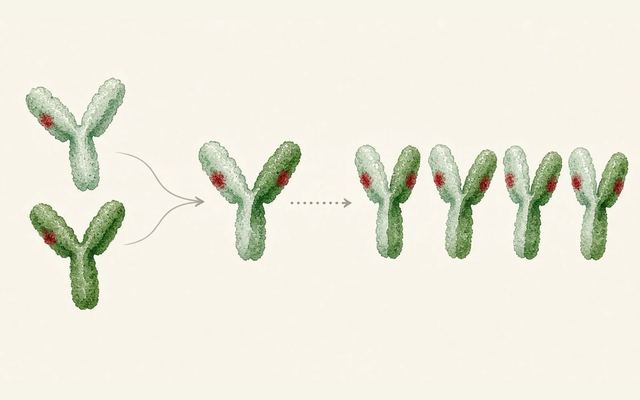
A 160-member bispecific library: surface properties predictable from parents, ρ up to 0.95
Two parental antibodies combining into a bispecific, with red dots marking surface properties
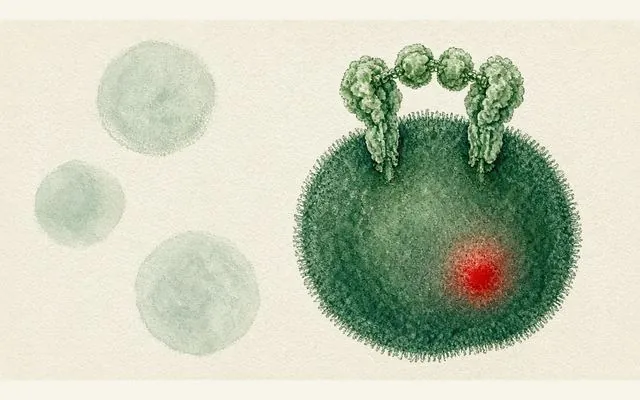
A trispecific IL-2R antibody reaches an EC50 of 0.015 nM with Treg bias
A green trispecific antibody binding a dark green regulatory T cell, with the rest quiescent
A 156-member bispecific screen selects a low-affinity SIRPα×CD38
A macrophage phagocytosing the tumour cell at right via a red bispecific
One email, with links to every paper. Reports and custom landscapes: contact@inlightbio.com.
Opens your email app with a pre-filled request; we add you by hand. Free, unsubscribe any time.