EIP immunogenicity risk assessment: tailored mitigation and monitoring (Review)
Biotherapeutics can trigger unintended immune responses that affect safety and patient benefit, and can even end a program, so immunogenicity (IG) risk needs to be understood throughout development by both sponsors and regulators. Immunogenicity risk assessment (IRA) is used to identify risk factors and to set mitigation and monitoring strategies. The European Immunogenicity Platform (EIP) presents an industry-aligned IRA framework in Frontiers in Immunology, from early de-risking in molecular design to bioanalytical monitoring and mitigation in clinical trials. The review updates the immunogenicity risk list, recommends how to assign an overall low, moderate or high risk level before clinical start, and discusses business considerations in that assessment.
Background and open questions
Published literature already offers extensive guidance on individual IRA risk factors, examples for different biological modalities, and bioanalytical monitoring in nonclinical and clinical studies. The EIP overview focuses on IRA and bioanalytical strategies aligned with health-authority guidance; literature that centers on nonclinical, in vitro and in silico IG risk-assessment assays (IVISIA) is outside the scope of its overview table. The authors write that, since earlier recommendations appeared, regulatory expectations, industry collaboration and data sharing, and technical innovation have all advanced how IRA is understood and used. Gaps remain, particularly in assigning an overall IG risk level, integrating business-risk considerations, clinical mitigation, and communicating the IRA to health authorities before clinical development starts. The review sets out to describe those changes and to collect current practical advice on IG risk management. In the conclusion, the EIP says it wants a shared understanding of the IRA process in industry, and that a more unified classification could support more streamlined IG testing in future.
Study design
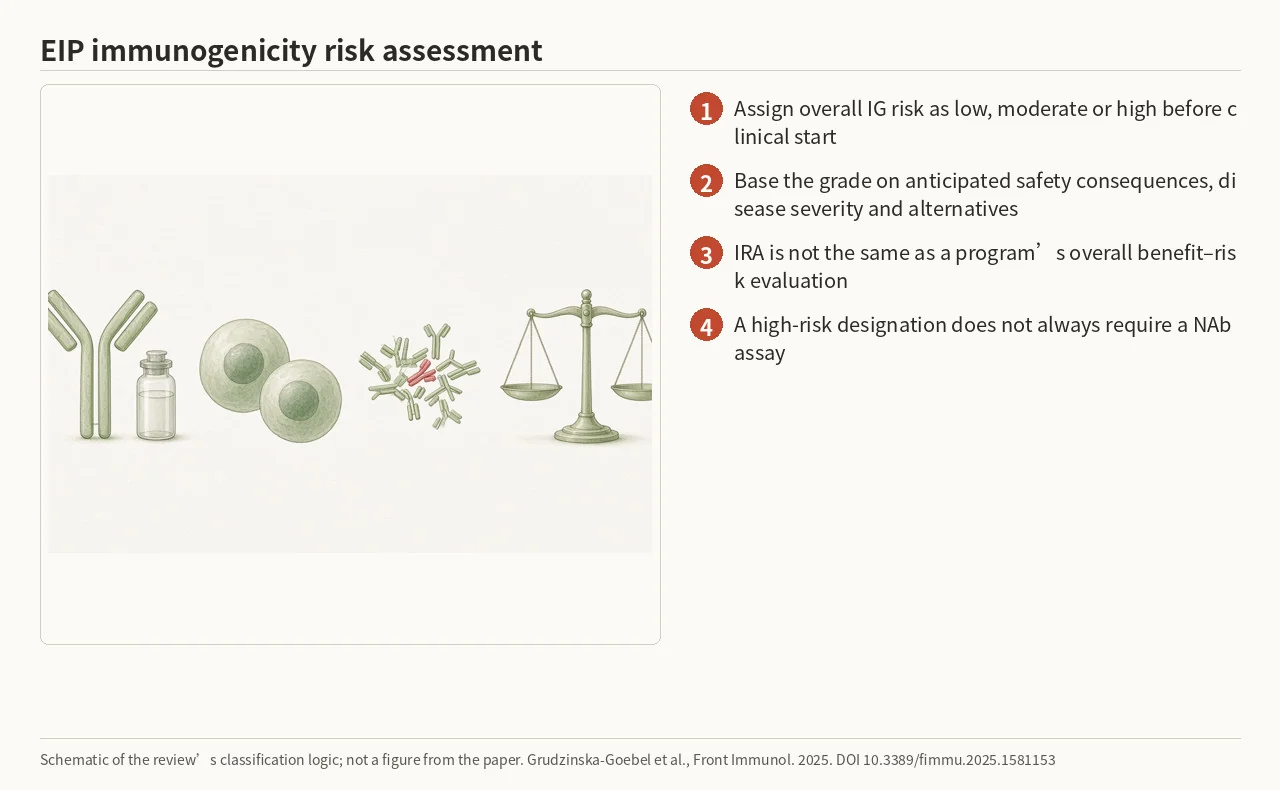
This is an industry-aligned recommendation from the EIP, not a prospective clinical trial. After risk factors are identified, their probability and their potential effects on efficacy and safety are evaluated together; when clinical data are still missing, knowledge from the same or similar molecular classes and from the literature is used to fill in. The EIP proposes translating anticipated clinical consequences—in relation to disease status (life-threatening or not) and the availability of alternative medication—into an overall IG risk level (low, moderate or high) assigned before clinical development starts. Alternative medication includes standard of care as well as other drugs that are in development or already on the market. The authors note that the presence of alternatives affects the IG risk category only for life-threatening diseases; that distinction is not used for non-life-threatening diseases. The assigned category may be revised when more knowledge or clinical data arrive, or when there is sufficient certainty.
Key results
The authors stress that IRA is distinct from the overall benefit–risk evaluation of a biotherapeutic program. IRA focuses on the potential impact of IG on safety and efficacy so that monitoring and mitigation can be defined; benefit–risk weighs therapeutic benefit against all associated risks, including but not limited to IG. Programs with high IG risk and a confirmed anti-drug antibody (ADA) incidence may still be marketed; lower-risk programs with a similar IG impact may be halted or delayed when more effective and safer alternatives exist.
Assignment of the overall category focuses on potential safety implications, irrespective of their probability. For substitution of endogenous proteins, especially those with unique, non-redundant functions, a high-risk category is recommended unless justified otherwise (the paper gives GLP-1 and insulin as examples). Where endogenous redundancy exists and there is enough knowledge and certainty of functional compensation, the overall level may be moderate; if certainty about full functional redundancy is lacking, a high-risk categorization should be considered, because neutralizing a protein with only partial redundancy may not always produce immediate clinical symptoms.
A further concern is ADA-mediated altered or exaggerated pharmacology, particularly for biotherapeutics that target membrane receptors and, theoretically, for short-half-life modalities such as peptides. Severity depends on mechanism of action, and is then read against whether the disease is life-threatening and whether alternatives exist, yielding a moderate or high classification. In life-threatening settings (for example, enzyme-deficiency diseases), IG-mediated loss of efficacy is itself a safety risk and is assessed as moderate or high depending on alternatives. In non-life-threatening diseases, an IG effect on efficacy generally has no safety implications but may be a substantial business risk. If risk identification raises no significant concerns, or ADA impact on efficacy can be excluded from the drug’s mechanism of action, or prior knowledge of the molecule or similar compounds is available, the program may be classified as low IG risk. A low-risk label is recommended only when there is sufficient certainty that little or no IG impact will be seen; otherwise a moderate category applies. When several risk factors—especially those tied to primary sequence, mechanism of action, or the patient—remain, and uncertainty about pharmacokinetic or pharmacodynamic effects is still high, a moderate category is more appropriate so that the IG profile can be learned earlier. A moderate category may also be warranted when first-in-human studies are done in patients, or when development is expected to move from phase I/II directly into pivotal trials.
A high-risk category is assigned when severe safety consequences are anticipated. Industry early de-risking follows company strategy: little may be done for low-risk molecules, while higher-risk products receive more extensive testing. In the clinic, high-risk molecules may, depending on anticipated safety consequences, require analyses beyond traditional bioanalytical methods; a high-risk designation does not always necessitate a neutralizing-antibody (NAb) assay. The EIP also underscores ongoing dialogue with health authorities throughout development.
Hypersensitivity is treated separately. Acute or delayed hypersensitivity (including anaphylaxis) and cytokine release syndrome (CRS) may affect safety and are not always mechanistically linked to ADA formation. The presence of ADAs is not necessarily predictive of anaphylaxis, other hypersensitivity reactions or CRS, which is often driven by the molecule’s mechanism of action. A high level of caution, and ready management strategies, should be maintained for clinical events that may come from such responses, even if the initial IRA suggests a lower IG risk.
Mechanistic interpretation
The framework can be read as a decision chain: identify risk factors; place anticipated safety consequences in the context of disease severity and alternative treatments; assign low, moderate or high risk; and only then set the depth of early de-risking in molecular design, bioanalytical monitoring during development, and mitigation in clinical trials. IRA answers how IG might affect safety and efficacy, and therefore how it should be monitored; it does not answer whether the program is worth doing. Business considerations are in scope: even without safety concerns, IG effects on pharmacokinetics or efficacy can still stop development, and may also influence a plan to develop a less immunogenic alternative. The authors also draw a boundary: their literature table does not cover IVISIA-focused methods papers, so this framework is not a catalogue of in vitro or computational prediction assays.
Limitations and uncertainties
Before clinical trials start, the IG profile in the intended patient population is often unknown, so overall risk assignment carries uncertainty. The authors also write that predicting the impact of IG on pharmacokinetics or efficacy from the type or number of risk factors is extremely difficult. Hypersensitivity and CRS cannot always be tied to a specific immunologic mechanism, and ADA is not a reliable predictor of those events. Companies that grade IG risk mainly on whether safety is affected may assign a low-risk category when no safety impact is anticipated and defer IG profiling to phase II or pivotal trials in the target population. The review says that not analyzing phase I samples is acceptable only if no unexpected findings related to pharmacokinetics, pharmacodynamics or efficacy, or safety, are seen, and that consultation with health authorities on that strategy before clinical start is highly recommended. The paper is an industry recommendation, not a health-authority guideline, and it does not replace product-specific discussions with regulators.
Clinical and industry implications
For antibody or protein programs approaching the clinic, this 2025 EIP review offers a practical grading language: in the absence of human IG data, monitoring intensity is set from anticipated safety consequences, whether the disease is life-threatening, and whether alternative treatments exist. It asks teams to keep IRA separate from overall benefit–risk, so that “high IG risk” is not treated as “not developable,” and “low risk” is not treated as a reason to ignore preparedness for hypersensitivity. For unique endogenous-protein replacement, membrane-receptor targets and short-half-life modalities, the starting posture in the text is more cautious. High risk is explicitly decoupled from a mandatory NAb assay, so analytical plans can follow anticipated safety consequences rather than the label alone.
Authors and source
The first author is Joanna Grudzinska-Goebel (Bayer AG, Berlin). The last author is Veerle Snoeck (UCB, Braine-l'Alleud). There are 26 authors in total, many of them immunogenicity specialists in industry or bioanalytical organizations. The conflict-of-interest statement records that several authors are employees of their companies and may hold company shares; details should be read in the original paper.
Grudzinska-Goebel J, Benstein K, Bloem K, Cowan KJ, Gorovits B, Jadhav M, et al. Immunogenicity risk assessment for tailored mitigation and monitoring of biotherapeutics during development: recommendations from the European Immunogenicity Platform. Front Immunol. 2025;16:1581153. https://doi.org/10.3389/fimmu.2025.1581153
Featured
AI Drug R&D Platforms

Related science

Human Ig transgenic animals and fully human antibodies (Review)
As of August 2025, transgenic platforms have yielded 30 fully human antibodies and 3 bispecifics with FDA approval; a dedicated section compares HuMab, XenoMouse, VelocImmune and later platforms.

Multi-objective antibody design and optimization using machine learning (Review)
A 2026 review of computational multi-objective optimization of existing antibodies and de novo design, covering affinity, specificity, polyreactivity, stability, aggregation and immunogenicity.

A 160-member bispecific library: surface properties predictable from parents, ρ up to 0.95
Two parental antibodies combining into a bispecific, with red dots marking surface properties
One email, with links to every paper. Reports and custom landscapes: contact@inlightbio.com.
Opens your email app with a pre-filled request; we add you by hand. Free, unsubscribe any time.