Human Ig transgenic animals and fully human antibodies (Review)
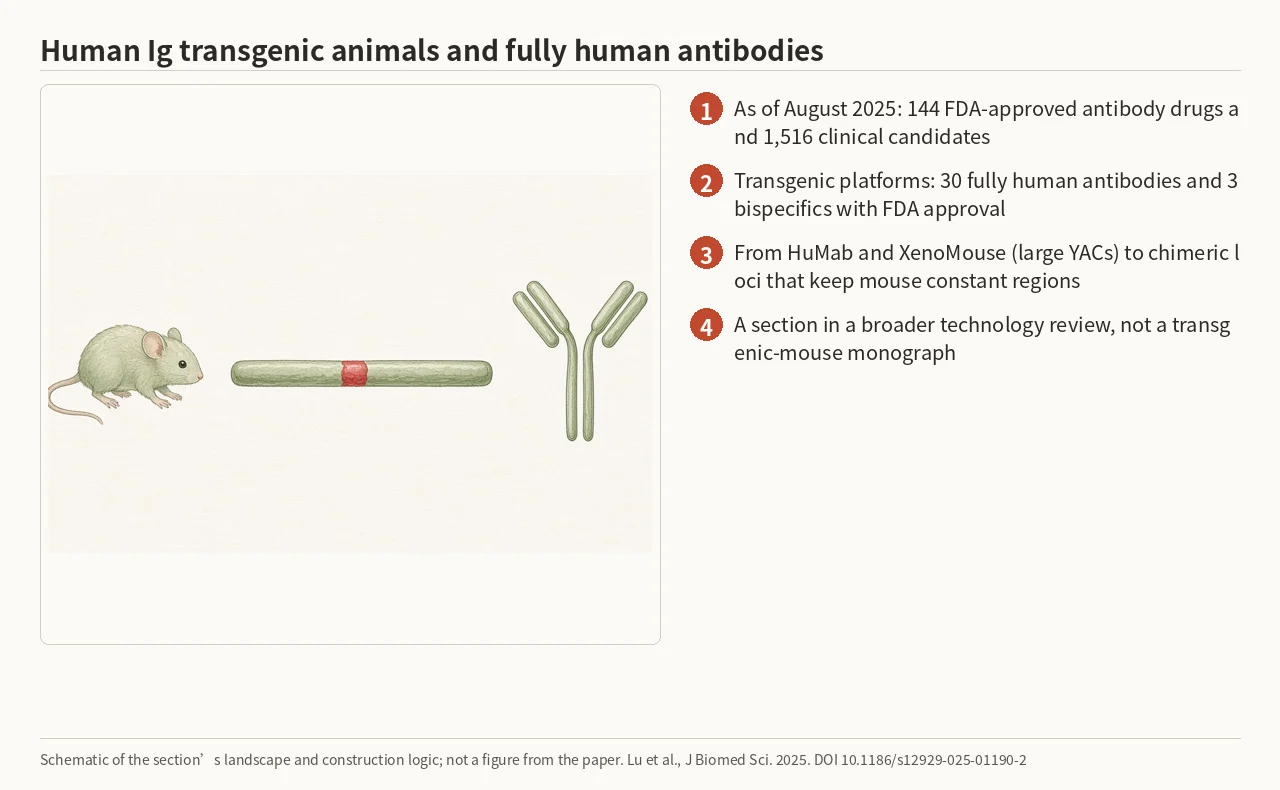
Lu, Wu and colleagues published a broad review of antibody technology, not a monograph on transgenic mice. The abstract lists chimeric and humanized engineering, phage display, transgenic mouse platforms and high-throughput single B-cell isolation as key advances, and gives counts as of August 2025: 144 FDA-approved antibody drugs and 1,516 candidates in clinical development worldwide; global sales of antibody-based therapeutics exceeded USD 267 billion in 2024 (GlobalData, August 2025). A dedicated section, “Antibodies from human Ig transgenic animals,” reviews animals that carry human immunoglobulin loci and can produce fully human antibody repertoires, and states that these platforms have so far yielded 30 fully human antibodies and three bispecific antibodies with FDA approval. This brief focuses on that section and those figures. The animals discussed here are immunoglobulin-locus transgenics; they are not the same as humanized mice used for safety evaluation after transplantation of human immune cells.
Background and open questions
Since hybridoma technology in 1975, chimeric and humanized engineering, phage display, transgenic mice and single B-cell isolation have successively improved the specificity, potency and safety of therapeutic antibodies. The authors also review newer modalities such as antibody–drug conjugates, bispecific antibodies and CAR-T cells, as well as mRNA–LNP delivery, in vivo CAR-T reprogramming, and tools from AI/ML, sequencing and structural modeling. On the market side, global sales exceeded USD 267 billion in 2024; pembrolizumab, dupilumab and adalimumab are cited as examples of the place of immuno-oncology and anti-inflammatory biologics. For readers who want to know where fully human antibodies come from, the practical questions are how current human Ig-locus transgenic platforms were built and how many approved drugs they have contributed. A distinction should be made at the outset: these animals carry human immunoglobulin genes and, after immunization, can produce fully human or human–mouse chimeric antibodies. They are not the same as humanized mice in which human immune cells or tissues are transplanted into immunodeficient animals for safety or immune evaluation.
Study design
The review covers antibody discovery platforms, therapeutic formats and market trends; transgenic animals are one section, not the whole paper. That section follows a historical path: a 1985 proposal to insert human Ig genes into the mouse germline, then minilocus transgenes, endogenous Ig knockouts, and the HuMab Mouse and XenoMouse platforms around 1994. The authors also distinguish “fully human antibody mice,” which introduce human variable and human constant regions, from “chimeric human antibody mice,” which pair human variable regions with rodent constant regions so that mouse Fc-mediated signaling and affinity maturation are retained. The counts use a cutoff of August 2025. Common-light-chain and VHH transgenic mice receive limited attention in this paper and are not compared systematically; this brief does not import platform details from other reviews.
Key results
The authors write that transgenic animals offer an in vivo route to fully human monoclonal antibodies and have a larger antibody repertoire than phage-displayed libraries, but that inserting large human Ig genes into the mouse genome is difficult. In early minilocus models, fully human antibodies were often less than 10% of the antibodies produced, which motivated endogenous Ig-knockout strains. The 1994 HuMab Mouse, in which murine heavy- and light-chain genes were deleted and human heavy and light chains were expressed, was the first fully human antibody mouse; only about 80 kb of the human IgH genome was introduced, compared with about 1.25 Mb for human IgH and about 1.82 Mb for Igκ. To move larger fragments, Green and colleagues in 1994 used yeast artificial chromosomes (YACs) to introduce human IgH (about 220 kb) and Igκ (about 170 kb) into mice, then bred them with animals lacking endogenous heavy and κ chains to generate XenoMouse. In 1997, Mendez and colleagues developed XenoMouse II by introducing a larger human IgH (about 1,020 kb) or Igκ (about 800 kb) YAC, including 66 VH and 32 Vκ genes. In 2000, Tomizuka and colleagues used TransChromo (TC) technology to introduce human chromosome fragments carrying the IgH (about 1.5 Mb) and Igκ (about 2 Mb) loci; hybridoma production was less than one-tenth that of normal mice. In 2002, Ishida and colleagues crossed the Kirin TC Mouse with a Medarex YAC-transgenic mouse to produce the KM Mouse, aiming for broader human Ig coverage and less interference from endogenous mouse Ig. The authors also note that, without expression of mouse constant-region genes, production of fully human antibodies, class switching and somatic hypermutation remained inefficient.
To keep mouse constant-region genes and improve Fc-mediated signaling and in vivo maturation, later platforms were built as chimeras. In 2013, Osborn and colleagues reported OmniRat, with human VH, D and JH segments linked to the rat CH locus and fully human light-chain loci. In 2014, Lee and colleagues reported KyMouse, with a human VH-D-JH repertoire linked to the mouse constant region; after immunization the mice produced high-affinity antibodies with long, human-like CDR-H3 loops and extensive somatic hypermutation. Murphy and colleagues used bacterial artificial chromosome (BAC)-mediated targeting to replace about 2.6 Mb of the mouse IgH variable region and about 3 Mb of the mouse kappa variable region with human counterparts, while keeping the endogenous mouse constant regions, to create VelocImmune. Retention of murine Fc regions was intended to keep compatibility with murine immune effector mechanisms and to allow efficient in vivo selection and maturation.
Table 3 lists major commercial platforms with the human VH/VK segment counts, constant-region origin and FDA-approved drug counts recorded in the paper (as of its cutoff): HuMab Mouse (Genpharm/Medarex/Bristol Myers Squibb; human Cμ; 13 approvals), XenoMouse (Abgenix/Amgen; human Cμ-Cδ-Cγ2; 11), KM Mouse (Kyowa Kirin and Medarex; human constant region; 1), VelocImmune (Regeneron; mouse constant region; 8), and OmniRat, KyMouse, Harbour H2L2, Trianni, RenMab and NeoMab (0 approvals in the table). The authors state that 30 FDA-approved fully human antibodies and three bispecific antibodies have come from these transgenic platforms. The first FDA-approved fully human antibody from a transgenic mouse was panitumumab (Vectibix, XenoMouse) in 2006. Examples in the text include denosumab, secukinumab and durvalumab from XenoMouse; nivolumab, ustekinumab and daratumumab from HuMab Mouse; dupilumab and others from VelocImmune; and burosumab, the only FDA-approved antibody derived from the KM mouse (2018, for X-linked hypophosphatemia). The authors also note that transgenic mice can be combined with hybridoma or single B-cell methods to generate high-affinity fully human antibodies.
Mechanistic interpretation
The technical logic in the section can be read in two steps. The first is to place a sufficiently large human variable-region gene set in the animal and to remove or reduce interference from endogenous mouse Ig; otherwise fully human antibodies remain a minority. YAC and large chromosomal transfers address the problem of fragments that are too short; the TC/KM path shows that expanding human sequence without mouse constant-region expression can still leave class switching and somatic hypermutation inefficient. The second step is to keep rodent constant regions on purpose, so that human variable regions can use native Fc signaling for selection and maturation in the animal, with the constant region switched to a fully human sequence later. VelocImmune’s BAC replacement is the example of that idea in the text. Approved drugs in the platform table are concentrated in the earlier industrial platforms HuMab, XenoMouse and VelocImmune; newer platforms had no FDA-approved drugs at the paper’s cutoff. That pattern reflects a time window, not a head-to-head trial of later platforms.
Limitations and uncertainties
This is a general review of antibody technology. Transgenic animals occupy one section; the paper is not a monograph on human Ig-locus mice, common-light-chain mice or VHH mice. Common-light-chain and VHH transgenic strategies receive limited attention. Approval counts are as of August 2025; later approvals or withdrawals are outside its window. The counts in the table are descriptive and should not be read as a head-to-head comparison of potency or developability across platforms. Sales and market examples belong to the review’s broader background, not as outcome measures of the transgenic section. This brief also does not discuss humanized mice that receive transplanted human immune cells.
Clinical and industry implications
For readers who follow the origin of fully human antibodies, this November 2025 review offers a checkable landscape as of August 2025: transgenic platforms have contributed 30 approved fully human antibodies and three bispecifics, and one table can be used to compare how HuMab, XenoMouse, KM Mouse, VelocImmune and later rat or mouse platforms were built. Fully human antibody mice are not a single technology; the path runs from short-fragment transgenes and large YAC inserts to chimeric loci that keep mouse constant regions. Choosing a platform, on this account, means looking both at human gene coverage and at whether affinity maturation in the animal still works. These are public industry facts, not an evaluation of any unapproved animal model.
Authors and source
The first author is Ruei-Min Lu; the corresponding author is Han-Chung Wu (Institute of Cellular and Organismic Biology, Academia Sinica, Taipei). The paper has 15 authors, based mainly at Academia Sinica, including the Biomedical Translation Research Center. The authors declare no competing interests.
Lu RM, Chiang HL, Yuan JP, Wang HH, Chen CY, Panda SS, et al. Technological advancements in antibody-based therapeutics for treatment of diseases. J Biomed Sci. 2025;32:98. https://doi.org/10.1186/s12929-025-01190-2
Featured
AI Drug R&D Platforms

Related science
EIP immunogenicity risk assessment: tailored mitigation and monitoring (Review)
EIP recommendations for assigning low, moderate or high immunogenicity risk before clinical start, based on anticipated safety consequences, disease severity and alternative treatments.
Multi-objective antibody design and optimization using machine learning (Review)
A 2026 review of computational multi-objective optimization of existing antibodies and de novo design, covering affinity, specificity, polyreactivity, stability, aggregation and immunogenicity.
A 160-member bispecific library: surface properties predictable from parents, ρ up to 0.95
Two parental antibodies combining into a bispecific, with red dots marking surface properties
One email, with links to every paper. Reports and custom landscapes: contact@inlightbio.com.
Opens your email app with a pre-filled request; we add you by hand. Free, unsubscribe any time.