Engineered AGO2: a C→U RNA editor 1.9× as efficient as Cas13
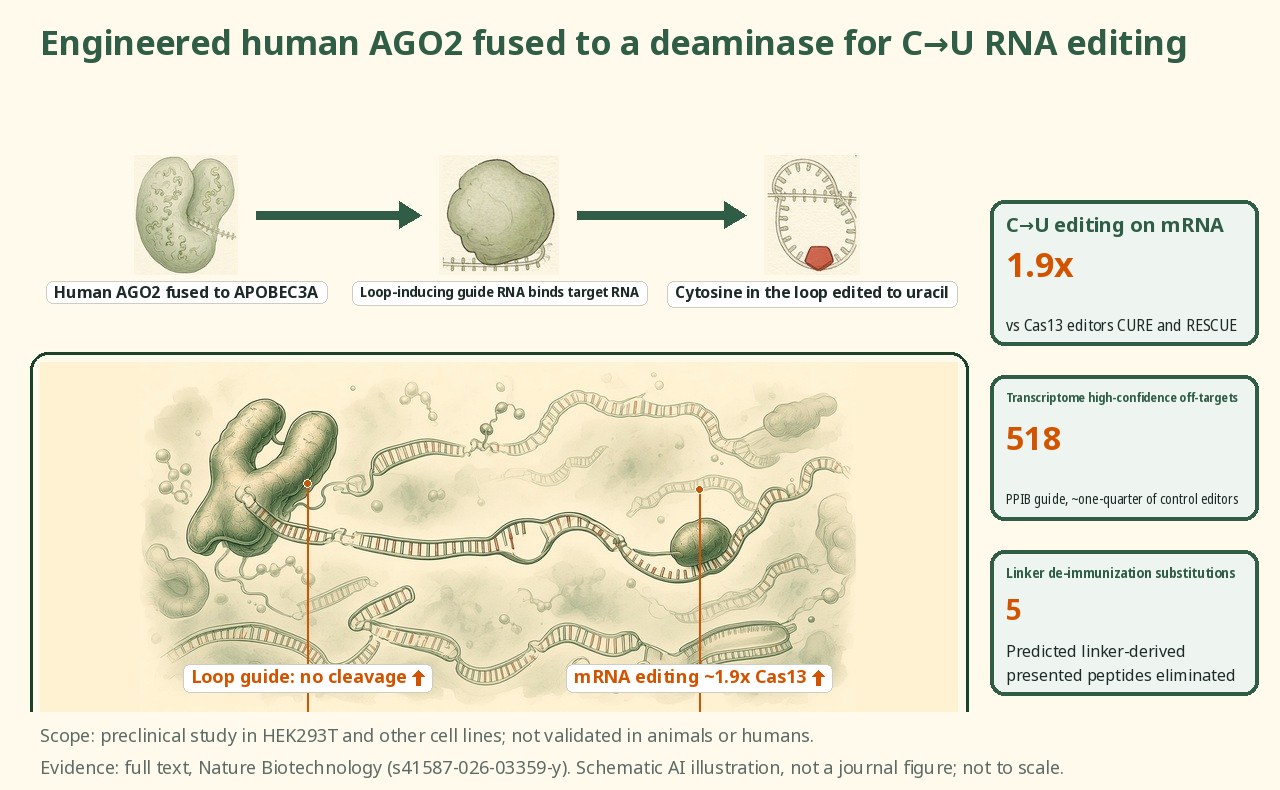
A Stanford team fused human Argonaute 2 (AGO2) to the human cytidine deaminase APOBEC3A and used "loop-inducing" guide RNAs to splay the target RNA locally into a single-stranded loop without cleaving the transcript, yielding ALTER, a C→U RNA base editor built entirely from human proteins. In HEK293T cells, editing of mRNA targets averaged 1.9× that of the Cas13 editors CURE and RESCUE, with equal or lower transcriptome-wide off-target editing; machine learning predicted far fewer immunogenic peptides than the Cas13 editors, and delivery with virus-like particles and AAV is already feasible.
Background and open questions
Programmable RNA-manipulation tools are today built almost entirely on non-human proteins. Cas13 / type VI CRISPR systems, and OMEGA-family proteins more broadly, cleave RNA in their catalytically active form once delivered into mammalian cells, while catalytically dead dCas13 fused to a deaminase can edit RNA sequence, rewrite m6A marks, and modulate splicing and translation. But these prokaryote-derived scaffolds have three hard-to-avoid problems: off-target and collateral cleavage activity, unknown interactions with host regulatory machinery, and the sheer size of Cas13. For therapeutic translation, immunogenicity and delivery matter even more: pre-existing adaptive immunity to Cas proteins already exists in the population, CRISPR RNA itself can trigger innate immune responses, and because transcripts constantly turn over, RNA editing will likely need repeat dosing — which only amplifies the immunogenicity problem.
The authors' alternative is this: rather than build an exogenous scaffold from scratch, directly "rewrite" a programmable machine the body already has. Mammalian cells already program Argonaute (AGO)-family proteins with small RNAs; after more than two decades of RNAi research, the binding rules, cleavage requirements and affinity control of AGO2 and its guide RNA are well characterized, and clinical siRNA drugs rely precisely on AGO2 to degrade target transcripts. The AGO2–guide complex searches intracellular RNA efficiently, with binding kinetics and affinity superior to Cas13 pairing with free RNA, and can bind even when the target has secondary structure. The open question, then, is whether — without disrupting these evolutionarily optimized properties — AGO2 can be switched from "degradation" to "site-specific binding and effector recruitment," yielding a programmable RNA-manipulation platform made entirely of human proteins.
Study design
The core of the design is "reverse-engineering" the guide RNA. An siRNA can be divided by function into five segments: the 5′ first base (g1) anchors in a pocket of AGO2; the seed region (g2–g8) complementarity determines target binding; the supplementary region (g13–g16) raises affinity; full complementarity in the central region (g9–g12) slightly lowers affinity but is required for cleavage; and pairing in the tail (g17 to the end) barely affects binding. A small RNA with a central-region mismatch can therefore retain high-affinity binding without triggering cleavage — the way most human miRNAs recruit repressors rather than cleave their targets.
Meanwhile, the APOBEC family acts on single-stranded RNA to catalyze C→U deamination, and A3A prefers to edit cytosines on the 3′ side of a stem-loop. Combining the two clues gives ALTER: fuse A3A onto AGO2 and use a central-mismatch guide to "splay" out a single-stranded loop on the target, so the target C lands in the deaminase's ideal substrate position while avoiding cleavage or downregulation of the transcript. AlphaFold3 modeling supported normal folding of each component of the fusion and binding of A3A to the unpaired segment of the target RNA.
Guide design was parameterized by three variables: induced-loop size x, position y of the target C within the loop, and loop orientation relative to the guide (i, j). The authors screened these parameters with an EGFP Y66H reporter — a weakly blue-fluorescent EGFP mutant that recovers green fluorescence after a single C→U edit; the reporter was stably integrated into HEK293T cells to reduce batch variability. At the protein level they systematically tested nuclease-inactivating mutations of AGO2, MID-domain double mutations that reduce non-cleaving downregulation, deletion of the 127-amino-acid PAZ domain, and A3A mutations that change activity and DNA/RNA selectivity, in combination. Editing efficiency was then quantified by Oxford Nanopore sequencing plus CRISPResso2, transcript abundance monitored by qPCR (with SNW1 and GAPDH or HNRNPL as references), and transcriptome-wide effects assessed by 2×150 bp mRNA-seq on an Illumina NovaSeq X Plus with STAR alignment, GATK variant calling and DESeq2 differential expression. Immunogenicity was predicted with the deep neural network MARIA for MHC class II presentation, guiding targeted de-immunization. Finally, delivery feasibility was validated with virus-like particles (VLPs) and AAV.
Key results
Loop-inducing guides let AGO2–A3A edit without downregulating the target transcript
The first construct, ALTER-1 (wild-type AGO2 fused to A3A Y132D) with guide 14L8(11,10) — inducing a 14-nt single-stranded loop between g11 and g12 with the target C at position 8 — induced significant fluorescence in EGFP Y66H reporter cells; a non-targeting guide, A3A alone, or removing the guide, AGO2, A3A or the linker from the construct did not. Knockdown was tested in cells stably expressing destabilized GFP (ddGFP): the 14L8(11,10) guide did not lower ddGFP fluorescence relative to the non-targeting control, showing that endogenous AGO2 does not silence the target through this guide; co-expression with ALTER-1 lowered fluorescence only slightly versus the guide alone, and not significantly versus "ALTER-1 plus a non-targeting guide."
The guide-parameter scan gave a clear structure-activity relationship: almost no editing with too small a loop, and lower efficiency when expanded to 20 nt; editing was comparable with the target C at loop positions 6, 7 or 8 but clearly lower at positions 9 or 10 (the authors suspect steric occlusion of the target by AGO2); moving the loop toward the guide 5′ end disrupted seed complementarity and lowered editing, while moving it toward the 3′ end had less effect. Introducing 1 or 3 mismatches in the central region (the canonical miRNA-binding mode) both lowered editing activity — meaning that what makes ALTER work is a non-natural "all-complementary-but-discontinuous" binding mode. Guides could be delivered as plasmid-encoded shRNAs or as exogenous siRNA duplexes.
Rational protein engineering optimized activity and background together
Swapping in the naturally non-cleaving AGO1 or AGO3 gave signal significantly below ALTER-1. Testing nuclease-related mutations in AGO2 one by one: D597A and D669A lowered editing, H634P was no different from ALTER-1, and Q633R clearly raised activity (the authors suspect enhanced electrostatic affinity for the negatively charged target RNA). The MID-domain F470V;F505V double mutation slightly lowered signal but lowered the non-targeting-guide background more, possibly by reducing P-body localization. Deleting the 127-amino-acid PAZ domain raised the editing signal 2× while lowering background, with AlphaFold3 modeling showing the other domains were little affected. The combined effects were not simply additive: all mutants with both ∆PAZ and F470V;F505V had undetectable editing activity.
On the A3A side, wild-type A3A gave slightly higher signal than Y132D without raising background; K30R;Y132D markedly raised targeted editing but also background. Joint optimization of both domains gave a series of constructs: ALTER-2 (AGO2 F470V;F505V;Q633R–A3A Y132D), ALTER-3 (AGO2 ∆PAZ;Q633R–wild-type A3A), and the most active ALTER-4 (AGO2 F470V;F505V;Q633R–A3A K30R;Y132G), which had lower background than ALTER-3 and nearly 2× its editing. To break A3A's UC-context preference, the authors grafted the A1 deaminase domain into A3A to make A3A ddA1 and built ALTER-5, which edited the GC version of the EGFP Y66H reporter efficiently and the AC version significantly too (note the three reporters are in different cell lines, so their fluorescence cannot be compared directly). Further characterization focused on ALTER-4 for its high activity, good selectivity for UC targets and all-human components.
Head-to-head with Cas13 editors and endogenous targets
Directly compared in HEK293T-EGFP Y66H cells: CURE-N gave almost no fluorescence, and RESCUE-S had one-third the activity of ALTER-4; sequencing confirmed the editing, and qPCR showed no editor caused significant knockdown of the EGFP Y66H transcript, with fluorescence recovery linear to the sequencing-derived percent C→U. At the abstract level: in HEK293T cells, ALTER's C→U editing of mRNA targets averaged 1.9× that of CURE and RESCUE.
On endogenous targets, ALTER-4 edited PPIB C90 (a site where CURE-N was previously reported to beat RESCUE-S) best; was comparable to RESCUE-S at SMARCA4 C503 (where RESCUE-S was previously reported better); and was significantly better than both Cas editors at ACTB C309 and TYMS C876. At all endogenous targets, ALTER-4 caused transcript decreases similar to the dCas editors. The nuclear lncRNA MALAT1 C1053 was barely editable at first, suggesting ALTER is largely excluded from the nucleus; adding a nuclear localization signal to the ALTER-4 N terminus (ALTER-4N) raised MALAT1 editing significantly without downregulating the target, though still below CURE-N (which carries both viral nuclear-localization and nuclear-export signals). ALTER-5 edited PPIB C92, a GC-context site, significantly better than RESCUE-S, whereas no CURE variant has been shown to work outside UC contexts. Bystander editing came in two classes: distal sites that are themselves A3A hotspots, and sites in or adjacent to the induced loop; editing TYMS with the 12L6 guide gave C876 editing comparable to 14L8 but greatly reduced C871 bystander editing — showing guide design can be used both to optimize targeted editing and to suppress bystander editing.
Transcriptome-wide off-targets: lower in number, and mainly from A3A rather than AGO2
mRNA-seq versus a NanoLuc transfection control showed that ALTER-4 targeting PPIB produced only 518 high-confidence C→U off-target edits, 4× fewer than reported for RESCUE-S and CURE-N. Targeting TYMS gave more off-targets, showing that off-target scale depends heavily on guide and target; but TYMS editing had a clear dose-response with ALTER-4, and lowering plasmid from 3 µg to 0.5 µg (at which TYMS editing matched full-dose CURE-N or RESCUE-S) cut off-targets 25-fold. Mapping each off-target site back to its transcript and analyzing its sequence and structural context revealed a clear −4 to +1 consensus and a preference for stem-loop secondary structure, matching known A3A editing-hotspot features; 73% of ALTER-4 off-target edits also appeared with A3A overexpressed alone or as a CURE component. In other words, the vast majority of off-targets come from A3A's own bystander activity, independent of AGO2 — and once fused to AGO2, A3A actually produced significantly fewer off-targets than A3A overexpressed alone.
For the specific concern of "would it hijack endogenous miRNAs or perturb RNAi," the authors ran several tests: known miRNA-regulated genes were more common among the off-targets of ALTER-4, CURE and RESCUE alike, and this consistency makes "miRNA-directed editing" hard to argue; when aligning the guide's seed-recognition motif to the off-target contexts, only ALTER showed reduced alignment frequency proximal to and increased alignment in the 3′-adjacent region of off-target sites, suggesting a small fraction of off-targets does arise from non-specific guide binding, but the proportion is small. On differential expression, ALTER-4 produced more differentially expressed genes than reported for the Cas editors, but gene-set enrichment found no significantly dysregulated pathways and gene-ontology enrichment of the differentially expressed genes showed no clear bias; with the PPIB guide, the proportion of known miRNA targets among differentially expressed genes was no different from all tested genes, while with the TYMS guide it was slightly higher among upregulated genes, but CURE-N, RESCUE-S and A3A overexpression showed similar rises. Off-target edits and differentially expressed genes overlapped little, suggesting the two arise by different mechanisms.
Machine-learning-assisted de-immunization and two delivery routes
The immunogenicity assessment focused on MHC class II presentation — activation of cytotoxic T cells needs CD4⁺ T-cell help, and evading MHC II-restricted antigen presentation is key to the long-term persistence of engineered human cells. Using MARIA, a deep neural network trained on mass-spectrometry antigen data, the authors scored every 15-mer containing a non-natural residue or an inter-protein junction in each construct, calling those above the 63rd percentile of total peptide scores (a 1% false-omission rate) "likely presented." As expected, Cas13-class editors had significantly more likely-presented peptides than the ALTER series.
For ALTER-1 and ALTER-4, most above-threshold peptides came from the (GGS)₆ artificial linker. Five substitutions in the linker (G200C, G201L, S202C, G210L, G216C) eliminated predicted presentation of linker-related non-natural peptides in ALTER-4. Further testing of different linkers — flexible (GGS) of various lengths, helical (EAAAK), XTEN-16 (SGSETPGTSESATPES), and no linker at all (direct fusion) — gave comparable activity in the EGFP Y66H assay, which the authors attribute to the first 35 residues of the AGO2 beam domain lacking defined structure and themselves acting as a flexible linker. In the no-linker version, only the AGO2 M1C and Y2W substitutions were needed to eliminate predicted presentation of junction-related non-natural MHC II peptides. The de-immunized ALTER-4M had only slightly lower editing activity, and the two no-linker variants were indistinguishable from the original ALTER-4.
For delivery, the authors built MMLV-Gag–ALTER fusion virus-like particles so ALTER loads its guide inside producer cells and is packaged as a ribonucleoprotein (RNP), removing the need to express the guide in target cells; these VLP-delivered ALTER RNPs produced a proportion of edited cells comparable to transient transfection (in cells stably integrating only the EGFP Y66H reporter), though at lower signal strength. The other route packaged the ALTER fusion protein and the guide into a single AAV vector (AAV-DJ) — AAV has a packaging limit of about 5 kb and is a clinically validated vector for many gene therapies; after treating reporter cells, editing was effective with the proportion of positive cells only slightly below transfection, again at lower signal strength.
Clinical and industry implications
For nucleic-acid therapeutics, the significance of this work is not "yet another RNA editor" but that it swaps the scaffold for programmable RNA manipulation from a prokaryotic source to a protein the body already carries. The core selling point of RNA versus DNA editing is reversibility without altering the genome, but at the cost of constant transcript turnover and likely long-term repeat dosing — and repeat dosing is precisely the most lethal scenario for immunogenicity: pre-existing immunity to Cas proteins already exists in the population, and sustained Cas13 expression may trigger anti-vector and anti-protein responses. ALTER, scaffolded on human AGO2 and guided by short RNAs, drives the predicted non-natural MHC II peptides far below those of Cas13 editors, and demonstrates a directly reusable AI de-immunization workflow (identify the linker as the main immunogenicity source, then clear it with a few substitutions, or drop the artificial linker entirely) — exactly the properties a multi-dose route most needs.
The engineering and delivery angles also have practical implications. Deleting the PAZ domain both raised activity and shrank the construct, letting the whole fusion plus guide fit under AAV's ~5 kb packaging limit — validated in cells; the VLP route lets the editor act transiently as a pre-loaded RNP, avoiding long-term expression in target cells — in line with the current convergence of in vivo editing toward "transient exposure, lower cumulative risk." The off-target findings are also directly actionable: since most off-targets come from A3A's bystander activity and fall with dose, "minimize editor exposure for equal targeted editing" is a clear process- and dosing-optimization path (here a 6-fold reduction in plasmid bought a 25-fold drop in off-targets).
The boundaries should be seen clearly. This remains a cell-level proof of concept: no disease model, no correction of a pathogenic mutation, no in vivo efficacy or immunology data, and the immunogenicity advantage is still only an algorithmic prediction. C→U editing could in principle correct a substantial share of pathogenic T→C mutations, yet such editors have not reached therapeutic use — which the authors attribute to immunogenicity and efficiency. ALTER offers a structural detour around one of those barriers — the immune burden of an exogenous scaffold — and incidentally suggests something with more industrial imagination: AGO2 can serve as a universal, short-RNA-programmed human targeting module onto which effector domains beyond deaminases can be loaded. Whether it delivers depends on subsequent validation in primary cells and in vivo models, and on experimental immunology testing those predictions.
Mechanistic interpretation
Demonstrated in the paper: With a central-mismatch, single-stranded-loop-inducing guide RNA, human AGO2 can be rewired from the "cleave/silence" machine of RNA interference into a "site-specific binding" programmable module, letting a fused human cytidine deaminase make a C→U edit inside the splayed-open loop without downregulating the target transcript beyond the level of dCas editors. Rational engineering based on existing RNAi knowledge (Q633R, F470V;F505V, ∆PAZ and A3A mutation combinations) can simultaneously raise signal, lower background and shrink the construct; the resulting ALTER-4 reached on average 1.9× the editing of Cas13 editors on mRNA targets in HEK293T cells, with equal or lower off-target editing determined mainly by A3A's bystander activity rather than AGO2 and greatly suppressible by lowering dose. Computational prediction shows significantly fewer non-natural MHC II peptides than Cas13 editors, further reducible to zero with a few substitutions.
Author hypotheses: The authors argue that directly co-opting a pathway the body already has preserves evolutionarily optimized properties (efficient target search, fast binding kinetics and high affinity, tolerance of secondary structure, and cell regulation that promotes target turnover) better than building an exogenous or pieced-together scaffold from scratch, while avoiding the immune and homeostatic burden of exogenous proteins. They propose ALTER's advantages over existing C→U editing approaches are: minimal fusion engineering; low immunogenic burden from using only short RNAs as guides; A3A K30R;Y132G having no detectable activity on DNA; and no A-to-I off-targets unlike ADAR-based technologies; and ALTER can edit effectively without entering the nucleus, further lowering genomic-DNA risk. They also speculate that the optimal mutations and guide design for editing differ from the RNAi optimum, which may in turn reveal new knowledge about AGO2 activity and regulation. It must be stressed that among these advantages, editing efficiency, off-target counts and delivery feasibility are directly validated here, while the immunogenicity part is currently only computational prediction with no experimental immunology data.
Limitations and uncertainties
- All experiments were done in a single cell line, HEK293T, with no primary cells, organoids or animal experiments, and no demonstration of therapeutic correction in any disease model; the targets edited are reporter genes and normal endogenous transcripts, not pathogenic mutations.
- The immunogenicity conclusions come from MARIA computational prediction (by default only the HLA-DRB1*01:01 allele), with no T-cell activation assays, in vivo immunogenicity data or population HLA-coverage analysis; the de-immunization benefit can only be treated as a hypothesis for now.
- ALTER-4 produced more differentially expressed genes than reported for the Cas editors, and the authors could not fully explain the mechanism, only that it arises by a different process from off-target editing and does not fall on significantly enriched pathways; comparisons of off-targets and differential expression with the Cas editors are mostly cross-study (control data taken from the published BioProject PRJNA635732) rather than same-batch experiments.
- The optimal guide depends heavily on the specific target and editor version: a guide better on EGFP for one set performed oppositely on PPIB and TYMS; the authors explicitly state that general guide-design rules await high-throughput screening.
- Editing nuclear targets required an added nuclear localization signal and was still below CURE-N; target-directed miRNA degradation (TDMD) of ALTER could not be detected under these conditions but may become important in real therapeutic settings with low editor abundance.
- Both VLP and AAV delivery routes were validated only in cultured cells, at lower signal strength than transfection; the authors also note the vectors themselves still carry immunogenicity risk. The paper does not cover non-viral delivery such as LNP.
- The authors and Stanford University have filed a provisional patent application on this work, a relevant disclosure of interest.
Authors and source
Lusi RF, Moncayo von Hase S, Model C, et al. Nature Biotechnology (open access, CC BY-NC-ND 4.0). Received 10 June 2026, accepted 22 September, published online 20 October 2026. https://doi.org/10.1038/s41587-026-03359-y. Data: NCBI SRA BioProject PRJNA1522030; code: https://github.com/rflusi/ALTER-code.
Numbers are as reported by the authors. Corrections: contact@
Related science
Shotgun engineering rebuilds amino acid synthesis in CHO and Jurkat cells
Barcoded constructs delivered at high multiplicity turn each cell into its own pathway experiment
A single inhaled dose of ARO-RAGE lowered BALF sRAGE by 90.2%
Alveoli and droplets at left, with the siRNA cleaving messenger RNA at right

Charge-switchable LNPs did not raise IL-6 and other inflammatory cytokines in LPS-pretreated mice
Lipid particles and a macrophage, with sparse red inflammatory cytokines at right
One email, with links to every paper. Reports and custom landscapes: contact@inlightbio.com.
Opens your email app with a pre-filled request; we add you by hand. Free, unsubscribe any time.